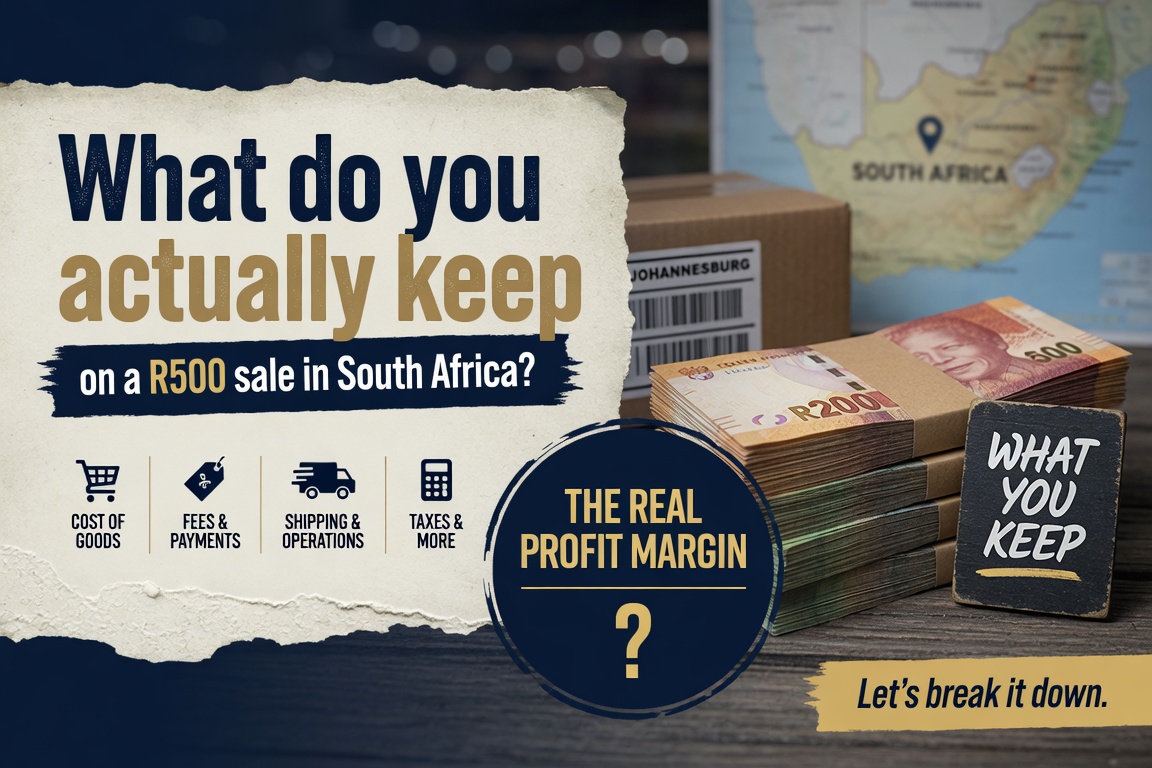

What do you actually keep on a R500 sale in South Africa?
Your store says you made R500. Your bank account disagrees. Between gateway fees, COGS, shipping, VAT and the cost of getting that customer, a surprising amount of every sale never reaches your pocket. Here’s the real maths — and how to claw some of it back.
Most South African store owners watch revenue. The dashboard says R180,000 this month, up 12%, and that feels like progress. But revenue is a vanity number. The figure that decides whether your business survives is what’s left after everything that sale costs you — and for a lot of SA stores, that number is far thinner than they think. Some are quietly losing money on every order and don’t find out until the cash runs short.
The problem is that the costs are scattered. The gateway fee comes off here, the Shopify transaction fee there, COGS is in your head, shipping gets absorbed, VAT feels like the government’s problem until it isn’t, and ad spend lives in a different tab entirely. Nobody adds them up per sale. So let’s do exactly that, with real numbers, on a single R500 order. If you want to plug in your own figures afterwards, the Shopify Profit Margin Calculator does this interactively for SA stores, with PayFast, Yoco and Ozow fees built in.
A R500 sale, taken apart
Do this maths for your own store
The margin maths in this post comes straight from our SA eCommerce Bundle 2026 — including the Unit Economics calculator that does it for you, a 19-chapter playbook, market report and legal templates. R500, instant download.
Let’s use a typical SA store: a physical product retailing at R500, bought from a supplier, sold online, shipped to the customer, with a modest amount of advertising driving traffic. Here’s where the money actually goes.
| Line item | Amount | Running total kept |
|---|---|---|
| Sale price (incl VAT) | R500.00 | R500.00 |
| Less VAT (15%, if registered) | –R65.22 | R434.78 |
| Less COGS (product cost, ~40%) | –R200.00 | R234.78 |
| Less gateway fee (3.2% + R2, PayFast) | –R18.00 | R216.78 |
| Less Shopify 3rd-party fee (2%, Basic) | –R10.00 | R206.78 |
| Less shipping shortfall (you absorb part) | –R35.00 | R171.78 |
| Less packaging | –R12.00 | R159.78 |
| Less ad cost (CAC spread per order) | –R70.00 | R89.78 |
| Net profit kept | R89.78 | ~18% |
On a R500 sale that looks like R500 of success, you keep about R90. And this is a healthy example — plenty of SA stores keep less, and a meaningful number keep nothing once you account for returns and the orders where ad spend overshot. The revenue number on your dashboard told you almost nothing useful.
The fee layer most people forget
Look at two lines in that table: the gateway fee (R18) and the Shopify third-party fee (R10). Together that’s R28 — nearly a third of your final profit — gone to payment processing alone.
The Shopify fee catches SA store owners off guard because it doesn’t exist in the marketing. Since Shopify Payments isn’t available in South Africa, every time you use a gateway like PayFast or Yoco, Shopify adds its own transaction fee on top: 2% on Basic, dropping to 1% on Grow and 0.6% on Advanced. That’s pure platform tax with no equivalent on WooCommerce. On R200,000/month of sales, the 2% Basic fee alone is R4,000/month — R48,000 a year.
The gateway fee itself is also more negotiable and more variable than people assume. The cheapest option depends entirely on your payment mix and average order value. We break this down across all six SA gateways in the cheapest payment gateway guide, and you can rank them on your own numbers with the Payment Gateway Comparator. Shaving even 0.5% off your effective rate puts real money back in the table above.
VAT: the margin illusion
If you’re VAT-registered, that R500 isn’t really R500 of yours — R65.22 of it belongs to SARS. The trap is mentally treating the full sale price as revenue and forgetting the VAT portion was never yours to keep. Stores that price as if VAT doesn’t exist, then have to register once they cross the R1m threshold, suddenly find their margin has shrunk by 13% overnight because they didn’t build VAT into their pricing.
If you’re not registered, you keep that R65 — but you also can’t claim VAT back on your gateway fees, hosting, apps or stock, so it’s not a free win. The point is simply this: know which side of the VAT line you’re on and price accordingly. Don’t let registration be a nasty surprise.
The real killer: customer acquisition cost
In our example, ad cost was R70 per order — the single biggest deduction after COGS. This is where most SA stores quietly bleed. If your blended customer acquisition cost (CAC) is R70 and your post-everything profit before ads was R160, you keep R90. But push ad spend a little too hard, or let your conversion rate slip, and CAC climbs to R130 — and now you’re keeping R30 on a R500 sale, or losing money outright.
This is why margin and marketing can’t be managed separately. Every rand you save on fees, COGS or shipping raises the CAC ceiling you can profitably afford — which means you can outbid competitors on ads and still make money. Thin-margin stores can’t advertise. Healthy-margin stores can scale. The margin is the growth lever.
What a healthy SA ecommerce margin looks like
There’s no single right number, but here’s a realistic frame for South African stores selling physical products:
- Under 10% net margin: Fragile. One bad ad month, a price increase from a supplier, or a spike in returns can tip you into a loss. Fix this before scaling.
- 10–20% net margin: Workable. This is where a lot of healthy SA stores sit. There’s room to advertise and reinvest, but you need to watch costs closely.
- 20–35% net margin: Strong. You can afford to acquire customers aggressively and still bank profit. This usually means good supplier terms, efficient fulfilment, or a brand that supports higher prices.
- Over 35%: Excellent, and usually a sign of either a premium brand, own-manufactured product, or digital goods with near-zero COGS.
The number that matters is net margin per order, after everything — not gross margin, which flatteringly ignores fees, shipping and ads.
Five ways to claw margin back
Once you can see where the money goes, you can go get some of it back. In rough order of impact:
- Lower your effective gateway cost. Pick the right gateway for your payment mix, and negotiate once you’re processing real volume. PayFast negotiates above ~R50k/month. Half a percent across all sales is meaningful.
- Drop the Shopify fee tier. If you’re on Basic and processing over ~R124k/month, upgrading to Grow cuts the third-party fee from 2% to 1% and pays for itself.
- Raise average order value. The fixed costs per order (packaging, the flat part of gateway fees, fulfilment admin) don’t scale with basket size. A R900 order is far more profitable per rand than two R450 orders. Bundles and post-purchase upsells are the levers here.
- Get shipping closer to break-even. Absorbed shipping is a silent margin leak. Free-shipping thresholds, regional couriers and accurate rates recover a lot of the R35 in our example.
- Cut your CAC. Better-converting product pages and checkout mean each ad rand buys more sales. A 5–15% conversion uplift — the kind a well-built store delivers over a poorly-built one — flows straight to the bottom line.
Frequently asked questions
The bottom line
Revenue is what you tell people at dinner. Net profit per order is what keeps the lights on. On a typical R500 SA sale, you might keep around R90 — and the difference between a store that scales and one that stalls is whether the owner knows that number and manages it deliberately.
Plug your own figures into the Shopify Profit Margin Calculator to see exactly what you keep on a sale, then use the Payment Gateway Comparator to check you’re not overpaying on fees. If the numbers look thin and you want help fixing the leaks — from gateway choice to a checkout that converts — that’s the kind of thing we do.

We have built 400+ online stores for South African businesses since 2014. Read more about eCommerce development in South Africa.