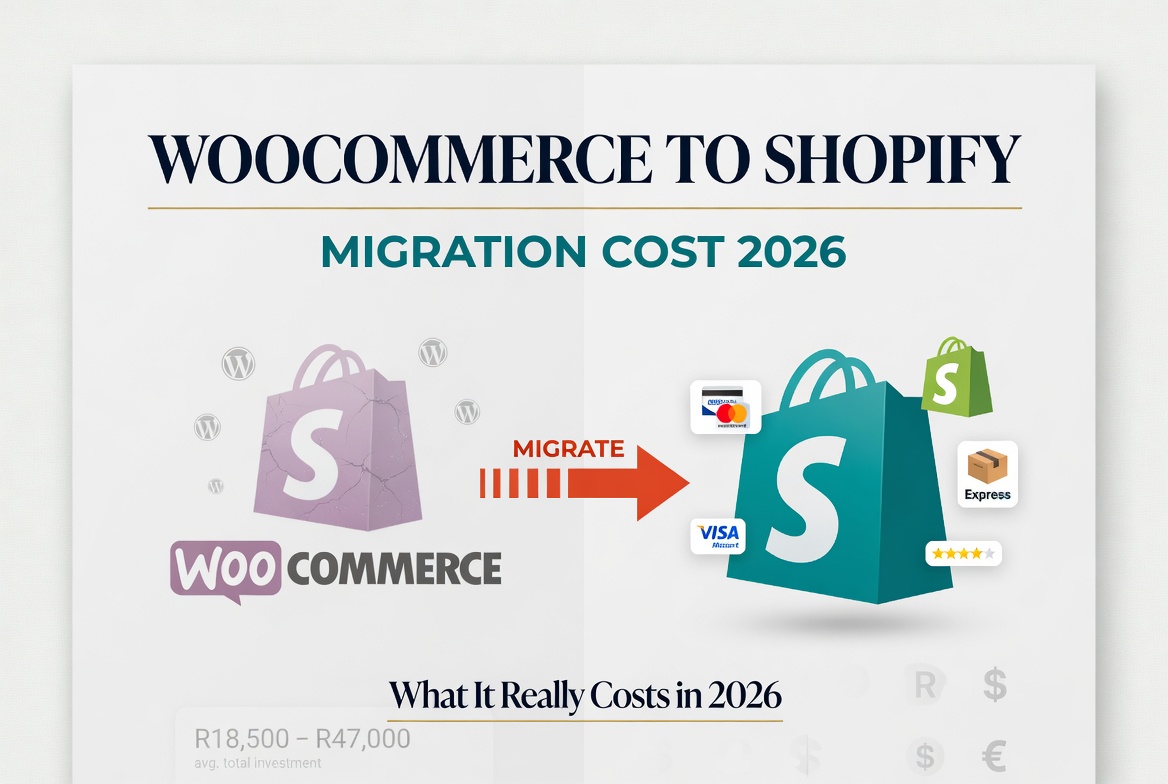

What does it really cost to migrate from WooCommerce to Shopify in 2026?
DIY migration tools quote $59. Agencies quote R75,000. Real numbers are usually somewhere in between — and the cost depends entirely on what your store actually looks like. Here’s the honest breakdown, with the maths.
Every WooCommerce store owner thinking about Shopify hits the same wall: nobody will give you a straight number. Migration apps advertise $59. Agencies quote anywhere from R15,000 to R150,000. WooCommerce forums tell you it’s “way more than you think.” Shopify reps tell you it pays for itself in three months. None of that is useful when you’re trying to decide whether to actually do it.
We’ve migrated 100+ stores from WooCommerce to Shopify since 2014. The real cost depends on five things: how many products you have, how much custom WordPress functionality you’ve built, whether you care about preserving SEO, what subscriptions or memberships exist, and how much downtime your business can absorb. Get those right and the cost is predictable. Get them wrong and you’ll bleed money for months.
This post walks through the actual line items, what each costs, and which scenario fits your store. If you want to skip to the numbers and plug in your own revenue, the Migration ROI Estimator on our tools page does it interactively — outputs payback month, projected uplift, and 12-month net gain.
The five cost components
Every WooCommerce-to-Shopify migration has the same five line items. The variation is which ones balloon for your specific store.
| Cost component | DIY range | Agency range (SA, ZAR) | What drives it |
|---|---|---|---|
| Data migration | $59–$500 one-off | R3,000–R15,000 | Product count, variants, customer history |
| Theme & design | $0–$400 (theme cost) | R8,000–R40,000 | Custom design vs theme as-is |
| 301 redirects & SEO | Free (manual) | R2,000–R8,000 | Number of indexed URLs |
| App replacement | Varies by app | R3,000–R20,000 setup | WooCommerce plugins to find Shopify equivalents for |
| New Shopify subscription | $29–$299/mo annual | R550–R5,600/mo | Plan tier (Basic, Grow, Advanced) |
Migration cost is the cheaper part for most stores. The expensive part is what happens on the way to launch — design, app replacement, and the SEO work. If you skip those, you save money on the way in and pay for it on the way out in lost traffic and lost sales.
1. Data migration: $59–$15,000
This is the part everyone fixates on, and it’s almost always the smallest cost. There are three ways to do it.
Automated migration tools (cheap): LitExtension, Cart2Cart and similar tools start around $59 for stores under 500 products. They handle products (with images and variants), customers, orders, blog posts and basic SEO data. They don’t handle WooCommerce Subscriptions, custom plugin data, or membership data. For a typical small SA store with 200–500 products and no complex plugins, $99–$199 covers it.
WordPress plugin migration (medium): Tools like W2S WooCommerce to Shopify run inside your WordPress dashboard. Similar price range, slightly more control over the mapping. Same limitations as automated tools.
Agency-managed migration (expensive but covers gaps): R3,000–R15,000 in South Africa for the data-only piece. What you’re paying for is data cleanup (deduping, fixing broken SKUs, correcting taxonomies), variant remapping (WooCommerce attributes don’t always map cleanly to Shopify options), and the parts the automated tools can’t do — subscriptions, custom fields, membership data, WooCommerce-specific shipping rules.
For most SA stores doing under R200k/month, a DIY tool at $99 is fine for the data. The agency premium is justified once you have over 1,000 products, complex variants, or custom plugin data that has to come across.
What can’t migrate: Customer passwords (everyone has to reset on first login — this is a security feature, not a bug). Custom plugin-table data unless you pay a developer to extract it. WordPress users (separate from customers). Anything stored only in a WordPress option table.
2. Theme & design: where most of the budget goes
Theme work is the largest cost component on most migrations and the one merchants under-budget the most.
Use a free Shopify theme: Dawn (Shopify’s flagship free theme) is good. Several other free themes are solid. Cost: R0 for the theme, plus 6–15 hours of setup work to match your brand. Agency cost for this in SA is typically R8,000–R15,000.
Buy a premium theme: Themes from Out of the Sandbox, Pixel Union, or the Shopify Theme Store cost $180–$400 once-off. Better starting point, less custom dev to match your current look. Agency cost to configure and customise: R12,000–R25,000.
Custom theme build: R30,000–R150,000 in South Africa depending on complexity. Justifiable when your WooCommerce site has heavily custom UX (interactive product configurators, complex bundling, custom B2B portals) that no off-the-shelf theme replicates. Most stores don’t actually need this — they think they do, but a well-configured premium theme covers 95% of what they’re after.
The honest take: if your WooCommerce site looks decent and you’re not in a niche that demands bespoke UX, a premium theme at $300 plus R15,000 of configuration gets you to a better-looking Shopify store than what you have on WooCommerce. The “we need a custom build” instinct is usually expensive nostalgia for the WooCommerce design you already have.
3. 301 redirects and SEO preservation
This is the part you cannot skip and the part most merchants try to skip.
WooCommerce uses URLs like /product-category/widgets/blue-widget/. Shopify uses /collections/widgets/products/blue-widget. Different structure. Without 301 redirects from every old URL to the new one, Google sees your URLs disappear, your rankings collapse, and you lose 20–40% of organic traffic in the first 30 days. That’s not a worst case — that’s the average outcome when migration is done without SEO work.
A proper SEO migration in South Africa covers:
- URL mapping spreadsheet: Every indexed URL (products, collections, blog posts, pages) mapped to its Shopify equivalent. For a 500-product store with blog content, expect 700–1,200 redirects.
- 301 redirect implementation: Either bulk-uploaded into Shopify or — if you have more than 5,000 — handled via the WooCommerce side until DNS cuts over.
- Meta titles and descriptions migrated: Yoast/RankMath data from WooCommerce manually exported and re-imported into Shopify SEO fields (no automatic tool does this well).
- Image alt tags preserved: Image SEO is a real signal and Shopify image alt text doesn’t auto-import from WooCommerce.
- Sitemap submission: New Shopify sitemap submitted to Google Search Console, old WooCommerce sitemap deindexed.
- Internal link rewrite: Blog post internal links pointing to old WooCommerce URLs need to be rewritten to point at Shopify URLs.
DIY cost: free, if you’re willing to spend 8–20 hours doing it yourself and you have the SEO knowledge to do it right. Agency cost in SA: R2,000–R8,000 depending on URL count. Either way it gets done — or you lose traffic.
4. App replacement: hidden cost killer
WooCommerce works with WordPress plugins. Shopify works with Shopify apps. Most don’t have one-to-one equivalents, and the Shopify versions almost always charge monthly fees where WooCommerce plugins were one-off purchases.
Common WooCommerce functionality and what it costs on Shopify:
| WooCommerce functionality | Shopify equivalent | Monthly cost |
|---|---|---|
| WooCommerce Subscriptions | Recharge, Skio, or Bold Subscriptions | $50–$300+/mo |
| Yoast / RankMath SEO | Shopify SEO Manager, Smart SEO | $15–$30/mo |
| Product bundles | Shopify Bundles (free), Bundler, BundleKit | Free–$30/mo |
| Advanced shipping rules | Advanced Shipping Manager, Shipeasy | $15–$80/mo |
| Reviews (WooCommerce / Yotpo) | Judge.me, Loox, Yotpo | Free–$50/mo |
| Wholesale pricing (B2B) | Wholesale Helper, B2B Wholesale Solution | $30–$300/mo |
| Email marketing (MailPoet etc) | Klaviyo, Omnisend, Shopify Email | Free–$150/mo |
For a typical SA store, app subscriptions add up to R800–R3,500/month on Shopify that you weren’t paying on WooCommerce. That’s R10,000–R42,000/year of ongoing cost. The trade-off is that nothing breaks, nothing needs updating, and you don’t lose a weekend to plugin conflicts.
5. The new Shopify subscription
Shopify’s 2026 plans (all USD, billed annually for the discount):
- Basic: $29/month annual / $39/month monthly — full online store, fine for most SA stores under R200k/month revenue.
- Grow (was “Shopify”): $79/month annual / $105/month monthly — 5 staff accounts, lower SA third-party transaction fee (1% vs 2%), better reports.
- Advanced: $299/month annual / $399/month monthly — 15 staff, lowest SA third-party fee (0.6%), advanced reports.
- Plus: from $2,300/month — enterprise.
In ZAR at current rates: Basic is roughly R550/month annual, Grow R1,500/month, Advanced R5,600/month. Crucial SA-specific point: because Shopify Payments isn’t available in South Africa, you pay Shopify an additional 0.2–2.0% on every transaction on top of your payment gateway fee. On Basic that’s 2.0%. On Grow it drops to 1.0%. On Advanced 0.6%. The Shopify plan upgrade isn’t just for features — it’s for the fee discount on every sale.
The break-even point in SA: upgrade from Basic to Grow once you process about R124,000/month. At that revenue, the 1% fee saving exceeds the extra subscription cost. We cover this maths in detail in our Shopify Profit Margin Calculator.
The honest TCO comparison: WooCommerce vs Shopify in SA
Here’s what most “WooCommerce is free!” arguments miss. Let’s compare actual monthly running costs for an SA store doing R200,000/month in revenue.
| Line item | WooCommerce (ZAR/mo) | Shopify Basic (ZAR/mo) |
|---|---|---|
| Platform subscription | R0 (WP free) | R550 (annual billing) |
| Hosting (production-grade WooCommerce / included on Shopify) | R1,500–R2,500 | Included |
| SSL, CDN, security plugins | R200–R600 | Included |
| Backups, maintenance, plugin updates | R500–R2,000 (dev retainer) | Included |
| App / plugin subscriptions | R200–R800 | R800–R3,500 |
| Payment gateway fee (3.2% PayFast) | ~R6,346 (cards+EFT mix) | ~R6,346 |
| Shopify third-party gateway fee (2%) | N/A | R4,000 |
| Total monthly (ex VAT) | R8,746–R12,246 | R11,696–R14,396 |
Shopify is more expensive month-to-month at lower revenue. That’s the honest answer, even though most pro-Shopify content downplays it. The Shopify third-party fee is the killer — on Basic at R200k revenue, it’s R4,000/month of pure platform tax with no equivalent on WooCommerce.
But there are two things that flip the comparison:
1. WooCommerce hidden costs don’t show up until something breaks. The R8,746 figure assumes nothing goes wrong. When a plugin update breaks your checkout (this happens), you pay R800–R2,000 for an emergency dev fix. When your hosting throttles you during Black Friday traffic (this also happens), you lose sales you can’t recover. When a plugin you depend on stops being maintained (very common), you pay to rebuild. We see WooCommerce stores routinely spending R3,000–R8,000/month on developer retainers just to keep things running. Shopify removes all of that.
2. The conversion uplift. Shopify’s checkout converts better than WooCommerce’s by 5–15% on average. On R200k/month, even a 5% uplift is R10,000/month additional revenue — which more than covers the higher platform cost. On R500k/month it’s R25,000/month. The Migration ROI Estimator models this explicitly. Run your numbers through it.
Total migration project cost: real ranges by store size
This is what merchants actually want to know. Here’s the honest answer for South African stores.
For most SA stores migrating from a typical WooCommerce setup — a few hundred products, a couple of custom plugins, a year or two of SEO investment to protect — R30,000–R50,000 is the realistic agency budget. The DIY route is genuinely doable for under R8,000 if you have the time and skill.
When migration pays back: the timeline
For a store doing R200,000/month with a 5% conversion uplift on Shopify (conservative), R30,000 in migration costs pays back in 3 months. With a 10% uplift, payback is 6 weeks. With a 15% uplift (which we’ve seen on stores where WooCommerce checkout was actively broken) payback is under a month.
The cost not to migrate is sneakier. Stay on WooCommerce and you’re still paying the hidden hosting, maintenance, security, and plugin-fragility costs every month. Those don’t go away. They compound.
Run your specific numbers through the Migration ROI Estimator to see your payback month. It models conversion uplift, AOV change, savings on hosting and maintenance, and outputs net gain over 12 months. Takes 30 seconds.
What people get wrong
- “I’ll just use the migration tool, I don’t need an agency.” Fine if your store is small and simple. If you have over 500 products, custom plugins, a B2B portal, or real organic traffic, the tool gets you 70% of the way and the remaining 30% breaks things. The 30% is what costs.
- “Custom plugins will migrate.” They won’t. Any functionality that lives in a custom WordPress plugin stays on WordPress unless you pay a developer to rebuild it on Shopify. Budget for this before you start.
- “My SEO will be fine.” Without 301 redirects you lose 20–40% of organic traffic in 30 days and take 3–6 months to recover. With proper redirects you lose under 5% and recover in 4–8 weeks. Don’t skip the redirect work.
- “WooCommerce is free, why pay for Shopify?” WooCommerce isn’t free — it costs in hosting, maintenance, plugin licences, developer retainers, and the time you spend fixing things. The “free” framing only holds if you don’t count the costs.
- “I’ll launch on a Saturday and sort issues Monday.” Don’t. Customer service spikes 4–10× in the first week post-launch as customers hit unexpected friction (account resets, gift card balances, subscription confusion). Have someone available. Don’t go on holiday during your migration window.
Frequently asked questions
The bottom line
For most South African WooCommerce stores doing over R100k/month, the migration to Shopify pays back within 3–6 months when done properly. The actual money cost is R30,000–R50,000 for a typical agency migration, R3,000–R8,000 if you DIY. The hidden cost — the part that catches everyone — is the SEO work and the app replacement. Get those right and the migration is a good investment. Skip them and it’s an expensive lesson.
If you want to see what your specific migration is likely to cost and when it pays back, the Migration ROI Estimator takes 30 seconds and outputs a real projection. For the broader question of which platform fits your stage, our eCommerce Platform Picker walks you through it. And for the step-by-step read on how the migration actually works, see our honest WooCommerce to Shopify migration guide, or our platform migration service if you’d rather we handled it.

We have built 400+ online stores for South African businesses since 2014. Read more about WooCommerce development in South Africa and Shopify development in South Africa.