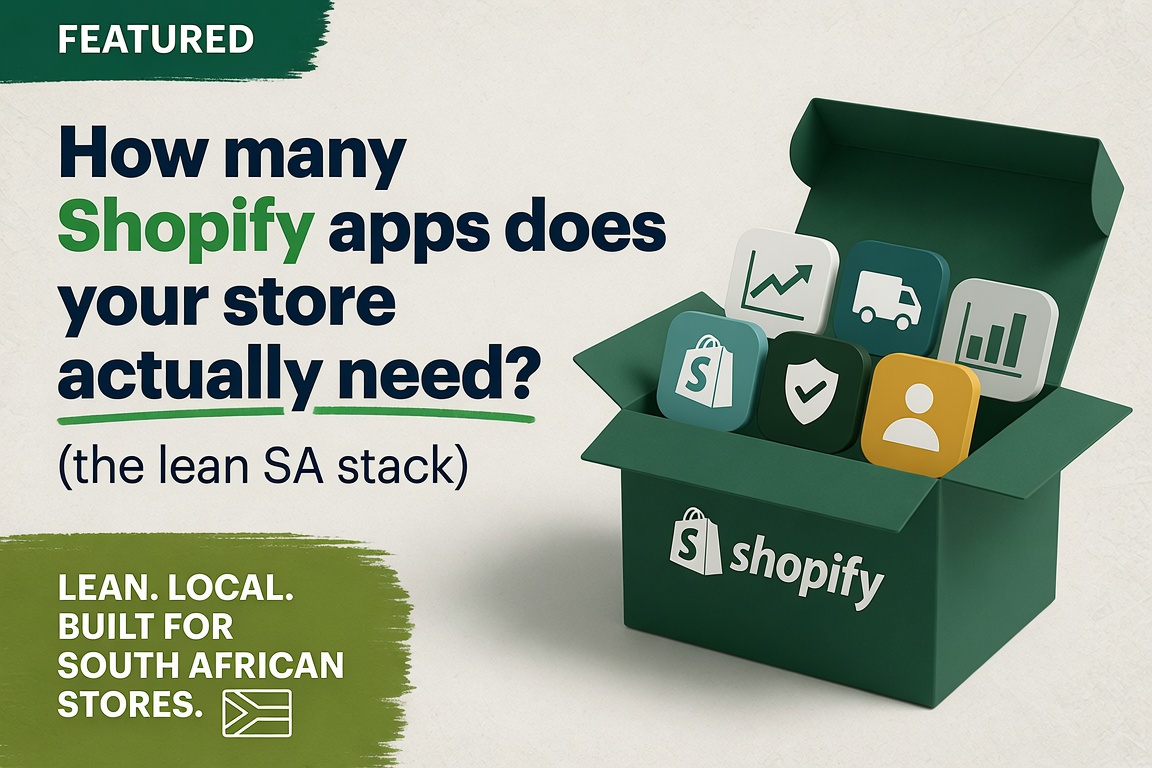

How many Shopify apps does your store actually need? (the lean SA stack)
The Shopify App Store has thousands of apps, all promising more sales. It’s how stores end up paying for fifteen overlapping tools that slow the site down and drain R3,000+ a month. Here’s the lean stack we actually install — one app per real problem, and what to skip.
App bloat is the most common, most expensive mistake we see on otherwise healthy Shopify stores. It happens quietly. You install a reviews app, then an upsell app, then a popup app, then a loyalty app you read about, then a second analytics app because the first one’s dashboard was confusing. Eighteen months later you’re paying for fourteen apps, half of them overlap, three you forgot you had, and your store loads half a second slower for every one running on the front end.
We’ve built over 400 stores, and the ones that scale profitably almost always run a smaller app stack than the ones that struggle. Not because apps are bad — the right ones earn their keep many times over — but because every app is a monthly fee and usually a little page-load weight. The discipline is simple to say and hard to hold: one good app per real problem, not one app per feature you read about.
This post lays out the lean stack by need. If you’d rather get a personalised set of recommendations for your platform, stage and specific pain points, the App Stack Recommender does that in about 45 seconds.
The lean starter stack: 4 to 7 apps
A healthy store doesn’t launch with twelve apps. It launches with the handful that solve problems you actually have. Here’s the core stack and what we install for SA clients, with honest notes on which we have an affiliate relationship with and which we simply rate.
| The problem | Our pick | Rough monthly cost |
|---|---|---|
| Email marketing | MailerLite (or Klaviyo when advanced) | Free → scales with list |
| Product reviews | Judge.me | Free tier, then ~$15 |
| Site search (if big catalogue) | Searchanise | From ~$19 |
| SEO basics | SEO Booster (or RankMath on Woo) | Free → ~$30 |
| Invoicing & VAT | Sufio | From ~$19 |
| Shipping (SA couriers) | ParcelSpot / Bob Go | Usage-based |
For most SA stores at launch, that’s R500–R1,500/month on top of your Shopify plan — and every one of those apps is solving a problem you genuinely have on day one. You don’t need all six; a tiny store might launch with just email and reviews and add the rest as the catalogue and order volume grow.
Honesty note, the same one we put on the recommender: some of those are affiliate links where we earn a small commission at no cost to you (MailerLite, Searchanise, Sufio, SEO Booster, ParcelSpot), and some are picks we earn nothing on and recommend anyway because they’re simply the best tool for the job (Judge.me, Klaviyo). We mark which is which, because the goal is your store working, not our commission.
What to add as you grow — not before
These are real, valuable apps. The mistake is installing them on day one before you have the volume to justify them. Add them when the problem actually appears:
- Loyalty & rewards (AiTrillion, Smile.io) — once you have enough repeat customers for a loyalty programme to mean something. Pointless with 30 customers.
- Post-purchase upsells (ReConvert) — once you have steady order flow to optimise. The thank-you page is the highest-converting place to upsell, but you need volume to see the lift.
- Customer support helpdesk (Gorgias) — once support volume outgrows your inbox. Below that, email and Shopify’s built-in tools are fine.
- Profit analytics (Lifetimely) — once you’re spending real money on ads and need true net-profit-per-order, not just revenue.
- Advanced email / SMS (Klaviyo) — when you outgrow MailerLite’s automations and the extra segmentation power starts paying for itself.
The pattern: each of these earns its fee only past a certain scale. Install them early and they’re just cost and clutter. Install them when the problem is real and they print money.
The bloat to skip
Some categories are where stores waste the most money. Be sceptical of:
- Duplicate-function apps. Two analytics apps. A loyalty app and a separate rewards app. A reviews app plus a UGC app that also does reviews. Pick one per job.
- All-in-one apps you only use 10% of. If you’re paying for a suite to use a single feature, a focused app is usually cheaper and faster. (The exception is when an all-in-one genuinely replaces four subscriptions — then it saves money. AiTrillion can do this for some growing stores.)
- Popup and “urgency” apps that annoy more than they convert. Countdown timers and spin-to-win wheels rarely survive an honest before/after conversion test.
- Apps that duplicate something Shopify now does natively. Shopify has added native bundles, basic email, and more. Check before you pay for an app to do something built in.
The hidden cost: speed and fees
Two costs of app bloat don’t show up on the invoice. First, monthly fees compound — fourteen apps at an average of R250/month is R3,500/month, R42,000 a year, often for capability you barely use. That’s a meaningful chunk of the margin we talked about in what you actually keep on a sale.
Second, every front-end app adds weight. Apps that inject scripts into your storefront — popups, reviews widgets, upsell bars, chat — each add a little to your page load. Stack enough and your store gets visibly slower, which hurts both conversion and SEO. A lean stack isn’t just cheaper; it’s faster, and speed sells.
On WooCommerce?
The same discipline applies, with different tools. Some of these (MailerLite, Klaviyo, Judge.me) have solid WooCommerce versions. Others are Shopify-first, but the WordPress plugin ecosystem covers the same ground — RankMath for SEO (free, and what this very site runs), WooCommerce-native reviews, and PDF-invoice plugins. The rule doesn’t change: one plugin per real problem, and watch what each one does to your page speed and your maintenance burden.
Frequently asked questions
The bottom line
You need fewer apps than the App Store wants you to believe. Start with the handful that solve problems you actually have — email, reviews, search, SEO, invoicing, shipping — and add the rest only when the problem is real. A lean stack is cheaper, faster, and easier to manage, and it leaves more margin for the thing that actually grows your store: getting and keeping customers.
Get a personalised stack for your platform and pain points with the App Stack Recommender, and check what those subscriptions do to your bottom line with the Profit Margin Calculator. If you’d like us to install and — more importantly — configure the right stack so each app actually earns its keep, that’s a big part of what we do.

We have built 400+ online stores for South African businesses since 2014. Read more about Shopify development in South Africa.