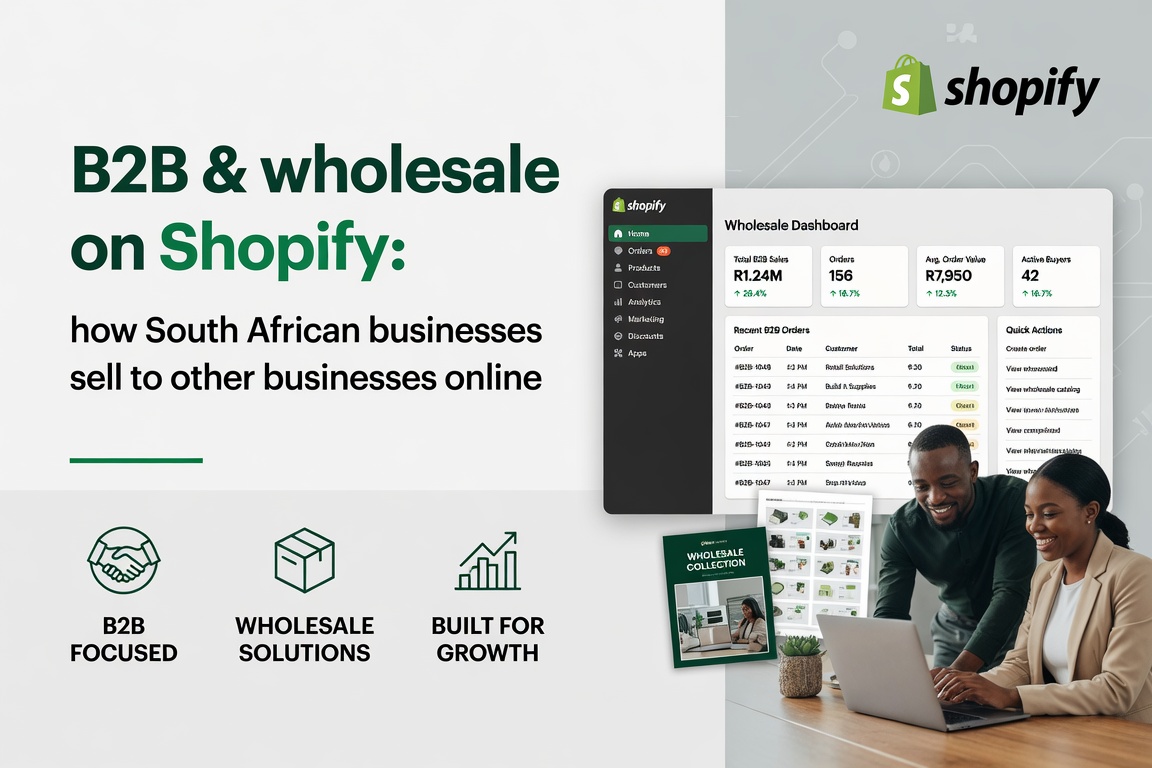

B2B & wholesale on Shopify: how South African businesses sell to other businesses online
Wholesale and trade selling has different rules to retail — tiered pricing, customer-specific catalogues, credit terms, bulk orders. Here’s how to run B2B properly on Shopify in South Africa, what’s built in, what needs an app, and when to use a dedicated wholesale channel.
If you sell to other businesses — wholesale, distribution, trade accounts, reseller pricing — the standard retail store setup doesn’t fit. Your customers buy in volume, expect prices specific to their account, often order on credit or via quote, and don’t want to see retail prices or pay retail shipping. Trying to bolt this onto a plain retail store usually ends in spreadsheets, manual invoices and email chaos.
The good news: Shopify handles B2B well in 2026, either through native B2B features or through wholesale apps, depending on your plan and needs. This guide covers what B2B selling actually requires, how to do it on Shopify, and the SA-specific considerations. If you’d rather have it built for you, that’s our B2B eCommerce service.
What B2B selling actually needs (that retail doesn’t)
Before choosing how to build it, understand the requirements that make B2B different:
- Customer-specific pricing. Different trade customers get different prices — based on volume, relationship, or negotiated rates. A customer should log in and see their prices, not retail.
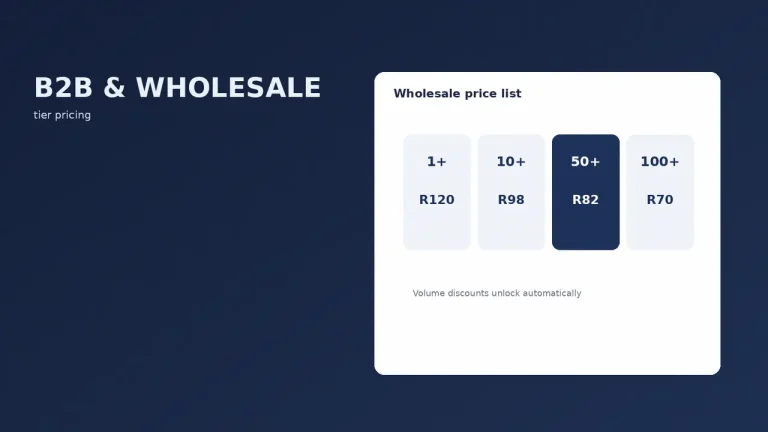
- Tiered / volume pricing. Buy 10, pay one price; buy 100, pay less. Quantity breaks are standard in wholesale.
- Gated access. Often you don’t want the public seeing wholesale prices at all. Trade customers log in to a private catalogue; the public sees retail or nothing.
- Minimum order quantities/values. Wholesale usually has a minimum — you don’t sell single units at trade prices.
- Credit terms and invoicing. Many B2B customers buy on account (30-day terms) rather than paying upfront by card, or want a quote/proforma before committing.
- Bulk and repeat ordering. Trade buyers reorder the same lines regularly and want fast bulk-order and reorder tools, not a one-item-at-a-time retail flow.
What changes when you sell to businesses
Retail defaults versus what trade buyers expect.
| Retail store | B2B / wholesale | |
|---|---|---|
| Pricing | One public price | Per-customer prices and quantity breaks |
| Access | Open to everyone | Trade login to a private catalogue |
| Order size | Single units | Minimum order quantity or value |
| Payment | Card at checkout | 30-day account terms, quotes, proformas |
| VAT display | Including VAT | Excluding VAT |
| Delivery | Parcel couriers | Freight and pallet options |
The ways to do B2B on Shopify
There are three main approaches, and the right one depends on your size and how much of your business is B2B:
| Approach | How it works | Best for |
|---|---|---|
| Native Shopify B2B | Built-in B2B (company profiles, price lists, terms) on higher-tier Shopify | Serious / pure B2B operations |
| Wholesale apps | Add tiered pricing, gated access, MOQs to a standard store | Mixed retail + wholesale on standard plans |
| Separate B2B store / channel | A dedicated trade store alongside your retail one | Clean separation of trade and public |
Option 1: Native Shopify B2B
Shopify has built genuine B2B functionality into its platform, available on its higher tiers (Plus, and increasingly surfaced on upper standard plans). It lets you create company profiles for trade customers, assign each company its own price list and payment terms, set customer-specific catalogues, and let buyers log into a dedicated B2B buying experience. Because it’s native, it’s robust and integrated — no app juggling. This is the route for businesses where B2B is the core of what they do, or a major channel, and who can justify the higher plan. It’s the cleanest long-term foundation.
Option 2: Wholesale apps on a standard store
If you’re a smaller operation, or you run retail and wholesale off one store, dedicated wholesale apps add the B2B features to a standard Shopify plan at lower cost. Apps in this space (Wholesale Helper, B2B/Wholesale Solution and others) let you set wholesale price tiers, gate prices behind a trade login, enforce minimum orders, and offer quantity breaks — without jumping to the top plan. This is the pragmatic starting point for many SA businesses testing or running a modest trade channel alongside retail. The trade-off is you’re stitching features together with apps rather than using one native system, so keep the stack lean — see how many apps you actually need.
Option 3: A separate B2B store or channel
Some businesses run a clean separation: a public retail store and a distinct trade store (or a gated section) with its own catalogue, pricing and login. This gives the clearest division — the public never sees wholesale pricing, trade customers get a purpose-built experience — at the cost of maintaining two storefronts. It suits businesses where retail and trade are genuinely different operations with different products or branding.
The South African B2B considerations
- Payment terms over card payments. SA trade customers frequently expect 30-day account terms, not upfront card payment. Your setup needs to support invoicing, proforma quotes, and “pay on account” rather than forcing checkout-time card payment. This is often the biggest gap in a naive B2B setup.
- VAT and pricing display. B2B buyers typically want to see prices excluding VAT (they claim it back), whereas retail shows VAT-inclusive. Your store needs to handle both correctly depending on who’s logged in.
- Quotes and bulk enquiries. Many B2B sales start as a quote request, not an instant checkout. A clean quote-request flow that turns into an order matters more than a slick one-click checkout.
- Credit control. Selling on terms means managing who gets credit and tracking what’s owed — integrate with your accounting (Xero, Sage) so trade invoicing isn’t a manual nightmare.
- Logistics for bulk. Wholesale orders are bigger and heavier; your shipping setup needs freight/pallet options, not just parcel couriers. See our shipping guide.
How a typical SA trade order flows
Most B2B sales start as a quote, not a card checkout.
B2B and retail together: the hybrid reality
Most SA businesses doing wholesale also do some retail, and the question is how to serve both without compromising either. The common, practical answer: run one Shopify store with wholesale functionality layered on, where logged-in trade customers see their pricing and the public sees retail. It keeps your inventory, orders and admin in one place while presenting the right experience to each audience. Move to native B2B or a separate store when the trade side grows enough to justify it.
Start unified, split when trade grows
The three options above, as a growth path.
Frequently asked questions
The bottom line
Selling to businesses online needs more than a retail store with a discount code. It needs customer-specific pricing, gated trade access, minimum orders, payment terms and a quote-friendly flow. Shopify delivers all of this — through native B2B on higher plans for serious trade operations, or wholesale apps on standard plans for businesses running retail and wholesale together. The SA-specific parts — 30-day terms, VAT-exclusive pricing, quotes, bulk logistics — are exactly where a naive setup falls short and a proper one pays off.
If you want a B2B or wholesale channel built properly on Shopify — trade pricing, gated catalogues, payment terms and accounting integration — that’s our B2B eCommerce service. Tell us how your trade business works and we’ll design the right structure for it.

We have built 400+ online stores for South African businesses since 2014. Read more about Shopify development in South Africa.