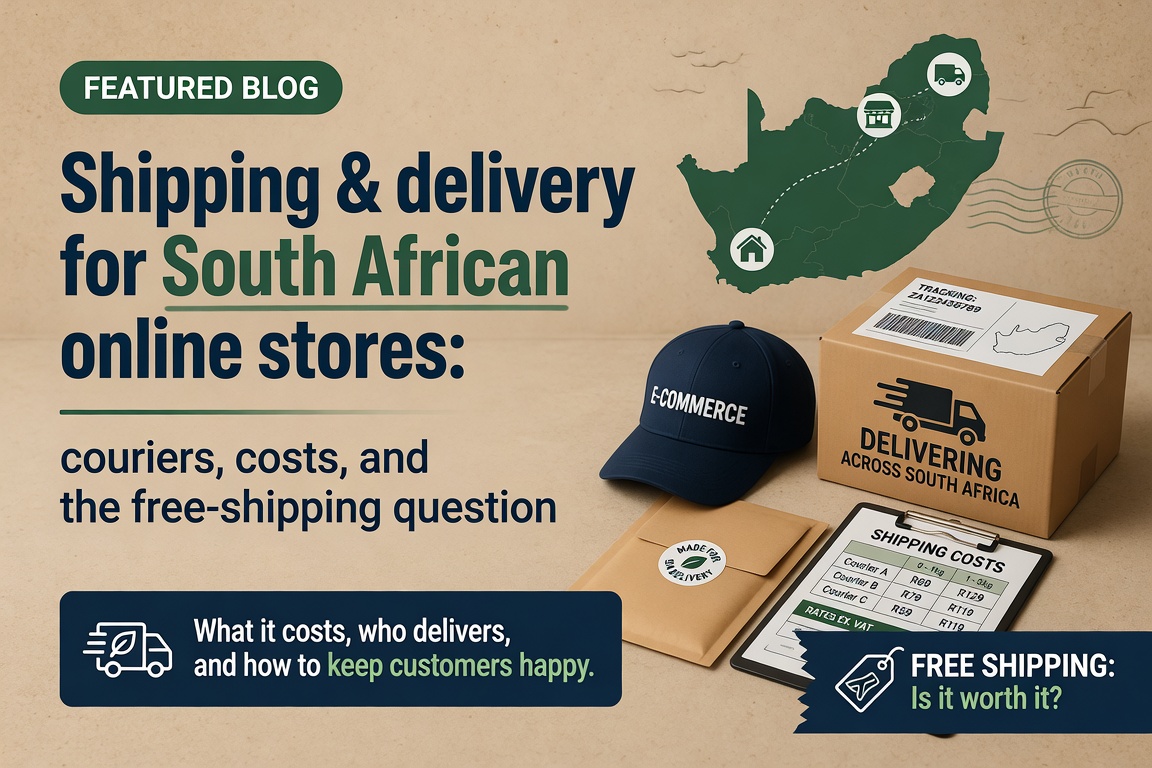

Shipping & delivery for South African online stores: couriers, costs, and the free-shipping question
Shipping is the number-one cause of abandoned carts in South Africa — and the area where most stores either overpay or quietly lose money. Here’s how SA courier options actually work, what they cost, and how to set up delivery so it converts instead of killing the sale.
You can have the best product, the slickest store and a perfectly optimised checkout, and still lose the sale at the last step because the delivery fee surprised the customer. Shipping cost shock is the single biggest reason South Africans abandon carts — we covered it in the abandoned cart recovery playbook — and getting your delivery setup right is one of the highest-leverage things you can do for conversion.
It’s also genuinely confusing. South Africa has a crowded courier market with door-to-door services, pickup-point networks, and locker systems, all priced differently by route, weight and speed. This guide cuts through it: the main options, what drives the cost, the three ways to charge for shipping, and the SA-specific traps.
The three types of delivery in South Africa
SA courier options fall into three models, and the cheapest one depends on your product and your customer:
- Door-to-door — the courier collects from you and delivers to the customer’s address. The most convenient and what most shoppers expect, but the most expensive. The Courier Guy, Aramex, RAM, Fastway, SkyNet and DSV play here.
- Pickup points (store-to-store) — the parcel is delivered to a retail collection point near the customer, who collects it. Cheaper, with fewer failed deliveries. Pargo (thousands of pickup points) and PEP Paxi (collection at PEP stores nationwide) dominate, and they’re usually the cheapest options going.
- Lockers — the parcel goes to a self-service locker the customer unlocks with a PIN. PUDO, operated by The Courier Guy, runs an expanding locker network at malls, petrol stations and residential areas. Low cost, 24/7 convenience, good for smaller high-value items.
The smart move for most stores is to offer more than one — a door-to-door option for convenience plus a cheaper pickup or locker option for price-sensitive customers. Giving the customer the choice reduces abandonment.
Three delivery models, three price points
Offer door-to-door plus one cheaper option.
| Model | Cost | Main players |
|---|---|---|
| Door-to-door | Highest | The Courier Guy, Aramex, RAM, Fastway, SkyNet, DSV |
| Pickup points | Usually lowest | Pargo, PEP Paxi |
| Lockers | Low, 24/7 collection | PUDO (The Courier Guy) |
What drives shipping cost (and why a flat rate is risky)
Courier pricing in South Africa shifts on several axes, which is why no single courier is “cheapest” for everything:
- Route: A parcel within a metro costs far less than one to a rural address. The same parcel from Sandton to Sea Point and from Soweto to Mthatha can differ by R40–R120.
- Weight and dimensional weight: Couriers charge on actual weight or dimensional (size-based) weight, whichever is higher. A big, light box can cost a fortune — pack efficiently.
- Speed: Same-day and overnight cost more than economy (which can take 3–9 days on the cheapest tiers).
- Surcharges: Remote-area surcharges (R50–R150), fuel surcharges (often 5–15%), and peak-season loading around Black Friday and December all stack on top.
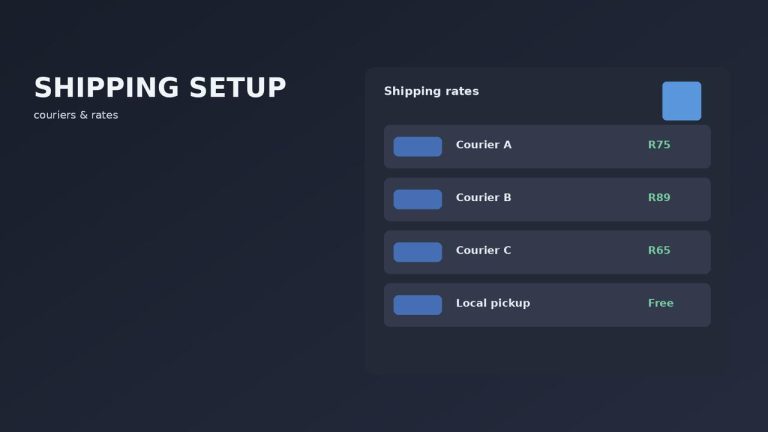
This is why a single flat shipping rate is risky: set it low and you lose money on rural and heavy orders; set it high and you scare off metro customers. Most successful stores use live rates or zone-based rates instead.
Use a shipping aggregator (don’t manage couriers one by one)
The biggest time-and-money saver for an SA online store is a shipping aggregator — a platform that connects to multiple couriers, compares live rates, books the cheapest, prints the waybill and sends tracking, all from one dashboard. Instead of negotiating and managing several courier accounts, you let the aggregator find the best rate per parcel automatically.
What an aggregator does with every order
One dashboard instead of separate courier accounts.
The main options for SA ecommerce:
- Bob Go (formerly uAfrica) — connects to The Courier Guy, Pargo, RAM, SkyNet, Internet Express and more, with native Shopify and WooCommerce integration, no monthly fee, and live rates at checkout. The default choice for many SA stores.
- ParcelSpot — compares quotes across multiple couriers with door collection and delivery, advertising savings of up to 60% on shipping. We list it in our recommended resources.
An aggregator lets you offer live, accurate rates at checkout — so the customer sees the real cost for their address, you never undercharge, and you get the cheapest courier for each parcel automatically. It pairs directly with the lean app stack we recommend.
The three ways to charge for shipping
How you present shipping cost matters as much as what it costs. Three approaches:
| Approach | How it works | Best when |
|---|---|---|
| Live / calculated rates | Real courier rate shown at checkout per address | Varied products, wide delivery area |
| Flat or zone rates | Fixed price (or per region) | Consistent product sizes, simple offer |
| Free shipping | Built into price, or above a threshold | Lifting conversion & order value |
The free-shipping question
“Should I offer free shipping?” is the question every SA store owner asks, and the honest answer is: free shipping is rarely actually free — you’re either absorbing the cost or building it into your prices. But it’s one of the most powerful conversion tools you have, because it removes the cost shock that kills carts. The trick is to do it without destroying your margin.
The best approach for most stores is a free-shipping threshold — “free delivery on orders over R750.” This does two things at once: it removes shipping anxiety for larger orders, and it actively pushes up your average order value as customers add an item to qualify. Set the threshold a bit above your current average order value so it nudges baskets upward. Below the threshold, charge a real (ideally live) rate.
Whatever you choose, the cardinal rule is: show shipping cost early, never spring it at the final step. A customer who knows the delivery cost on the product page is far less likely to abandon than one ambushed by it at checkout. And before you commit to absorbing shipping, model it against your margin — our Profit Margin Calculator and what you keep on a R500 sale show how quickly absorbed shipping eats your profit.
The SA-specific traps
- Underpricing rural and heavy deliveries. A flat rate that works for metro orders bleeds money on remote or bulky ones. Use live or zone rates.
- Ignoring dimensional weight. Light but bulky products get charged on size. Right-size your packaging.
- Not setting peak-season expectations. Black Friday and December overwhelm couriers. Communicate realistic delivery times or you’ll drown in “where’s my order” queries and refund requests.
- Offering only door-to-door. You exclude price-sensitive customers who’d happily collect from a Pargo point or PUDO locker for less.
- Forgetting returns. The Consumer Protection Act gives customers return rights. Have a clear returns process and factor reverse-logistics cost into your pricing.
Frequently asked questions
The bottom line
Shipping isn’t an afterthought — it’s a conversion lever and a margin risk rolled into one. Offer more than one delivery model (door-to-door plus a cheaper pickup or locker option), use an aggregator to get live, accurate rates and the cheapest courier per parcel, show costs early, and use a free-shipping threshold to lift order value without bleeding margin. Get it right and shipping stops being the reason carts die and starts being a reason customers buy more.
If you’d like your delivery setup configured properly — live courier rates, pickup options, free-shipping thresholds and a clean returns flow on your Shopify or WooCommerce store — that’s part of what we do. It’s often one of the fastest conversion wins available.

We have built 400+ online stores for South African businesses since 2014. Read more about eCommerce development in South Africa.