
AI for your eCommerce store: practical uses for South African retailers (not the hype)
Past the buzzwords, AI is genuinely useful for online stores right now — writing product copy at scale, answering customer questions, personalising what shoppers see, and cutting hours of admin. Here’s what actually works for an SA store today, and what’s still marketing.
There’s a lot of noise about AI in ecommerce, and most of it is either breathless hype or vague “AI-powered” labels slapped on ordinary features. Cut through it and there’s a real, practical core: a handful of things AI does today that save an SA store owner genuine time and money, and lift sales. This isn’t about some futuristic store that runs itself — it’s about the specific, available tools that earn their place right now.
We use these with the stores we build, so this is the grounded version: where AI delivers real value for an SA online store today, where it’s still half-baked, and how to adopt it without wasting money on novelty. For more, see our AI for eCommerce service.
1. Writing product content at scale
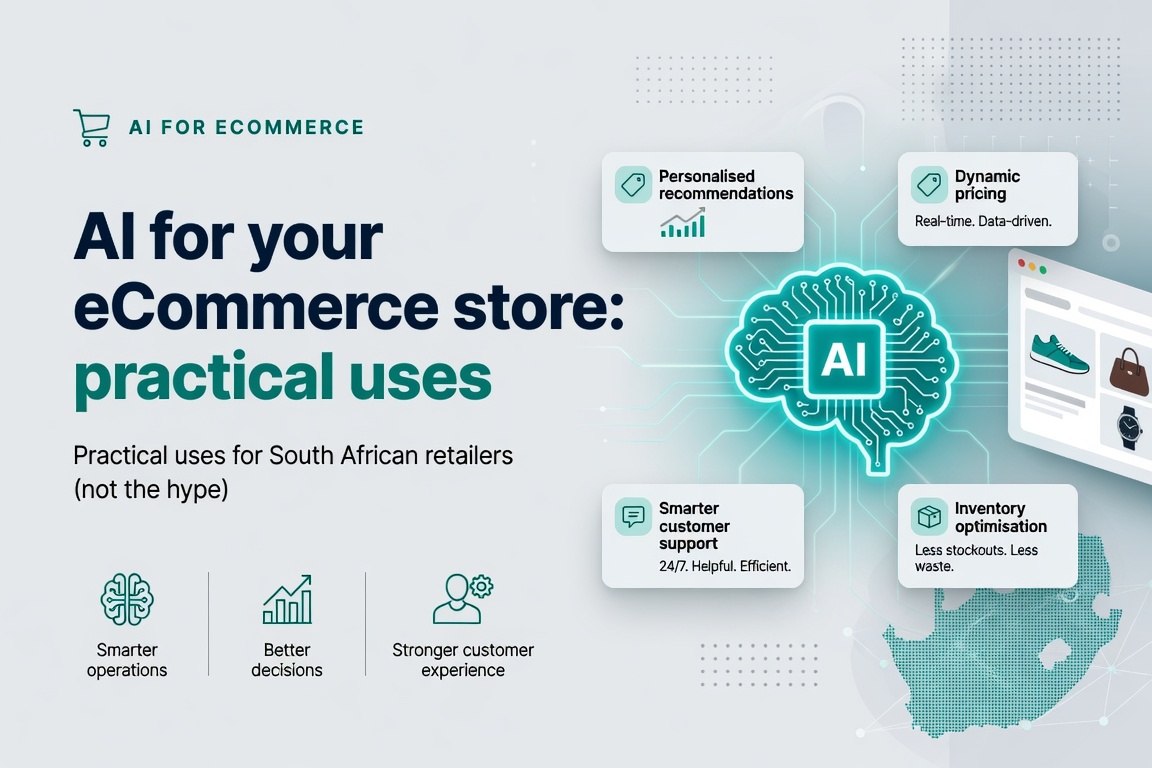
This is the highest-value, most-proven use of AI for ecommerce, full stop. Writing unique, good product descriptions for a large catalogue is mind-numbing, time-consuming work — and using the manufacturer’s copy (which dozens of other stores also use) actively hurts your SEO. AI solves exactly this: it can draft unique, on-brand descriptions for hundreds or thousands of products in a fraction of the time, which you then edit and polish.
The key word is draft — AI gets you 80% of the way fast, and a human makes it accurate and on-brand. Done right, it turns a month of copywriting into a few days. We’ve used this approach to write hundreds of product descriptions in a fraction of the usual time. It also extends to meta titles and descriptions, category copy, and email content. This single use case usually justifies the whole AI conversation for a catalogue-heavy SA store.
2. Customer service and chat
AI chat has gone from frustrating to genuinely useful. A well-set-up AI assistant can answer the repetitive questions that flood every store — “where’s my order,” “what’s your returns policy,” “do you ship to X,” “is this in stock” — instantly, 24/7, freeing you to handle the queries that actually need a human. For an SA store where the owner is often also the support desk, that’s hours back every week.
The caveat: AI chat is only as good as what it’s given. Connected to your real policies, catalogue and order data, it’s excellent; left generic, it frustrates. And it should always hand off cleanly to a human for anything it can’t handle — a dead-end bot is worse than no bot. Given WhatsApp’s dominance in SA, AI-assisted WhatsApp support is particularly powerful here.
3. Personalisation and recommendations
“Customers who bought this also bought” and personalised product recommendations are AI working quietly in the background, and they reliably lift average order value. Modern recommendation engines learn from browsing and purchase behaviour to show each shopper the products they’re most likely to want, on the homepage, product pages and in the cart. For SA stores, the practical win is higher basket sizes without lifting a finger once it’s set up — the engine does the merchandising. Personalised email (sending each customer products relevant to them) is the same idea applied to your email channel.
4. Search that understands intent
On-site search is where ready-to-buy customers go, and bad search loses sales. AI-powered search understands typos, synonyms and natural language (“warm waterproof jacket”) rather than just matching exact keywords, and returns relevant results that convert. For stores with large catalogues, upgrading search is one of the most directly revenue-linked AI improvements available — people who search convert at much higher rates, so helping them find the right product fast pays off immediately.
5. Cutting the admin
Less glamorous but real: AI takes a chunk out of the back-office grind. Drafting and scheduling social posts, summarising customer feedback and reviews, categorising and tagging products, generating image alt text for SEO and accessibility, drafting email campaigns, even helping analyse your sales data and spot trends. None of these is revolutionary alone, but together they hand a busy SA store owner hours back to spend on the things that actually grow the business.
What’s still hype (for now)
Being honest about the limits matters as much as the wins:
- “Fully autonomous” stores. AI that runs your entire business with no human input is marketing, not reality. AI is a powerful assistant, not a replacement for judgment.
- AI image generation for products. Useful for lifestyle and background imagery, but customers want to see the actual product. Don’t mislead with generated product shots.
- “AI” as a feature label. Plenty of tools slap “AI-powered” on basic automation. Judge tools by what they do, not the label.
- Set-and-forget anything. AI outputs need review — unedited AI product copy, unsupervised chat, or unchecked recommendations can embarrass you. Human oversight stays essential.
How to adopt AI without wasting money
The smart approach is targeted, not wholesale. Pick the one use case with the clearest payoff for your store — for most catalogue-heavy SA stores that’s product content; for high-support stores it’s AI chat; for big catalogues it’s search — and implement that properly before adding more. Don’t buy a dozen AI apps because they’re trendy; that’s the app bloat we warn about in how many apps you actually need. Start where the time-or-money saving is obvious, measure it, then expand. AI should pay for itself in saved hours or added sales, or it’s not worth the subscription.
Frequently asked questions
The bottom line
AI is genuinely useful for SA online stores today — not as a magic autonomous shopkeeper, but as a powerful assistant for specific, high-value jobs: drafting product content at scale, handling repetitive support, personalising recommendations, improving search, and cutting admin. The winners adopt it surgically, starting with the one use case that clearly pays off, keeping a human in the loop, and ignoring the “AI-powered” labels that mean nothing. Done that way, AI quietly makes your store cheaper to run and better at selling.
If you’d like help putting AI to work in your store — product content, smart search, chat or personalisation, set up properly rather than as novelty — that’s our AI for eCommerce service. Tell us where you’re losing the most time and we’ll point AI at it.