
How to rank your Shopify store on Google in South Africa (SEO that actually works)
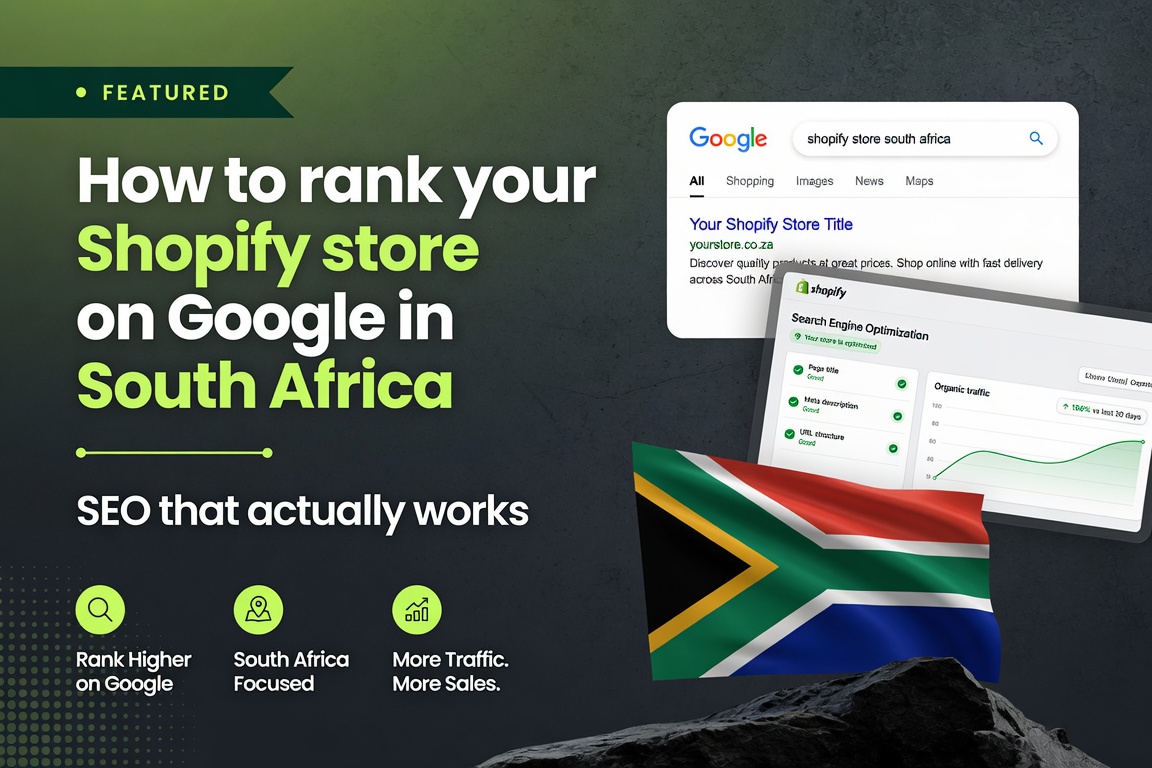
SEO is the traffic that doesn’t stop the moment you stop paying for it. It’s also where most Shopify stores quietly leave money on the table. Here’s how Shopify SEO really works in 2026, the SA-specific angles, and the order to actually do it in.
Google Ads buys you traffic for as long as you keep paying. SEO — getting your store to rank organically — is the opposite: it takes work upfront and time to compound, but once you rank for “buy [your product] south africa,” that traffic keeps arriving for free, month after month. For most SA stores, the smartest play is both: ads for immediate demand, SEO for the long game. We’ve covered Google Ads separately; this is the SEO half.
Shopify is reasonably good at SEO out of the box, but “reasonably good” isn’t “optimised,” and the default settings leave plenty on the table. Here’s how to actually rank, in the order that matters, with the SA-specific bits the international guides skip.
Do Shopify SEO in this order
Each stage builds on the one before. Detail for each step below.
Steps 5 and 6 of this guide are combined in the last stage.
How Shopify SEO actually works
Google ranks pages on roughly three things: relevance (does the page match what someone searched?), authority (do other sites and signals suggest you’re trustworthy?), and experience (is the page fast, mobile-friendly and easy to use?). Shopify SEO is the work of making your product pages, collection pages and content score well on all three for the searches your customers actually make.
The good news: Shopify handles a lot of the technical basics automatically — clean URLs, a sitemap, mobile-responsive themes, SSL, decent site structure. The catch: it does nothing about your keywords, your content, your page titles, or building authority. That’s the work, and it’s where stores win or lose.
Shopify covers the technical basics. Ranking is left to you.
What the platform does out of the box, and the work it does not do.
| Shopify handles automatically | You have to do |
|---|---|
| Clean URLs and a sitemap | Keyword research |
| Mobile-responsive themes | Page titles and meta descriptions |
| SSL | Content |
| Decent site structure | Building authority |
Step 1: Keyword research (rank for what people actually search)
Everything starts here. There’s no point optimising for words nobody searches, or words so competitive you’ll never rank. You want the sweet spot: terms with real search volume, clear buying intent, and achievable competition.
For SA stores, the highest-value keywords usually combine a product with buying intent and often a local qualifier: “buy online south africa,” “ for sale,” “[brand] price.” These convert far better than broad informational searches because the person is ready to buy. Map your important keywords to specific pages: product keywords to product pages, category keywords to collection pages, and informational keywords (“how to choose a ”) to blog content that feeds those pages.
Give every keyword type its own kind of page
One target page per keyword, so pages don’t compete with each other.
| Keyword type | Target page |
|---|---|
| Product (“[brand] price”) | Product page |
| Category | Collection page |
| Informational (“how to choose a ”) | Blog post that links to the product and collection pages |
Step 2: On-page SEO (the foundations on every page)
This is the bread and butter, and it’s where Shopify’s defaults need help. On every important page:
- Page title (title tag): The single biggest on-page signal. Put your main keyword near the front, keep it under ~60 characters, make it compelling. Don’t leave Shopify’s auto-generated titles untouched.
- Meta description: Doesn’t directly affect ranking, but a good one lifts your click-through rate, which does. Write it to sell the click.
- Headings (H1, H2): One clear H1 per page with the keyword; H2s structuring the content. Helps Google understand the page.
- Product descriptions: Write real, unique descriptions — not the manufacturer’s copy that 50 other stores also use. Duplicate descriptions are a ranking killer. (This is exactly where AI can help draft at scale, then you edit.)
- Image SEO: Descriptive file names and alt text. Image search is real traffic, and alt text helps accessibility and ranking.
- URL structure: Clean, keyword-relevant URLs. Shopify’s are decent by default — don’t mangle them.
A tool like the SEO Booster app (or RankMath if you’re on WooCommerce) automates a lot of this hygiene — see our App Stack Recommender for where it fits in a lean stack.
Step 3: Site speed and technical health
Google explicitly uses page experience as a ranking factor, and South African shoppers — many on mobile data — abandon slow stores fast. Speed is both an SEO and a conversion issue. The big levers on Shopify: compress and properly size images (the number-one cause of slow Shopify stores), don’t install fifteen apps that each inject scripts into your storefront, choose a well-built theme, and lazy-load below-the-fold images. We dig into the app side in how many apps your store actually needs — app bloat is a stealth speed killer.
Step 4: Content that ranks and feeds your products
Product and collection pages can only rank for so much. Content — a real blog — is how you rank for the informational searches your buyers make on the way to purchasing, and how you build topical authority that lifts your whole site. A store selling camping gear that publishes genuinely useful guides (“how to choose a tent for the Drakensberg”) earns traffic, trust and internal links to its product pages.
The key is intent-matched, genuinely useful content — not thin keyword-stuffed filler, which Google now actively suppresses. Each post should target a real search, answer it properly, and link naturally to the relevant products. This compounds: every quality post is a permanent door into your store.
Step 5: Structured data and rich results
Structured data (schema markup) is code that tells Google exactly what’s on a page — that this is a product, with this price, this rating, this availability. Get it right and Google can show rich results: star ratings, prices and stock status right in the search listing, which dramatically lifts click-through. Product schema, review schema and FAQ schema are the high-value ones for ecommerce. Many themes and SEO apps add this; it’s worth confirming it’s present and valid.
Step 6: Authority and local signals (the SA angle)
Relevance and technical health get you in the game; authority wins competitive keywords. The main levers:
- Backlinks: Links from other reputable SA sites — suppliers, local press, industry directories, partners — signal trust. Quality over quantity; a few relevant local links beat dozens of spammy ones.
- Google Business Profile: If you have any physical presence, a complete Business Profile helps you appear in local searches and Maps.
- Reviews: Genuine customer reviews build trust signals and, via review schema, can show stars in search results.
- Local relevance: Making it clear you’re an SA store serving SA customers — ZAR pricing, local shipping info, SA contact details — helps you rank for local-intent searches over international competitors.
How long does Shopify SEO take?
Be realistic: SEO is a months-to-results channel, not days. New stores typically see meaningful organic traffic build over 3–6 months of consistent work, with competitive keywords taking longer. This is exactly why the smart approach pairs SEO with ads — ads deliver traffic now while SEO compounds in the background. Anyone promising first-page rankings in two weeks is either targeting keywords nobody searches or not telling the truth.
The mistakes that keep SA stores off page one
- Leaving Shopify’s default page titles and meta untouched. Free wins, ignored.
- Duplicate manufacturer product descriptions. Identical to dozens of competitors — Google has no reason to rank yours.
- Slow store from unoptimised images and app bloat. Hurts ranking and conversion at once.
- No content strategy. Relying on product pages alone caps how much you can rank for.
- Ignoring search intent. Optimising for high-volume informational terms that don’t convert, instead of buying-intent terms.
- Expecting instant results and quitting at month two. SEO compounds; quitting early wastes the foundation you laid.
Frequently asked questions
The bottom line
Shopify gives you a decent SEO starting point, but ranking is won in the work it doesn’t do for you: keyword research focused on buying intent, real on-page optimisation, a fast store, useful content, valid structured data, and authority built over time. It’s a months-not-days channel, which is exactly why it pairs so well with ads — and why starting now beats starting later.
If you’d like your Shopify or WooCommerce store’s SEO foundations built properly — or a content and ranking strategy that compounds — that’s part of what we do. Pair it with a well-run Google Ads account and you’ve got both the short and long game covered.

We have built 400+ online stores for South African businesses since 2014. Read more about Shopify development in South Africa.