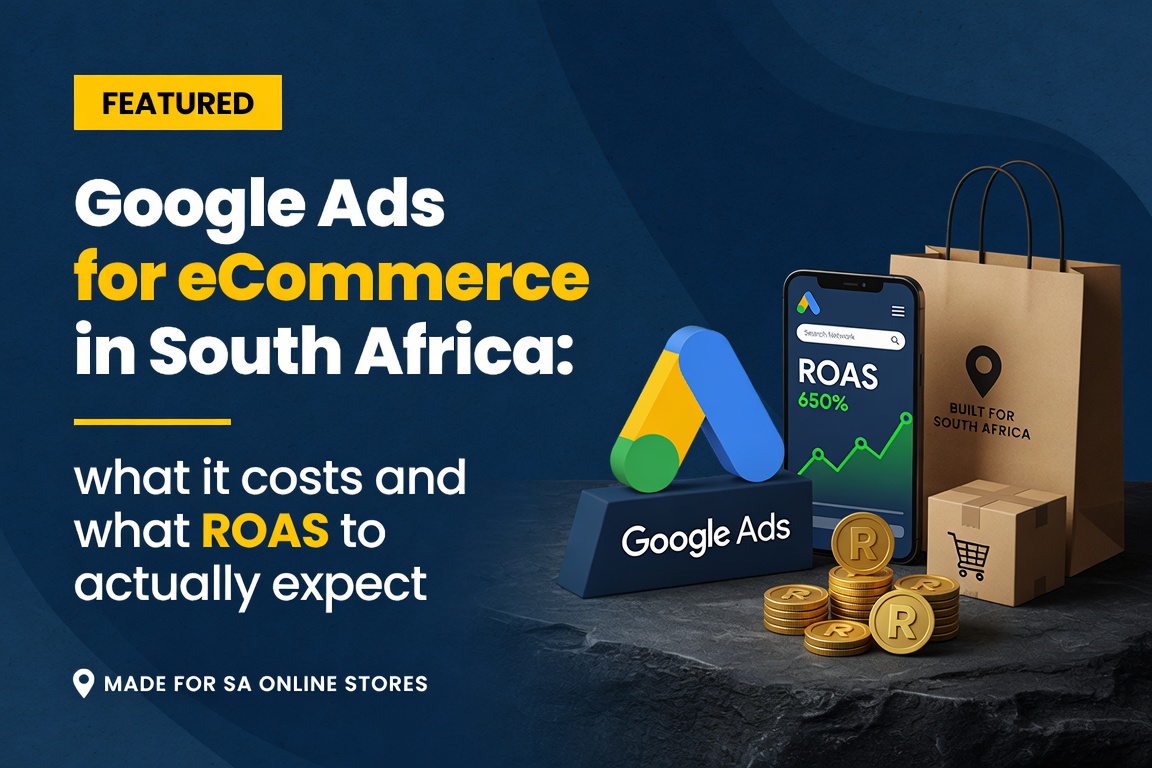

Google Ads for eCommerce in South Africa: what it costs and what ROAS to actually expect
Google Ads can be the fastest way to put your products in front of buyers — or the fastest way to burn a budget with nothing to show for it. Here’s how it really works for SA online stores, what a sensible budget looks like in rands, and the ROAS numbers to expect (not the ones agencies promise).
Every SA store owner eventually arrives at the same question: should I be running Google Ads, and if so, how much will it cost and what will I get back? The honest answer is that Google Ads is one of the highest-intent traffic sources available — people searching “buy [your product]” are ready to spend — but it’s also unforgiving. Money goes out the door in real time, and a poorly set-up account can spend R10,000 and bring back R4,000.
We manage Google Ads for South African ecommerce stores, so this is the realistic version: what the formats are, what to budget, what return to expect, and the mistakes that quietly waste money. No “10x ROAS guaranteed” nonsense.
The Google Ads formats that matter for ecommerce
You don’t need all of Google’s ad types. For an online store, three do most of the work:
- Shopping ads — the product listings with image, price and store name that appear at the top of search results. These are the workhorse of ecommerce because they show your actual product to someone already searching for it. They run off a product feed connected to Google Merchant Center.
- Performance Max (PMax) — Google’s automated campaign type that spreads your product feed across Search, Shopping, YouTube, Gmail and the Display network using machine learning. Powerful once it has data, but it needs a clean feed and conversion tracking to work, and it can waste budget early while it learns.
- Search ads — classic text ads for high-intent keywords (“buy running shoes online south africa”). Useful for capturing specific demand and brand-defence (bidding on your own brand name).
A typical healthy SA ecommerce account runs Shopping/PMax as the engine, a tight Search campaign for high-intent terms, and a remarketing campaign to bring back people who visited but didn’t buy. We cover the full service on our Google Ads for eCommerce page.
What Google Ads actually costs in South Africa
There are two costs, and people conflate them: the ad spend (what you pay Google) and the management fee (what you pay whoever runs it). Keep them separate.
| Cost | Typical SA range | Notes |
|---|---|---|
| Ad spend (to Google) | From ~R5,000/mo to test | Goes directly to Google; you control it |
| Management fee | From ~R6,000/mo | Setup, optimisation, reporting |
| Realistic starting total | ~R11,000+/mo | Spend + management combined |
| Cost per click (CPC) | ~R2–R15+ depending on niche | Competitive niches cost more |
A common mistake is starting with too little spend. Below roughly R5,000/month, Google’s algorithms don’t get enough conversion data to optimise, and you end up paying to gather data without reaching the point where the account becomes efficient. It’s usually better to run a focused campaign on your best products with a real budget than to spread a tiny budget across everything.
What ROAS to actually expect
ROAS — return on ad spend — is revenue divided by ad spend. A ROAS of 4 means R4 of revenue for every R1 spent on ads. Here’s the honest framing that agencies don’t lead with: ROAS is meaningless without your margin.
If your net margin (after product cost, fees, shipping) is 25%, then a ROAS of 4 means ads cost you R1 to generate R4 of revenue, of which R1 is gross margin — you’ve broken even on the ad, before profit. To actually make money, you need a ROAS comfortably above your break-even point. Your break-even ROAS is roughly 1 divided by your margin: a 25% margin needs a break-even ROAS of 4, a 40% margin needs 2.5.
At a 25% margin, the low end of a healthy ROAS loses money
ROAS = revenue ÷ ad spend. Break-even ROAS ≈ 1 ÷ net margin.
New accounts often sit below break-even for the first 1–2 months while campaigns learn.
This is why margin work and ad work go together. The healthier your margin, the lower the ROAS you can profitably tolerate, which means you can bid more aggressively and win more traffic. Thin-margin stores can barely afford to advertise. Run your real margin first — our Profit Margin Calculator shows your break-even point, and what you keep on a R500 sale explains why.
The foundations you need before spending a cent
Most wasted ad budget isn’t wasted in the ad account — it’s wasted because the foundations underneath weren’t there. Before you run ads, you need:
- Conversion tracking that works. If Google can’t see which clicks turned into sales (and their value), it can’t optimise and you can’t measure ROAS. This is the single most common failure. Get Google Tag / GA4 ecommerce tracking verified before spending.
- A clean product feed in Merchant Center. Shopping and PMax run off this. Bad titles, missing attributes or disapproved products throttle everything.
- Landing pages that convert. Sending paid traffic to a slow or confusing page is paying for visitors you then lose. The ad gets the click; the page has to close it.
- Remarketing in place. Most first-time visitors don’t buy. Remarketing is usually the most efficient spend in the whole account.
Foundations first, budget last
What needs to work before the first rand goes to Google.
If your store’s checkout and product pages don’t convert, ads amplify the leak rather than fix it. That’s why we look at the store before the ad account.
The mistakes that waste SA ad budgets
- No conversion tracking, or broken tracking. You’re flying blind and Google can’t optimise. Fix this first, always.
- Starting too small. A budget too thin to gather conversion data never reaches efficiency.
- Judging too early. New campaigns have a learning period. Killing them in week one wastes the data you paid for.
- Chasing ROAS while ignoring margin. A “great” 5x ROAS can still lose money on a thin-margin product. Always tie ROAS to break-even.
- Set-and-forget. Accounts drift — search terms change, products sell out, competitors shift. Unmanaged accounts decay.
- Not bidding on your own brand. Competitors bid on your brand name; if you don’t defend it, you pay in lost sales.
Should you DIY or get help?
You can learn Google Ads yourself, and for a small, simple account it’s doable. But the learning curve is real and you’re learning with live money. The maths is simple: if professional management costs R6,000/month but lifts your ROAS from 2 to 4 on R20,000 of spend, that’s an extra R40,000 of revenue — the management pays for itself many times over. The question isn’t “can I afford management,” it’s “can I afford to run inefficiently while I learn.”
Doubling ROAS on R20,000 of spend adds R40,000 in revenue
Monthly revenue from R20,000 ad spend. Management fee: R6,000/month.
Revenue, not profit. Judge the gain against your break-even ROAS above.
We manage Google Ads for SA ecommerce stores from R6,000/month, including setup, conversion tracking, feed optimisation, ongoing management and real reporting. Details on the Google Ads service page.
Frequently asked questions
The bottom line
Google Ads is a powerful, high-intent channel for SA ecommerce — but it rewards preparation and punishes guesswork. Get conversion tracking, a clean feed and converting pages in place first, budget enough to gather real data (ad spend plus management, realistically R11,000+/month to start), and judge results against your break-even ROAS, not a vanity multiple. Do that and ads become a reliable growth engine. Skip it and they become an expensive lesson.
If you’d like ads set up and managed properly — tracking, feed, campaigns and reporting — that’s our Google Ads service, from R6,000/month. And before you spend, run your margin through the Profit Margin Calculator so you know the ROAS you actually need to hit.

We have built 400+ online stores for South African businesses since 2014. Read more about eCommerce development in South Africa.