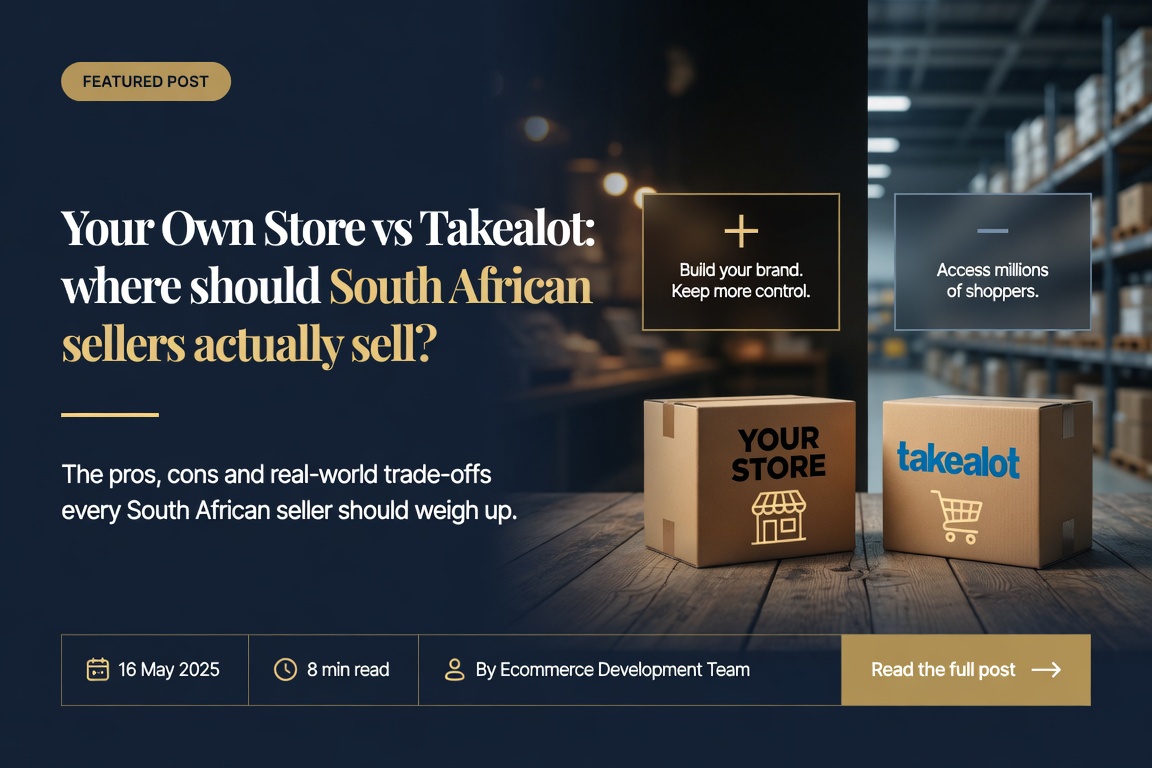

Your own store vs Takealot: where should South African sellers actually sell?
Takealot gives you instant access to millions of shoppers — and takes a cut of every sale, owns the customer, and can change the rules anytime. Your own store is the opposite. Here’s the honest trade-off, the real numbers, and why the smart answer is usually “both, in the right order.”
It’s the question almost every SA seller faces: should I sell on Takealot, build my own online store, or both? Takealot is South Africa’s largest marketplace with a massive built-in audience, and the pull is obvious — list your products and tap millions of existing shoppers immediately. But that reach comes at a real cost, and “just sell on Takealot” is advice that’s cost plenty of businesses their margin and their customer relationships.
This is the honest comparison: what each model gives you, what it takes, the actual fees, and how to think about the decision. Spoiler: it’s rarely either/or — but the order and emphasis matter enormously.
The fundamental trade-off
Strip away the detail and it comes down to one thing: reach vs ownership.
A marketplace like Takealot rents you reach. You get instant access to a huge audience you could never build alone, but you don’t own the relationship — the customer is Takealot’s, not yours. You can’t email them, you compete on a crowded listing page against identical products, you pay a commission on every sale, and you play by rules Takealot sets and can change. You’re a tenant in someone else’s mall.
Your own store is ownership. You build the audience yourself (slower, harder), but you own the customer relationship, the data, the brand experience, and your margin. No commission per sale, no competing on a shared listing, no platform that can change your terms overnight. You’re not renting reach — you’re building an asset.
Takealot rents you reach. Your own store builds an asset.
The trade-off, line by line.
| Takealot | Your own store | |
|---|---|---|
| Audience | Instant, built in | You build it (slower) |
| Customer | Takealot’s; you can’t email them | Yours, with the data |
| Cost per sale | Commission on every sale, plus fees | No commission |
| Listing | Shared page, identical products | Your brand experience |
| Rules | Set by Takealot, can change | Set by you |
What Takealot actually costs
The reach isn’t free, and the fees stack up in a way that surprises sellers:
| Fee | Roughly | Notes |
|---|---|---|
| Success / commission fee | ~5–18% by category | Taken on every sale, VAT-inclusive price |
| Monthly account fee | ~R400/mo | Fixed, regardless of sales |
| Fulfilment / logistics | Per-order + weight-based | If using Takealot’s warehousing (FBT) |
| Storage fees | Per volume/day | For inventory held at Takealot |
| Optional ads | Variable | To stand out in crowded listings |
Add it up and Takealot’s total take on a sale can comfortably reach the high teens to twenties of percent once commission, fulfilment and storage combine — before your own product cost. The trap, which catches resellers especially, is pricing to be competitive on Takealot and discovering the fees exceed your margin, so you’re selling at a loss. Whatever you list there, model the full fee stack against your margin first — our Profit Margin Calculator and what you keep on a R500 sale show how fast a 15–20% platform cut erases thin margins.
On a R500 sale, Takealot can keep R75–R100
Rand taken per R500 sale (VAT-inclusive price). Success fee 5–18% by category; full platform cut 15–20%.
Full cut = commission, fulfilment and storage combined. The ~R400 monthly account fee comes on top. Your product cost is not included.
The hidden cost: you don’t own the customer
The fees are visible; the bigger cost often isn’t. On Takealot, the customer belongs to Takealot. You can’t build an email list from them, can’t run a welcome or win-back flow, can’t build brand loyalty, can’t cross-sell directly. Every sale is a transaction, not a relationship. On your own store, that same customer becomes someone you can email, re-market to, and turn into a repeat buyer at near-zero cost — which, as our email marketing guide shows, is where the real long-term profit in ecommerce lives. A Takealot sale ends at the sale; an owned-store sale is the start of a customer.
Where each one wins
Takealot is strong when:
- You’re starting out and want sales now, before you’ve built any audience.
- Your products have healthy enough margins to absorb the fees and still profit.
- You’re testing demand for a product without committing to building a store.
- You sell commodity/known products people search for directly on Takealot.
- You value the logistics convenience of Takealot handling fulfilment.
Your own store is strong when:
- You’re building a brand, not just shifting units.
- Your margins are thin and a 15–20% platform cut would hurt.
- You want to own the customer relationship and sell to them repeatedly.
- You have (or can build) your own traffic via SEO, ads, social or an existing audience.
- You want control over pricing, presentation and the customer experience.
The smart answer: both, in the right order
For most SA sellers it isn’t either/or — it’s both, used for what each does best. The marketplace gives you reach and immediate sales; your own store builds the brand, owns the customer and protects your margin. The strategic question is emphasis and sequence.
A sensible pattern: use Takealot for reach, discovery and immediate volume, while building your own store as the long-term home of your brand — and actively work to convert marketplace customers into owned-store, repeat customers (a flyer in the box, a better direct price, a loyalty reason to buy from you next time). Lean on Takealot early when you have no audience; shift weight to your own store as you build one. The mistake is treating Takealot as the destination rather than a channel — building your entire business on a platform you don’t control, with no owned asset of your own, leaves you exposed to every fee hike and rule change they make.
Both channels, weighted over time
Lean on Takealot early, shift to your own store as you grow.
Frequently asked questions
The bottom line
Takealot and your own store aren’t really competitors — they’re tools for different jobs. The marketplace rents you reach and immediate sales but takes a significant cut and owns your customer. Your own store is slower to build but keeps your margin, your data and your brand, and turns customers into an asset you own. For most SA sellers the answer is both, weighted toward the marketplace early and toward your own store as you grow — with the cardinal rule being never to build your whole business on a platform you don’t control.
If you’re selling on Takealot and want to build the owned-store side — the brand home that protects your margin and lets you actually keep your customers — that’s exactly what we build. Tell us what you sell and we’ll help you create the asset Takealot never will.

We have built 400+ online stores for South African businesses since 2014. Read more about eCommerce development in South Africa.