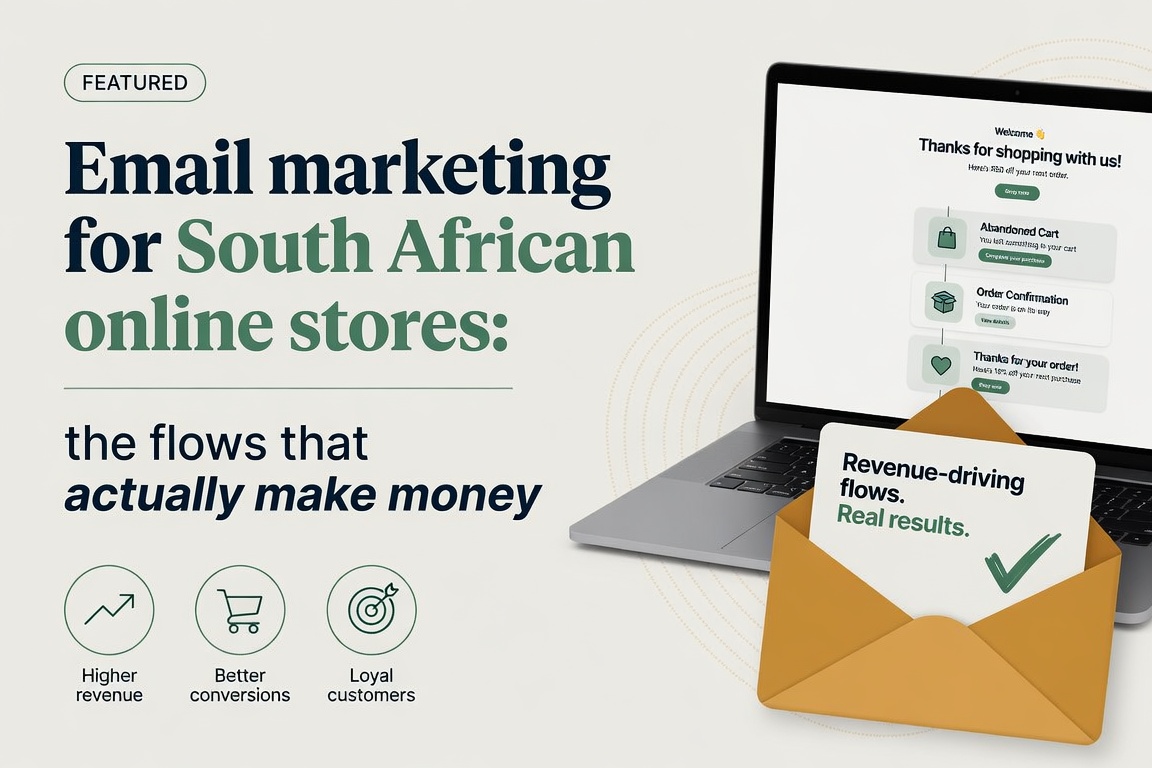

Email marketing for South African online stores: the flows that actually make money
Email is the highest-ROI channel in ecommerce — you own the list, it costs almost nothing, and a handful of automated flows quietly generate sales while you sleep. Here’s how to do email properly for an SA store, which platform to use, and the automations worth setting up first.
Of all the marketing channels, email is the one most SA store owners under-use and most regret ignoring. Unlike ads, you don’t pay per click. Unlike social, you own the audience — no algorithm decides who sees you. And unlike SEO, you can switch it on and see returns this month. Email consistently delivers the highest return on investment of any ecommerce channel, and the best part is that most of the money comes from automations you set up once and leave running.
The catch is that “doing email” isn’t blasting a newsletter when you remember to. The real value is in a few well-built automated flows triggered by what customers do. This guide covers the platform choice for SA stores, the flows that make money in priority order, and the local considerations.
Build your email channel in this order
Each step below gets its own section.
1. Own the list
foundation
Sign-up offer, pop-up, email first in checkout, post-purchase opt-in.
2. Five flows
set up once
Automations that earn every month without more work.
3. Regular sends
keep it warm
Launches, promotions, useful content, seasonal pushes.
4. Segments
right message
New vs returning, spend, category, engagement.
First: own your list
Everything starts with building a list you own. Every visitor who leaves without buying and without joining your list is gone for good — you can’t reach them again for free. So capturing emails is the foundation: a sign-up offer (a first-order discount or genuinely useful content), a well-timed pop-up, capturing the email early in checkout, and a post-purchase opt-in. A modest welcome incentive pays for itself many times over because every subscriber is someone you can sell to repeatedly at near-zero cost. Build the list now, even before the flows are perfect.
Which email platform for an SA store?
The two that matter for most SA stores:
| MailerLite | Klaviyo | |
|---|---|---|
| Best for | Most small/mid SA stores | Scaling, data-driven stores |
| Strength | Simple, affordable, generous free tier | Deep segmentation & ecommerce automation |
| Learning curve | Gentle | Steeper |
| Cost | Lower, scales gently | Higher, scales with contacts |
MailerLite is the sensible starting point for most SA stores — affordable, genuinely easy to use, a generous free tier to start, and all the automation features a growing store needs. Klaviyo is the power tool: deeper segmentation, richer ecommerce-specific automation and analytics, at a higher price that scales with your list. The honest advice: start with MailerLite unless you already know you need Klaviyo’s advanced segmentation, and switch later if you outgrow it. Don’t pay for Klaviyo’s power before you’re using MailerLite’s. You’ll find both in our recommended resources and the App Stack Recommender.
The flows that make money (in priority order)
If you set up nothing else, set up these automated flows. They run on autopilot and generate the bulk of email revenue:
- 1. Abandoned cart flow. The highest-return automation in ecommerce. When someone reaches checkout but doesn’t buy, a short series of reminders brings a meaningful share of them back. We’ve covered this in depth in the abandoned cart recovery playbook — if you do one flow, do this.
- 2. Welcome series. When someone joins your list, a sequence of 2–3 emails introduces your brand, delivers any promised discount, and gently steers them to a first purchase. New subscribers are at their most interested the moment they sign up — capitalise on it immediately rather than waiting for the next newsletter.
- 3. Post-purchase flow. After someone buys: a thank-you, order/shipping updates, then a follow-up asking for a review and suggesting complementary products. This turns one-time buyers into repeat customers — far cheaper than acquiring new ones — and generates the reviews that build trust and SEO.
- 4. Win-back flow. For customers who bought once but have gone quiet, an automated “we miss you” sequence (often with an incentive) revives a share of lapsed customers at almost no cost.
- 5. Browse abandonment. For subscribers who viewed products but didn’t add to cart — a gentle nudge about what they looked at. Lower priority but easy once the others are running.
Build the five flows in this order
Priority order, left to right, with the customer action that triggers each flow.
Cart = abandoned cart flow (highest return). After sale = post-purchase flow. Browse = browse abandonment.
These five flows are the engine. They’re set up once and then earn continuously, which is what makes email’s ROI so high — the work is front-loaded and the returns are ongoing.
Then: the regular sends
On top of the automated flows, regular campaigns keep your list warm and drive spikes: new-product announcements, promotions and sales, genuinely useful content, and seasonal pushes (Black Friday email is huge — see our Black Friday readiness guide). The principle that separates stores that get unsubscribed from ones that get bought from: provide value, don’t just sell. A list that hears from you only when you want money tunes out; one that gets useful, relevant content stays engaged and buys when you do promote.
Segmentation: send the right thing to the right people
Blasting every email to your whole list is the fastest way to train people to ignore you. Even basic segmentation — new vs returning customers, big spenders vs bargain hunters, by past purchase category, by engagement level — lets you send relevant messages that convert far better. You don’t need Klaviyo-level sophistication to start; even simple segments dramatically outperform one-size-fits-all blasts. This is where email earns its ROI reputation.
The South African considerations
- POPIA compliance. South Africa’s data protection law means you need proper consent to email people, a clear unsubscribe option, and responsible handling of personal data. Build your list with genuine opt-in — bought lists are both illegal-risky and useless.
- Local timing. Send when SA inboxes are active (SAST), not on a US schedule that lands overnight.
- WhatsApp as a complement. Given WhatsApp’s dominance here, an opt-in WhatsApp channel can complement email for time-sensitive nudges — but email remains the workhorse you own.
- ZAR and local relevance. Prices in rands, local shipping and returns info, SA-relevant offers — basics, but they matter for trust.
Frequently asked questions
The bottom line
Email is the highest-ROI channel in ecommerce and the one most SA stores neglect. Own your list, pick the right platform (MailerLite for most, Klaviyo when you scale), and set up the five money-making flows — abandoned cart, welcome, post-purchase, win-back, browse abandonment — that earn continuously once built. Layer regular value-led campaigns and basic segmentation on top, stay POPIA-compliant, and you’ve got a channel that generates sales month after month without ongoing ad spend.
If you’d like your email set up properly — platform, list-building, and the automated flows that actually make money — on your Shopify or WooCommerce store, that’s exactly the kind of thing we help SA stores get right. It’s usually the best-ROI marketing work there is.

We have built 400+ online stores for South African businesses since 2014. Read more about eCommerce development in South Africa.