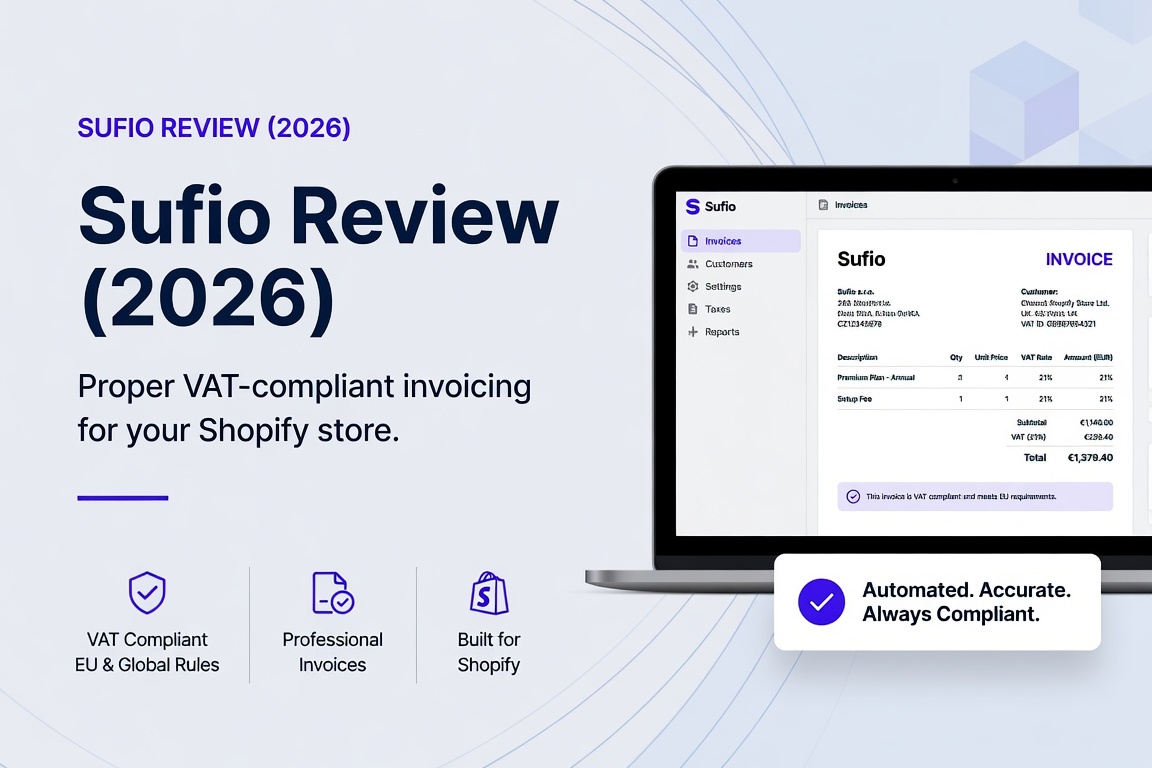

Sufio review (2026): proper VAT-compliant invoicing for your Shopify store
Shopify’s built-in order documents aren’t real invoices — and once you’re VAT-registered or selling B2B in South Africa, that becomes a problem. Sufio automates professional, compliant invoices. Here’s an honest review of what it does, what it costs, and who actually needs it.
Invoicing is one of those things that doesn’t matter at all — until it suddenly does. When you’re a small store taking card payments, Shopify’s order confirmation is fine. But the moment you register for VAT, start selling to businesses who need a proper tax invoice, or simply want documents that look professional and meet South African requirements, you discover Shopify’s native order documents fall short. They’re not compliant tax invoices, they lack proper sequential numbering, and they can’t issue credit notes correctly.
Sufio is the most established app for solving this, and a long-standing recommendation of ours. This review covers what it does, the SA VAT angle specifically, where it shines, the limitations, current pricing, and who genuinely needs it versus who can wait.
Why Shopify’s built-in documents aren’t enough
A compliant VAT invoice in South Africa has specific requirements: your business and VAT numbers, the customer’s details (especially for B2B), a unique sequential invoice number, the issue date, itemised goods with applicable VAT, and the total. Shopify’s order confirmations and basic documents don’t reliably meet this. The gaps that bite SA stores:
- Not legally-compliant tax invoices — fine as receipts, but not what a VAT-registered business or a B2B customer needs.
- No independent sequential numbering — a legal requirement in many jurisdictions, and something tax authorities expect.
- No proper credit notes — when you refund or return, you need a compliant credit note, which Shopify doesn’t generate correctly.
- Limited branding and format control — they look like order confirmations, not professional invoices.
What Sufio does
Sufio automatically creates and sends professional, compliant invoices, credit notes, receipts and reminders for every order. Its core strengths:
- Compliant documents — invoices validated to meet legal requirements in 50+ countries, with the proper fields, sequential numbering and tax handling.
- Automatic VAT/tax handling — applies the correct tax treatment and displays VAT properly on documents.
- B2B VAT validation — captures and validates business customers’ VAT numbers and can set them tax-exempt where applicable, which ties directly into selling B2B and wholesale on Shopify.
- Automation — invoices generate and send themselves on the triggers you set; no manual document creation.
- Brandable templates — add your logo, colours and fonts so documents look like your business, not a generic receipt.
- Bulk and long-term storage — print or download thousands of PDFs at once, with secure multi-year document storage for compliance even if you delete old orders.
- Native Shopify B2B integration — officially recommended by Shopify for B2B, supporting payment terms, PO numbers and automatic tax exemptions.
Where Shopify’s documents stop and Sufio starts
What a VAT-registered or B2B store needs from its invoices.
| Requirement | Shopify native | Sufio |
|---|---|---|
| Compliant tax invoice | No, works as a receipt | Yes, validated for 50+ countries |
| Independent sequential numbering | No | Yes |
| Credit notes for refunds | Not generated correctly | Yes (Professional plan) |
| B2B VAT number validation | No | Yes (Professional plan) |
| Branding | Looks like an order confirmation | Your logo, colours and fonts |
What it does well
- Compliance done properly. This is the whole point, and Sufio handles it thoroughly — sequential numbering, credit notes, multi-region tax rules, the lot. Its documents are validated by certified accountants.
- Genuine automation. Set it up once and invoices flow automatically. For a VAT-registered store this removes a real admin burden.
- Professional output. The documents look polished and on-brand, which matters for B2B credibility.
- Strong B2B support. VAT-number validation and tax exemptions make it a natural fit for wholesale and trade selling.
- High ratings. It’s consistently well-reviewed (around 4.9 across hundreds of reviews) and long-established.
Where it falls short
- Pricing jumps between tiers. The plans step up in invoice volume, and the jumps can feel steep — a growing store can outgrow a tier and face a noticeable cost increase.
- Advanced features sit on higher plans. Credit notes from refunds, multi-language/currency, VAT number validation and custom document numbering are on the upper tiers, so the genuinely important compliance features may push you past the entry plan.
- Occasional VAT-with-discount edge cases. Some users have reported VAT calculation quirks in specific discount scenarios that needed manual checking — worth verifying your particular setup during the trial.
- It’s specialised. If you just want a prettier packing slip and aren’t VAT-registered or selling B2B, Sufio may be more (and more expensive) than you need.
Sufio pricing in 2026
| Plan | From | Roughly includes |
|---|---|---|
| Starter | ~$7/mo | 15 invoices/mo, auto-create & send, compliant docs |
| Growth | ~$19/mo | 50 invoices/mo, pro forma, reminders, EU B2B tax exemptions |
| Professional | ~$49/mo | 5,000 invoices/mo, credit notes, multi-currency, VAT validation, custom numbering |
Pricing and tier features change — check the Shopify App Store listing for current rates. As a USD-billed app, factor the exchange rate into your rand budget. A 14-day free trial is available, which is the right way to confirm the VAT handling works for your exact setup before committing.
Each plan costs more than double the one below
Monthly price, USD, approximate. Monthly invoice allowance in brackets.
Starter to Growth is +$12 a month; Growth to Professional is +$30. Credit notes, VAT number validation and custom numbering are on Professional.
Per invoice, the top plan is the cheapest
Plan price divided by its monthly invoice allowance, USD, assuming you use the full allowance. Lower is better.
Our arithmetic from the plan table above. The low per-invoice cost only applies if you actually send that volume.
Who needs Sufio (and who doesn’t)
- You need it if: you’re VAT-registered (or about to cross the R1m threshold), you sell B2B and customers need proper tax invoices, you want compliant credit notes for refunds, or you simply need professional, automated invoicing without manual work.
- You can probably wait if: you’re a small, non-VAT-registered B2C store where Shopify’s order confirmation suffices and a basic order-printer app would cover any packing-slip needs more cheaply.
The trigger point for most SA stores is VAT registration or starting B2B sales — that’s when compliant invoicing stops being optional. If you’re approaching either, read our guide to starting a store in SA for the VAT context, and you’ll find Sufio in our recommended resources.
Frequently asked questions
The verdict
Sufio does one thing and does it thoroughly: proper, automated, compliant invoicing that Shopify can’t manage on its own. For VAT-registered and B2B-selling SA stores it removes a genuine compliance headache and a chunk of admin, with professional documents and strong Shopify B2B integration. Its downsides — tier pricing jumps and key features on higher plans — are worth weighing, and the free trial is the way to confirm the VAT handling fits your exact setup. If you’re VAT-registered or selling to businesses, it’s the category leader and a sound choice.
If you’d like compliant invoicing set up correctly on your store — Sufio configured for SA VAT, your branding and B2B exemptions — that’s part of what we do, especially on B2B and wholesale builds.

We have built 400+ online stores for South African businesses since 2014. Read more about Shopify development in South Africa.