
How to write product descriptions that actually sell (and where AI fits)
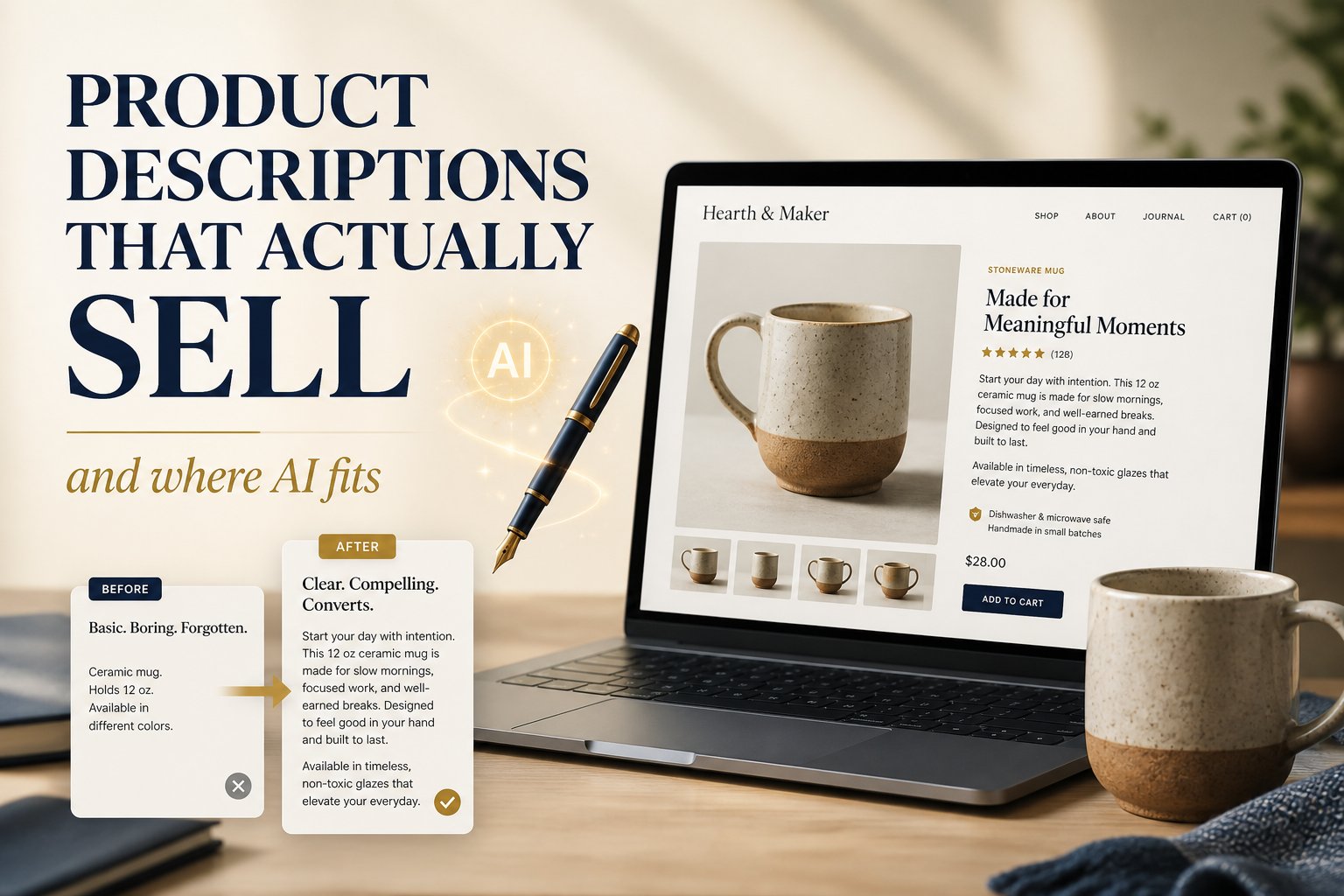
Your product description is your silent salesperson — it’s what closes the sale when no one’s there to answer questions. Most are dull, duplicated from the manufacturer, and quietly costing sales. Here’s how to write descriptions that convert, and how to use AI to do it at scale without sounding like a robot.
A product description does two jobs: it persuades a human to buy, and it helps Google rank the page. Most store descriptions do neither well. They’re either a bare spec list, or — worse — the exact manufacturer copy that fifty other stores also use, which both fails to persuade and actively hurts your SEO because Google has no reason to favour duplicate content. Either way, you’re leaving sales on the table on the very page where the buying decision happens.
Good descriptions are a learnable craft, and AI has made writing them at scale realistic for the first time. This guide covers what makes a description convert, the structure that works, the SA-specific touches, and exactly where AI helps (and where it shouldn’t). It connects to our Shopify SEO guide and AI for eCommerce guide.
Why most product descriptions fail
- They list features, not benefits. “2000mAh battery” means nothing to most buyers. “Lasts a full day on one charge” means something. Features tell; benefits sell.
- They’re copied from the manufacturer. Identical to dozens of competitors, so they don’t differentiate you and don’t rank.
- They don’t address objections. The customer has questions — will it fit, how long does it last, what if it breaks — and a good description answers them before they’re asked.
- They’re written for the seller, not the buyer. Full of internal jargon and brand-speak instead of the words customers actually use.
- They ignore SEO. No thought to the terms people search, so the page never surfaces.
Features tell, benefits sell
The examples from this guide, rewritten for the buyer.
| Seller wording | What the buyer reads |
|---|---|
| 2000mAh battery | Lasts a full day on one charge |
| Waterproof to 50m | Swim, shower and surf without a second thought |
| Mid-layer knit | Jersey (the word customers actually use) |
The anatomy of a description that sells
A strong product description generally has these elements:
- A compelling opening line that captures the core appeal — the single best reason to want this product, up front.
- Benefits framed around the customer — translate each key feature into what it does for them. “Waterproof to 50m” becomes “swim, shower and surf without a second thought.”
- The specifics that matter — size, materials, dimensions, what’s in the box. Buyers need facts to commit, and missing details cause abandoned carts and returns.
- Objection handling — pre-empt the hesitations (fit, durability, compatibility, care) right in the copy.
- Sensory and emotional language where it fits — help the customer imagine owning and using it.
- A light nudge to act — reinforce the value, hint at scarcity or popularity honestly.
- Scannable formatting — a short paragraph plus bullet points for specs, because people skim. A wall of text doesn’t get read.
The order a selling description follows
Top to bottom. Short paragraph first, specs in scannable bullets.
Write for the customer’s language
The single biggest improvement most stores can make: write in the words your customers use, not your internal jargon. If customers call it a “jersey” and you call it a “mid-layer knit,” you lose both the connection and the search traffic. Read your reviews, your customer emails, your search analytics (a good search app shows you exactly what people type) — that’s the vocabulary to write in. It makes copy resonate and aligns naturally with what people search on Google.
The SEO layer
Descriptions are prime SEO real estate, so weave keywords in naturally: the product’s main search term in the opening and a heading, related terms through the body, and a unique meta description for the listing. The key word is naturally — keyword-stuffed copy reads badly and Google now suppresses it. Write for the human first, then make sure the obvious search terms are present. Unique descriptions also simply rank better than duplicated manufacturer copy, which is reason enough to rewrite them. More in our Shopify SEO guide.
The SA touches
- Local context. Reference SA-relevant uses, seasons (our summer is December, not June), and conditions where it helps the customer picture it.
- Clear pricing and VAT. Be clear whether prices include VAT, and show ZAR.
- Shipping and returns reassurance. A line about delivery and your returns policy near the buy button eases the cautious SA shopper (returns rights matter under the CPA).
- Local sizing/units. SA sizing, metric units — don’t make customers convert.
Where AI fits (and where it doesn’t)
Writing unique descriptions for a large catalogue used to be a brutal time sink, which is exactly why so many stores fell back on manufacturer copy. AI changes that — it’s the single highest-value AI use for ecommerce. Used well:
- AI drafts, you direct and edit. Give it the product facts, your brand tone, and the benefit angles, and it produces a solid first draft in seconds. You then edit for accuracy, voice and the human touch. This turns weeks of copywriting into days.
- It’s brilliant for scale. Hundreds or thousands of products become feasible to describe uniquely — killing the duplicate-content problem at a stroke.
- It needs a human. Unedited AI copy can be generic, occasionally inaccurate, and same-y across products. AI gets you ~80% there fast; the human makes it correct, on-brand and genuinely persuasive. Never publish blind.
- Feed it real customer language. The better your prompt (real benefits, customer vocabulary, tone), the better the output. Garbage in, garbage out.
AI drafts, a human finishes
The workflow that turns weeks of copywriting into days.
Never publish unedited AI copy.
We’ve used this approach to write large catalogues of unique descriptions in a fraction of the usual time — AI for the heavy lifting, human editing for the quality. See the AI for eCommerce guide for the wider picture.
Frequently asked questions
The bottom line
Your product descriptions are where browsing turns into buying, and most stores treat them as an afterthought — dull, duplicated, feature-listing copy that neither persuades nor ranks. Writing benefit-led, objection-handling, customer-language descriptions that are unique to your store lifts both conversion and SEO. And AI finally makes doing this across a big catalogue realistic: draft fast with AI, edit for quality and voice, and you’ve turned your weakest pages into silent salespeople.
If you’d like help rewriting your catalogue — whether a hands-on copy project or an AI-assisted approach to do it at scale — that’s exactly the kind of thing we do. See the AI for eCommerce guide for how we put AI to work on it.

We have built 400+ online stores for South African businesses since 2014. Read more about Shopify development in South Africa.