
The true cost of running an online store in South Africa (the full breakdown)
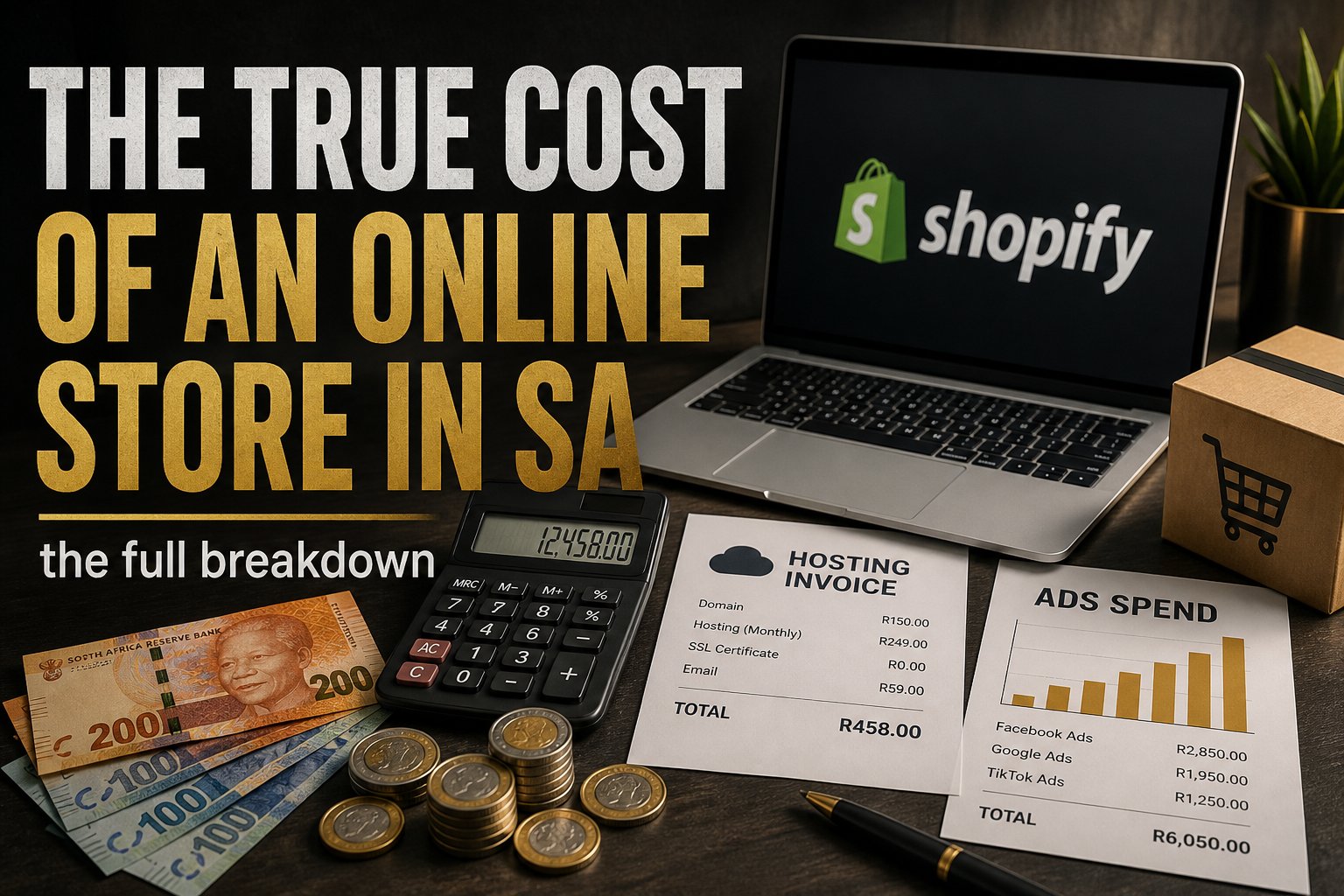
Most people budget for building a store and forget what it costs to keep one running. Platform fees, payment charges, apps, shipping, marketing — it adds up in ways that quietly eat your margin. Here’s the honest, line-by-line annual cost of an SA online store.
When people plan an online store, they fixate on the build cost — the once-off to get it live. But the build is the cheap part. The real question, the one that decides whether your store is a business or an expensive hobby, is what it costs to run month after month. And those running costs are where a lot of SA stores quietly lose money, because they’re scattered across a dozen line items that never get added up in one place.
So let’s add them up. This is the honest, full breakdown of what an SA online store actually costs to run — the obvious costs, the sneaky ones, and the per-sale charges that erode your margin on every order. We build and run stores for SA businesses, so these are real numbers, not theory. (To see how these costs hit a single order, pair this with what you actually keep on a R500 sale and the Profit Margin Calculator.)
The four cost categories
Store costs fall into four buckets, and confusing them is how budgets go wrong:
- Once-off (build): getting the store designed and launched.
- Fixed monthly: platform, apps, hosting — you pay these whether you sell anything or not.
- Per-sale (variable): payment fees, transaction fees, shipping — scale with your sales.
- Marketing: the cost of getting traffic — often the biggest line of all.
1. The once-off build cost
Covered in depth in our guide to starting a store, but in summary: DIY runs R0–R8,000; a professionally built Startup Shopify store starts from around R20,000 excl VAT; Pro/custom builds run R30,000–R80,000+. This is once-off — important, but not what determines your ongoing profitability. Don’t let it dominate your thinking at the expense of the running costs below.
2. Fixed monthly costs
These land every month regardless of sales — the baseline you must cover before you make a cent of profit:
| Cost | Typical (ZAR/mo) | Notes |
|---|---|---|
| Platform | ~R550–R5,600 | Shopify Basic→Advanced; or WooCommerce hosting from ~R400 |
| Apps | ~R300–R2,000 | Email, reviews, search, upsell — varies with stack |
| Domain | ~R20–R50 | Annual fee, amortised |
| Email hosting | ~R50–R150 | Professional address (you@yourstore.co.za) |
| Theme/maintenance | Variable | Theme once-off; support as needed (~R600/hr) |
Your platform plan sets most of the fixed bill
Typical monthly range per line item, rand.
Platform range is Shopify Basic to Advanced; WooCommerce hosting starts from about R400. Theme and maintenance omitted (variable, support about R600/hr). Source: table above.
The two levers here: your platform plan and your app stack. App bloat is the silent killer — it’s easy to drift to R2,000+/month in overlapping subscriptions. Keep it lean (see how many apps you actually need). All-in figure for a small Shopify store: budget roughly R1,500–R2,500/month fixed.
3. Per-sale costs (the margin eaters)
These scale with every order, and they’re where margin quietly disappears because they don’t show up as a monthly bill — they’re skimmed off each sale:
- Payment gateway fee: ~2–3.5% + a per-transaction fee, depending on gateway and method (see the Payment Gateway Comparator).
- Shopify third-party transaction fee: 0.6–2% on top, because Shopify Payments isn’t available in SA (see the Shopify payments guide). Stack this with the gateway and you’re often over 5% per sale on Basic.
- Shipping: whatever you absorb vs charge the customer — a major variable (see the shipping guide).
- Transaction-based app fees: some apps (certain upsell or BNPL tools) take a small cut of the sales they generate.
- Product cost: the big one — what you paid for the goods.
Add these up and on a typical order, payment + platform fees alone can take 5%+ before product cost and shipping. That’s why margin modelling matters: a 30% “markup” can shrink to a thin net margin once every per-sale cost is counted.
Fees take 2.6% to 5.5% of every sale
Percentage of order value on a Shopify store in SA, before per-transaction rand fees, product cost and shipping.
On a R500 order that is R13.00 to R27.50. Higher Shopify plans pay a lower third-party fee. Ranges from the list above.
4. Marketing (usually the biggest line)
The cost everyone underestimates. A store nobody visits sells nothing, so traffic is a running cost, not optional. Depending on your approach:
- Google/Meta ads: realistically from ~R5,000/month ad spend to gather data and convert, plus management if outsourced (from ~R6,000/month) — see the Google Ads guide.
- SEO: “free” traffic, but it costs time or money to build — content, optimisation (see Shopify SEO).
- Email: the cheapest channel by ROI — mostly the cost of your email tool (see email marketing).
- Content/social: time, or the cost of someone creating it.
For a store actively trying to grow, marketing is frequently the single largest monthly cost — often exceeding platform, apps and fees combined. Budget for it honestly from day one; the “build it and they will come” assumption is the most expensive mistake in ecommerce.
A realistic annual picture
Marketing outweighs everything else in year one
Annual cost, rand. Per-sale fees, product cost and shipping not included: they scale with revenue.
Marketing at R10,000/month for active ads plus management. Fixed costs R18,000–R30,000/year. Startup Shopify build from about R20,000 excl VAT.
How to keep costs under control
- Right-size your platform plan. On Shopify, upgrading plans lowers the third-party transaction fee — once your volume justifies it, the higher plan can be cheaper net. Model it.
- Keep the app stack lean. Audit subscriptions regularly; cancel overlap and anything not earning its keep.
- Protect your margin. Price with every per-sale cost included, not just product markup.
- Use the cheapest effective marketing first. Email and SEO compound cheaply; lean on them alongside paid ads rather than relying on ads alone.
- Watch shipping. Use an aggregator for live rates and a free-shipping threshold that protects margin.
Frequently asked questions
The bottom line
The build cost gets the attention, but it’s the running costs that determine whether your store makes money. Fixed monthly costs (platform, apps) form the baseline; per-sale fees quietly skim every order; and marketing — often the biggest line — is the non-optional cost of getting anyone to visit. Add them honestly, price your products to cover all of it, keep the controllable costs (apps, plan, shipping) lean, and you’ve got a business. Ignore them and you’ve got a store that’s busy but not profitable.
If you’d like help building a store that’s efficient to run — the right plan, a lean stack, margin-aware setup — or working out the real numbers for your situation, that’s exactly what we do. Run your figures through the Profit Margin Calculator first, then let’s talk.

We have built 400+ online stores for South African businesses since 2014. Read more about eCommerce development in South Africa.