We have built more than 400 stores since 2014, and run over 100 WooCommerce-to-Shopify migrations. The same nineteen things catch people out. Not exotic things – ordinary, boring, expensive things, learned in the wrong order.
Each of these is a chapter in the SA eCommerce Bundle 2026. Here is the short version of each.
The 19 points, in the order you hit them
Five stages from first decision to month eighteen.
Before you build anything
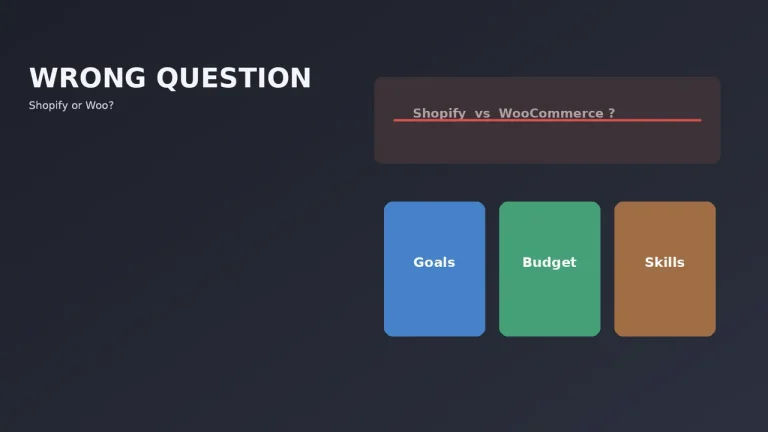
1. The platform decision is a total-cost decision, not a monthly-fee decision. WooCommerce looks free until you price hosting, a developer on retainer, and the day a plugin update takes checkout down. Shopify looks expensive until you price the same. Run the numbers on both across three years, not one month. Our Platform Picker does it for you.
2. Your payment gateway costs more than you think, and the difference is not the headline rate. PayFast at 3.2%, Yoco, Ozow, Peach – the headline percentage is the least interesting number. Settlement periods, monthly minimums, chargeback fees and whether instant EFT is included change the real cost more than half a percent does. On a R500 sale the gateway is rarely your biggest leak.
3. Shopify Payments is not available in South Africa. Everyone discovers this at the worst possible moment. There is a workaround, it is fine, and it costs you a transaction fee on top of the gateway fee. Budget for it before you pick a plan.
4. You will not register for VAT on day one, and you need to know exactly when you will. The R1 million threshold arrives faster than founders expect and the transition is administratively brutal if you have not priced for it. Decide upfront whether your prices are VAT-inclusive.
5. Your domain choice is a five-year decision. A .co.za signals local. A .com signals ambition and costs you nothing in local rankings. What costs you is changing it in year three.
While you build
6. A theme is not a design. Buying a premium theme gets you a good skeleton. It does not get you a product page that answers a South African buyer’s three questions: how much is delivery, how long will it take, and can I send it back.
7. Mobile is not a version of your site. It is your site. The majority of South African ecommerce traffic is mobile, often on a constrained data connection. If the desktop looks perfect and the phone is fine, you have built it backwards.
8. You need fewer apps than you think. Every app is a monthly fee, a script in your head tag, and a thing that can break. We have seen stores paying R3,000 a month for apps doing work the theme already did. Start with four.
9. Product photography is the highest-leverage money you will spend. Not ads. Not apps. Photos. The brain forms an impression of your brand from the image before it reads a word.
10. Write the returns policy before you launch, not after the first return. The Consumer Protection Act gives your customer rights whether or not you have a policy. Having one written in advance means you set the process instead of improvising it while a customer is angry.
The legal part you keep postponing
11. POPIA applies to you the moment you collect an email address. Not when you get big. Now. You need a privacy policy, a named information officer, and a lawful basis for every piece of personal information you hold.
12. The ECT Act requires specific disclosures on your site. Full name, registration number, physical address, and the cooling-off provisions. Most SA stores are non-compliant and nobody has told them.
13. “Free shipping” is a pricing decision, not a marketing one. If you absorb R95 of courier cost on a R400 order, you have quietly changed your margin structure. Do the arithmetic first and set a threshold that protects it.
Free shipping on a R400 order gives away R95
One R400 order where the store absorbs the courier cost. Rand.
R95 is 23.75% of the order value, before product cost and gateway fees.
The launch itself
14. Nobody comes. Launch day traffic is your family. Every founder is quietly shocked by this. The store is the beginning of the work, not the end of it.
15. Your first hundred orders come from channels, not from Google. SEO takes six months to compound. Your first customers come from a mailing list, a WhatsApp broadcast, an existing following, or paid ads. Have one of those before you have a store.
16. Load-shedding will take your business offline unless the business is not in your house. The store stays up – it is hosted elsewhere. What goes down is you, packing orders in the dark, unable to print a waybill. Plan the operation, not the website.
After launch, when it gets real
17. Abandoned carts are not a technology problem. The recovery email is worth having. The reason they abandoned is almost always the delivery cost appearing at step three of checkout. Show it earlier.
18. Your conversion rate is a number you must actually know. Most SA store owners we speak to cannot tell us theirs. If you do not know it, no advice anyone gives you can be evaluated. Somewhere between 1% and 3% is normal. Below 1%, something specific is broken and it is findable.
19. The store that wins is the one that is still being improved in month eighteen. This is the whole thing, really. Almost nobody keeps going. The ones who do are not smarter, they just did not stop at the launch.
The long version
Each of the nineteen above is a full chapter in the Playbook, with the working, the numbers, and the SA-specific detail that the American guides leave out. It ships with the 2026 SA eCommerce Report, an Excel toolkit of five live-formula sheets, three editable legal templates (POPIA, CPA, ECTA) and a library of 50 AI prompts written for local stores.
The SA eCommerce Bundle 2026
Nineteen chapters, the market report, the toolkit, the templates, the prompts. R500 R299 special, instant download, lifetime updates.
Or skip the reading and get a quote. We have done this 400 times.

We have built 400+ online stores for South African businesses since 2014. Read more about eCommerce development in South Africa.