
HostKing review 2026: cheap South African hosting, but is it enough for a store?
HostKing gets two things right that most budget hosts get wrong: the stack is NVMe and LiteSpeed rather than tired SATA drives, and they print the renewal price on the plan card instead of hiding it. But there is one number they do not publish anywhere, and for a WooCommerce store it is the number that decides whether your checkout holds up.
We build and rescue online stores for a living, so we end up inheriting hosting decisions other people made. This review looks at HostKing through the lens of running a store rather than a brochure site, because those are very different workloads and most hosting reviews quietly ignore the difference.
The short verdict
| Question | Answer |
|---|---|
| Good for a brochure or small business site? | Yes. At this price, genuinely good value. |
| Good for a WooCommerce store? | Probably, on the Premium tier — but you cannot verify it from published specs. |
| Biggest strength | NVMe plus LiteSpeed and LSCache as standard, at the cheapest entry price of the local hosts we track. |
| Biggest weakness | No published RAM, CPU or entry-process limits at all. |
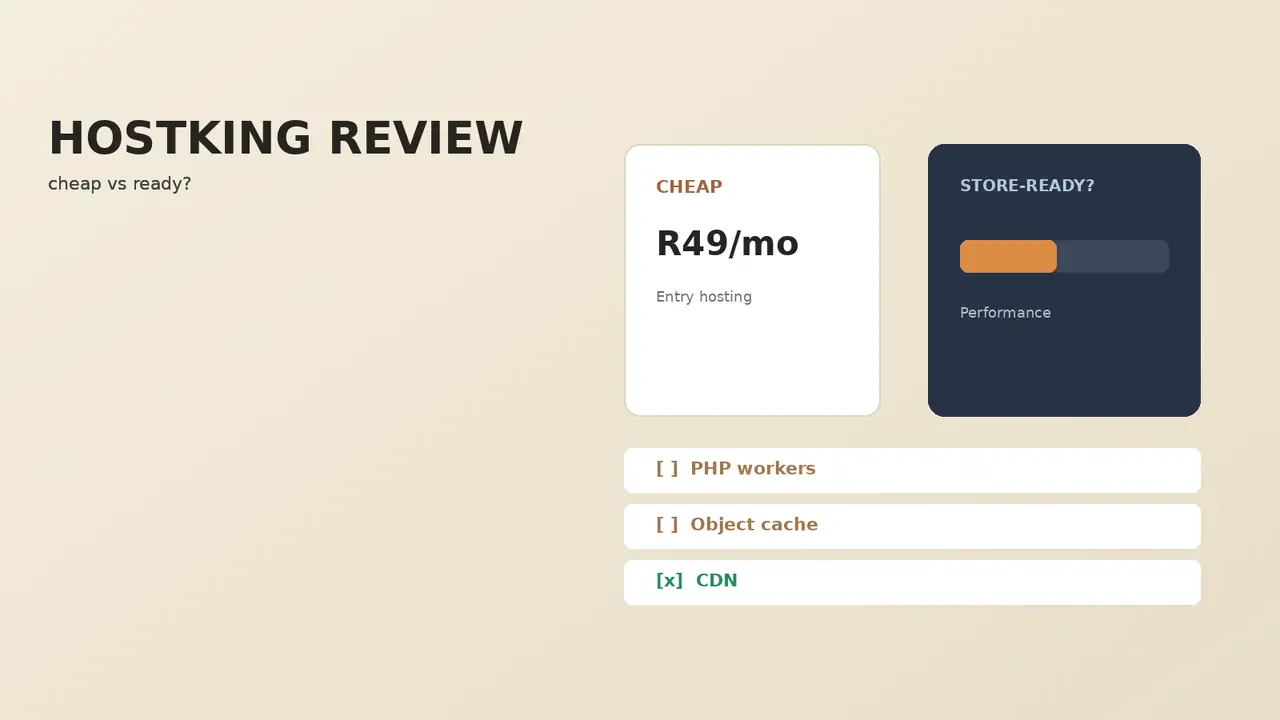
| Entry price | R34.50/mo on annual billing, renewing at R69/mo. |
Who HostKing actually is
HostKing has been hosting South African small businesses since 2013, with sister operations in the UAE and Nigeria and a global arm. They state that they run their own infrastructure rather than reselling someone else’s capacity, which is their stated explanation for the low pricing. They publish an ISPA take-down page, so there is a formal complaints route behind them.
They advertise a 99.9% uptime guarantee and a 30-day money-back guarantee, and they carry customer reviews on Trustpilot. One thing worth noting up front: their marketing leans heavily on being the cheap option — there are dedicated pages for “cheap web hosting” and even “free web hosting”. That positioning is fine, but it tells you who they are optimising for, and it is not the store owner doing R150,000 a month.
The plans, and what they really cost
HostKing sells the same resources under three different panels — Web Hosting and WordPress Hosting both on DirectAdmin, and a separate cPanel Hosting line at the same price. Pick the panel you prefer; the plan tiers below are the shared range.
| Plan | Annual rate/mo | Year one total | Renews at | Storage | Sites | |
|---|---|---|---|---|---|---|
| Launch | R34.50 | R414 | R69/mo | 50 GB NVMe | 1 | 25 |
| Starter | R64.50 | R774 | R129/mo | 75 GB NVMe | 2 | 50 |
| Premium | R129.50 | R1,554 | R259/mo | 100 GB NVMe | 100 | Unlimited |
Read the renewal column carefully. The advertised prices are a 50% first-year discount on annual billing, which means the price exactly doubles in year two. HostKing is refreshingly upfront about this — the renewal figure is printed on every plan card, and their own FAQ says they would rather tell you than hide it in the terms. Credit where it is due. But a store owner budgeting off the R34.50 headline is budgeting for half the real cost.
Every plan includes free SSL, daily backups with one-click restore, email hosting, a free domain on annual billing, and free migration. From Starter upward they will also design a one-page website for you at no cost, built by their own designers.
Check the current HostKing pricing →
The stack: genuinely good for the money
This is where HostKing earns its place on the shortlist. The shared plans run NVMe storage, LiteSpeed web server with LSCache built in, and AcceleratorWP with LSAPI. That is a better hardware and software combination than several local competitors charging more.
Why it matters for a store: as we set out in our WooCommerce hosting guide, WooCommerce is database-heavy and NVMe is dramatically quicker than SATA SSD on the random reads that generates. LiteSpeed also handles concurrent requests far better than stock Apache when several people are browsing at once. Getting both at the entry tier is unusual.
LSCache being pre-installed is a real convenience too. It is a capable page cache and you are not paying separately for a premium caching plugin, which is a genuine saving on a WooCommerce speed project.
The problem: the numbers that are missing
Here is our substantive criticism, and it is the reason we cannot recommend HostKing unreservedly for stores.
Nowhere in HostKing’s published plan specifications could we find RAM, CPU allocation, IOPS, entry processes or process limits. You get storage, site count, mailbox count and “unlimited bandwidth”. That is a brochure-site specification sheet.
For a store, RAM and entry processes are the numbers that determine whether your checkout survives three simultaneous shoppers. Bandwidth is almost never the constraint. Storage is almost never the constraint. A store with 500 products and optimised images typically sits under 10 GB, so the 50 GB on the entry plan is generous in a dimension that does not matter, while the dimension that does matter is simply absent.
Compare this to HOSTAFRICA, who publish RAM, CPU percentage, IOPS, entry processes and NPROC for every tier. You can size a HOSTAFRICA plan against a real workload on a spreadsheet. With HostKing you have to ask, and then take the answer on trust.
The other missing detail is the data centre. The site references customers in Cape Town, Johannesburg and Durban and states that they operate their own infrastructure, but we could not find a named facility or a stated Tier certification. For most buyers that is a footnote. If you care about load-shedding resilience and want to know whose generators are between you and a dark server room, it is worth asking directly.
We are not suggesting the resources are bad. We have no evidence either way, which is precisely the point. Before you put a store on HostKing, open live chat and ask for the RAM allocation, CPU limit and entry-process limit on the plan you are considering, plus the data centre location. If the answers are good, buy with confidence. If they cannot tell you, that is your answer.
Where HostKing genuinely wins
- Price-to-stack ratio. NVMe and LiteSpeed at R69/mo renewal is the best hardware-per-rand we found among local hosts.
- Honest renewal pricing. Printing the renewal rate on the plan card is a small thing that says a lot about how a company treats customers. Plenty of hosts do the opposite.
- Free migration, planned around downtime. Combined with the 30-day guarantee, the cost of trying them is close to nothing.
- Panel choice. DirectAdmin or cPanel at the same price. Both are standard panels, so you are not locked in if you want to leave later.
- Free website design on Starter and above. A real designer building a one-page site, not an AI template generator. Worth little to an established store, worth a lot to someone starting from zero.
- Local support seven days a week. Live chat and tickets, 08:00 to 20:00 SAST.
Where we would push back
- No published resource limits. Covered above. For a store this is the single biggest gap.
- The renewal doubles. Transparent, but steeper than most. A 50% first-year discount is effectively a 100% year-two increase.
- No object cache advertised. Same criticism we make of most local shared hosting. LSCache is a page cache and does nothing for cart and checkout. Ask whether Redis is available.
- “100 websites” on Premium is a marketing number. Without a published RAM figure, the number of sites a plan can host is unknowable. Do not read it as capacity.
- Unnamed data centre. Ask before you buy if latency or uptime redundancy matters to you.
- Support closes at 20:00. There is an AI assistant on live chat overnight, but if your checkout breaks at 22:00 on a Saturday you are waiting for a human until morning. HOSTAFRICA runs to 23:00.
How it compares to the other local options
Against HOSTAFRICA, HostKing wins on price and on storage specification, and loses badly on transparency. If you are a specification-driven buyer who wants to size a plan properly, HOSTAFRICA gives you the data. If you want the best stack per rand and are comfortable asking questions on live chat, HostKing is the better buy.
Against Domains.co.za, HostKing is cheaper at entry level, while Domains.co.za publishes full tier specifications and ships Redis on its WordPress plans — which for a store is a meaningful advantage. Against xneelo, HostKing is considerably cheaper, while xneelo owns its own data centres and has a longer reliability track record.
Our main hosting guide puts all of them in one table if you want to compare directly.
Which plan should you actually buy?
- Brochure site, blog or pre-launch store: Launch at R69/mo renewal. Good value, and the free domain on annual billing is a genuine saving.
- Small business site plus a second staging or project site: Starter. The free website design makes this the best-value tier if you are starting from nothing.
- A live WooCommerce store: Premium, and only after you have asked about RAM and entry processes. Do not run a store on the entry tier at any host.
- An established store doing real volume: ask about their VPS range, or compare against a host that publishes shared-plan specifications so you can size properly.
HostKing review FAQs
Is HostKing good for WooCommerce?
The stack is right — NVMe, LiteSpeed, LSCache and daily backups are all what a store wants. The uncertainty is resource allocation, which they do not publish. On the Premium tier, with confirmed RAM of 4 GB or more, we would be comfortable. Below that, ask first.
Is HostKing really only R34.50 a month?
For the first year, on annual billing, paid up front — R414 for year one. It renews at R69/mo. The renewal price is printed on the plan card, so nothing is hidden, but budget for the renewal figure.
Does HostKing use cPanel or DirectAdmin?
Both. The standard Web Hosting and WordPress Hosting plans run DirectAdmin, and there is a separate cPanel Hosting line at the same resources. Both are standard panels, so migrating away later is straightforward.
Where are HostKing’s servers?
South Africa, per their marketing, and they state they run their own infrastructure. They do not name a specific facility or Tier certification publicly. Ask on live chat if it matters to you.
Is the free website design worth anything?
If you have no site at all, yes — it is a professional one-page site built by a human designer, included with the hosting. If you already have a WooCommerce store, it is irrelevant to your decision and should not sway you.
Can I get SSH access?
They reference SSH access for domain management on shared plans. If your developer needs WP-CLI for bulk imports or database work, confirm the scope of that access before committing.
Our verdict
HostKing is a legitimate, long-running South African host with a better technical stack than its price suggests, and a refreshingly honest approach to renewal pricing. For a brochure site, a blog or a small business website, it is among the best value in the local market and we would happily recommend it.
For a store, we have to hedge, and the reason is not that we think the hosting is bad. It is that we cannot tell. A store lives or dies on RAM, CPU allowance and concurrent request handling, and those figures are simply not published. Everything visible about the stack is encouraging. The part you would need to size a plan properly is missing.
So the practical advice is straightforward: if you are running a store, spend five minutes on their live chat before you spend any money. Ask for RAM, CPU limit, entry processes and the data centre. Then use the 30-day guarantee properly — put real orders through the checkout and watch what happens under load. If the answers and the behaviour hold up, you have found unusually good value.

We have built 400+ online stores for South African businesses since 2014. Read more about WooCommerce development in South Africa.