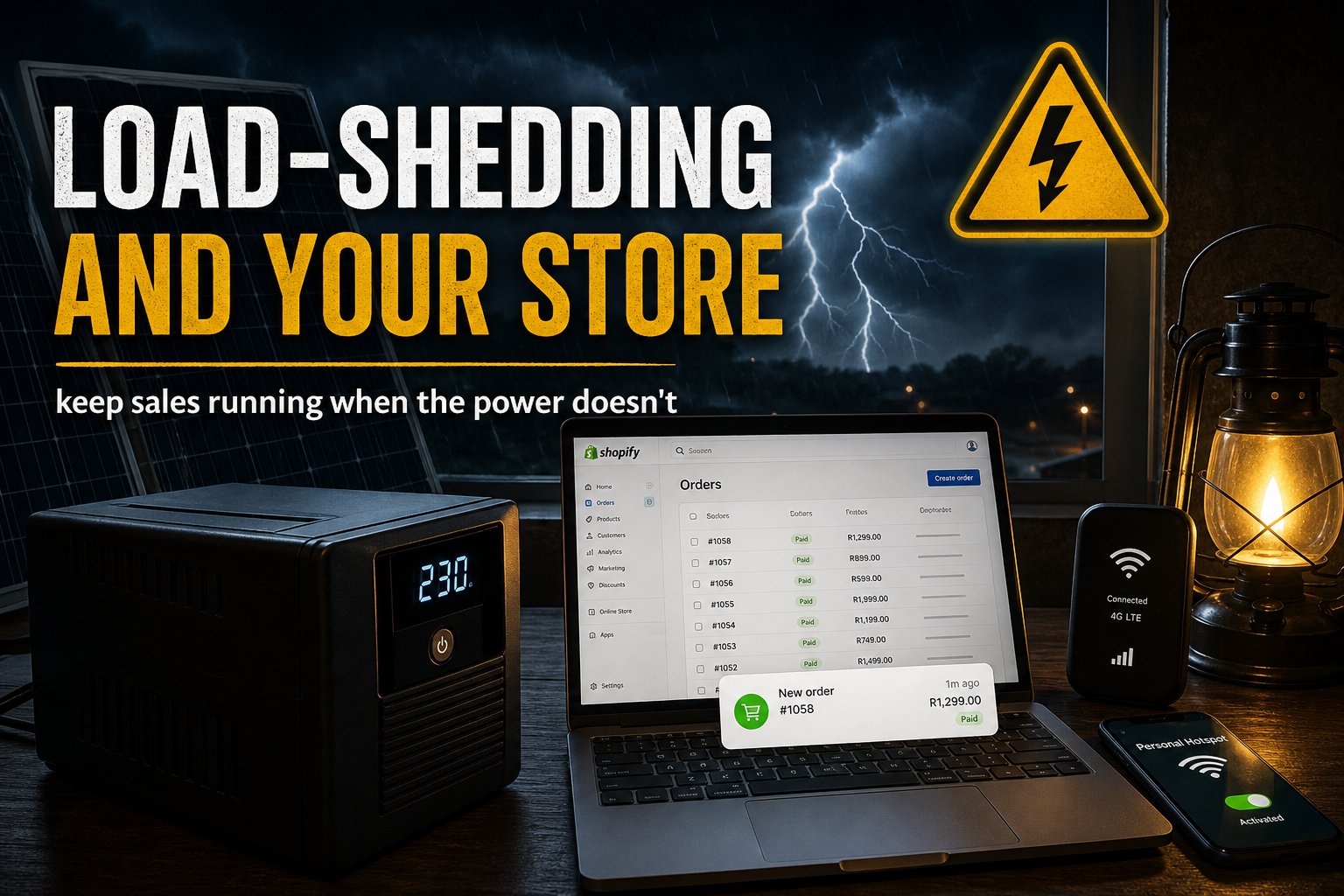

Load-shedding and your online store: keeping sales running when the power doesn’t
One of the quiet advantages of selling online in South Africa: your store doesn’t switch off when the power does — if it’s set up right. Here’s how load-shedding actually affects an online store, and how to make sure you keep selling, packing and shipping through the dark hours.
Load-shedding is a fact of South African business life, and it shapes how local stores have to operate in a way no overseas guide will ever mention. But here’s the reassuring part, and a genuine advantage of ecommerce: a properly built online store keeps selling 24/7 regardless of whether your own lights are on. Your storefront lives on servers, not in your home or office, so a customer can browse and buy at 2am during stage 6 just as easily as at midday. The power going off at your end doesn’t take your shop offline.
That said, load-shedding does affect the parts of your operation that depend on your power and connectivity — packing, processing, communicating, shipping. This guide covers what load-shedding does and doesn’t affect for an online store, and the practical steps to keep everything running smoothly through the outages.
Load-shedding only hits the back half of an order
Which steps depend on your power, and which don’t.
A WooCommerce store stays up only if its host has backup power.
What load-shedding does NOT affect (the good news)
If your store is hosted properly, these keep working even when your power is out:
- Your storefront. On Shopify, your store is hosted on Shopify’s global servers — load-shedding in SA doesn’t touch them. On WooCommerce, your store stays up as long as your hosting has power (which reputable hosts do, via their own backup power), regardless of your home or office.
- Taking orders and payments. Customers can browse, add to cart and pay around the clock. Payment gateways run on their own infrastructure.
- Customer browsing. People often shop more during load-shedding — stuck at home, on their phones, with nothing else to do. Your store is open for them.
This is a real selling point of being online versus a physical shop: a brick-and-mortar store with no power is shut, but your online store keeps trading. It’s worth internalising — the sales don’t stop just because your area is dark.
What load-shedding DOES affect (and how to handle it)
The friction is on your side of the operation — the human and connectivity bits:
- Your ability to process and pack orders. Orders keep coming in, but you need power and internet to view them, print labels and pack. Fix: a UPS or power bank to keep a laptop and router running through a slot, a backup data connection (mobile data when fibre drops), and batching your packing around the schedule.
- Your internet connection. Fibre often goes down with the area’s power unless the provider has backup. Fix: a mobile data fallback (a phone hotspot or backup SIM) so you can keep working and stay reachable.
- Customer communication. Replying to queries needs you online. Fix: the same backup connection, plus setting expectations — an auto-reply or notice during known slots.
- Courier collections and deliveries. Couriers themselves can be affected, causing delays during heavy load-shedding periods. Fix: set realistic delivery expectations and build in buffer (see the shipping guide).
- Your own marketing/admin work. Anything you do at a computer pauses. Fix: plan power-dependent work around the schedule using a load-shedding app.
What goes down, and the fix
Each part of the operation when your area’s power is off.
| Part, and is it affected? | Fix |
|---|---|
| Storefront on Shopify No |
Hosted on Shopify’s global servers |
| Storefront on WooCommerce Only if your host loses power |
A host with backup power and uptime guarantees |
| Orders and payments No |
Gateways run on their own infrastructure |
| Processing and packing Yes |
UPS or power bank for laptop and router; batch packing around the schedule |
| Internet Yes, fibre often drops |
Phone hotspot or backup SIM with data |
| Customer replies Yes |
Backup connection, plus an auto-reply during known slots |
| Courier collections Can be delayed |
Realistic delivery times with a buffer |
Practical setup for a load-shedding-resilient store
Turn it into a marketing angle
There’s a positioning opportunity here too. “Shop anytime — we’re always open, even when the lights aren’t” resonates with SA shoppers who live with the same reality. Products that genuinely help during outages — power banks, lights, gas appliances, inverters, entertainment for the kids — can be merchandised around load-shedding periods. And simply being reliably available and communicative when others go quiet builds trust. The shared experience of load-shedding is something a local store can speak to authentically in a way an international competitor never could.
The WooCommerce hosting point
One technical note worth flagging: if you’re on WooCommerce, your store’s uptime during load-shedding depends entirely on your hosting provider having reliable backup power — which reputable hosts do, but budget or local hosts may not. A cheap host whose data centre goes down with the grid means your store goes down too. This is one more reason, alongside the maintenance burden, that many SA stores prefer Shopify, where uptime is simply handled. If you’re on WooCommerce, confirm your host has proper backup power and uptime guarantees. (More on the platform trade-off in our platform comparison.)
Frequently asked questions
The bottom line
Load-shedding is a genuine operational reality for SA stores, but it’s far less of a threat to an online business than to a physical one — a properly hosted storefront keeps selling 24/7 no matter what the grid does. The friction is on your side: processing orders, staying connected, communicating, shipping. Solve those with modest backup power, a data fallback, and planning around the schedule, and your store sails through the outages. Handled well, “always open, even when the lights aren’t” becomes a genuine advantage over both physical shops and less-prepared competitors.
If you’d like a store built to run reliably through anything — properly hosted, resilient, and set up for the realities of selling in SA — that’s exactly what we build. See the platform comparison for the hosting and uptime trade-offs.

We have built 400+ online stores for South African businesses since 2014. Read more about eCommerce development in South Africa.