
WooCommerce South Africa: the complete 2026 guide
How WooCommerce works for South African stores — what it really costs, which payment and courier plugins to use, the trade-offs against Shopify, and how to keep it fast and secure. From a team that has built 400+ ecommerce stores since 2014.
Yes — WooCommerce works well in South Africa. It’s a free, open-source plugin that turns any WordPress site into a full online store. You take payments through local plugins like PayFast, Peach, Yoco and Ozow, ship with local couriers, and pay no platform transaction fee. The trade-off: it’s self-hosted, so you (or your developer) own the hosting, security, updates and speed. This guide covers the whole picture.
WooCommerce is the most popular ecommerce software in the world, powering a huge share of online stores because it’s free and built on WordPress — the platform that runs a large slice of the entire web. For South African businesses that already run a WordPress site, or that want full control and ownership without a monthly platform fee, it’s an excellent choice.
The catch is the flip side of that freedom: WooCommerce doesn’t manage anything for you. Hosting, security, backups, updates and speed are all your responsibility — which is exactly why a poorly-set-up WooCommerce store is often slow, and a well-built one is fast and rock-solid. Below we break down cost, payments, shipping, the real trade-offs, and how it compares to Shopify. Prefer to have it built right? Get a free quote — our WooCommerce builds start from R20,000 excl VAT.
What is WooCommerce, and does it work in South Africa?
WooCommerce is a free plugin that adds full ecommerce to a WordPress website — product catalogue, cart, checkout, orders and reporting. Because it’s built on WordPress and open-source, you get complete control over your store’s code, design, data and hosting. And yes, it works fully in South Africa:
- Rand pricing & VAT. Sell in ZAR and display 15% VAT-inclusive prices natively.
- Local payment plugins. PayFast, Peach Payments, Yoco, Ozow, PayGate, Stitch and Paystack all have official or well-supported WooCommerce plugins.
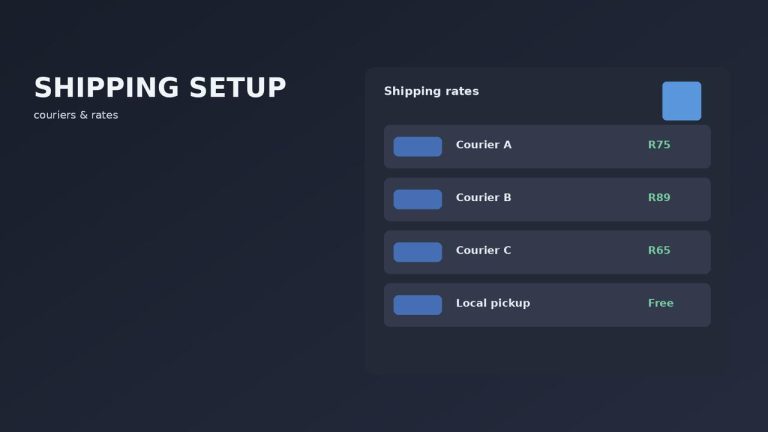
- Local couriers. Bob Go, The Courier Guy, uAfrica and Shiplogic integrate for live rates, waybills and tracking.
- No platform fee. Unlike Shopify, WooCommerce takes no cut of your sales — you only pay your payment gateway.
It’s the natural choice if you already run WordPress for your website or blog, want deep customisation, or want to own every part of your store outright.
What WooCommerce costs in South Africa (in rands)
The WooCommerce plugin itself is free. What you actually pay for is hosting, a domain, some plugins, and your own (or a developer’s) time. There’s no monthly platform subscription and no per-sale platform fee — a genuine cost advantage over Shopify at scale.
Realistically, a small WooCommerce store runs from around R150–R900/month depending mostly on hosting and premium plugins — often cheaper than Shopify month-to-month, especially at higher sales volumes where Shopify’s platform fee bites. The build cost is comparable to Shopify: our WooCommerce stores start at R20,000 excl VAT. Weigh it against Shopify’s numbers in our SA platform comparison.
Hosting and plugins set the monthly bill
Typical monthly cost in rands, from the table above. The WooCommerce plugin itself is free.
Domain (about R100–R200 a year) and payment fees (about 3% of sales) not shown.
Payment gateways for WooCommerce in South Africa
Every major South African gateway has a WooCommerce plugin, and here’s a real advantage over Shopify: WooCommerce charges no extra platform fee on transactions, so you only ever pay your gateway’s own rate.
- PayFast — the most popular SA gateway, with an official WooCommerce plugin. Broadest payment methods, no monthly fee.
- Peach Payments — lower card rates and strong recurring billing; good for subscriptions.
- Yoco — simple setup and a single provider if you also sell in person.
- Ozow — instant EFT, usually cheaper on bank transfers; run it alongside a card option.
Only one fee comes off a WooCommerce sale
The gateway charges its rate. WooCommerce adds no platform fee.
Most SA WooCommerce stores offer a card gateway plus instant EFT, and add Buy-Now-Pay-Later (Payflex, PayJustNow) for higher-ticket products. We install, configure and test the right combination for your store as standard.
The real trade-off: you own the maintenance
WooCommerce’s greatest strength — total control — is also the thing to go in with your eyes open about. Because it’s self-hosted, nobody is managing it for you:
- Speed depends on you. The most common complaint about WooCommerce is that it’s slow — and it usually is, when it’s on cheap hosting with too many plugins and an unoptimised theme. Built properly, on good hosting with caching, it’s fast.
- Security & updates are your job. WordPress core, WooCommerce and plugins all need regular updates, and the site needs proper security. Skip it and you’re exposed.
- Backups matter. You own your data — which means you’re responsible for backing it up.
None of this is a dealbreaker — it’s just work that Shopify does invisibly and WooCommerce hands to you. It’s why we offer ongoing WooCommerce maintenance and speed optimisation at R600/hr, and why a professionally-built-and-maintained store is worth it. If your WooCommerce store already feels slow, it’s almost always fixable.
WooCommerce or Shopify?
Choose WooCommerce if you already run WordPress, want deep code-level control and full data ownership, want no monthly platform fee, or have (or will pay for) someone to handle hosting and maintenance. Choose Shopify if you’d rather focus on selling than maintaining software, want security and updates handled for you, and want the smoothest possible checkout out the box.
We build and support both, so our advice isn’t tied to one platform. Get the full head-to-head in our Shopify vs WooCommerce vs 8 other platforms guide and our Shopify South Africa guide. Considering a move off WooCommerce? See how WooCommerce to Shopify migration works and what it costs — with zero rankings lost when done properly.
Build it yourself, or use a WooCommerce expert
WooCommerce is more technical than Shopify to set up well — hosting, WordPress, the theme, the plugin stack, payment and courier integrations, security and speed all have to be configured correctly. A DIY store is doable, but it’s where most of the “my WooCommerce store is slow / broke after an update” problems come from.
We’ve built 400+ ecommerce stores since 2014, including custom WooCommerce builds with SA payment gateways, courier integrations and conversion-focused design — from R20,000 excl VAT. We also fix, speed up and maintain existing WooCommerce stores at R600/hr. You deal with a real person, not a ticket queue. Request a free quote or see why founders work with us.
WooCommerce South Africa FAQs
Does WooCommerce work in South Africa?
Yes. WooCommerce works fully in South Africa — sell in rand with 15% VAT, take payments through local plugins (PayFast, Peach, Yoco, Ozow), and integrate SA couriers like Bob Go and The Courier Guy. Because it runs on your own WordPress hosting, you own and control the entire store.
Is WooCommerce free? What does it actually cost?
The WooCommerce software is free and takes no cut of your sales. What you pay for is hosting (~R100–R700/month), a domain (~R100–R200/year), any premium theme or plugins, and payment gateway fees (~3% of sales). A small store realistically runs from around R150–R900/month all-in — often cheaper than Shopify, especially at higher volumes.
Why is my WooCommerce store so slow?
Almost always one of a few culprits: cheap or overloaded hosting, too many plugins, an unoptimised or bloated theme, no caching, or large unoptimised images. WooCommerce isn’t inherently slow — a properly built store on good hosting is fast. Most slow stores can be dramatically sped up in a few hours; we start with a free audit so you know exactly what’s causing it.
Which is better for South Africa: WooCommerce or Shopify?
Neither is universally better — it depends on you. WooCommerce suits stores that already use WordPress, want full control and no platform fee, and have someone to handle maintenance. Shopify suits owners who’d rather focus on selling and have hosting, security and updates handled for them. We build both and lay out the full comparison in our platform guide.
Can you build or fix a WooCommerce store for me?
Yes — both. We build custom WooCommerce stores from R20,000 excl VAT with SA payment gateways, courier integrations and conversion-focused design, and we fix, speed up and maintain existing WooCommerce stores at R600/hr excl VAT. Free quote upfront, no surprises.

We have built 400+ online stores for South African businesses since 2014. Read more about WooCommerce development in South Africa.