How to sell on Amazon South Africa in 2026: registration, fees, FBA and a launch plan
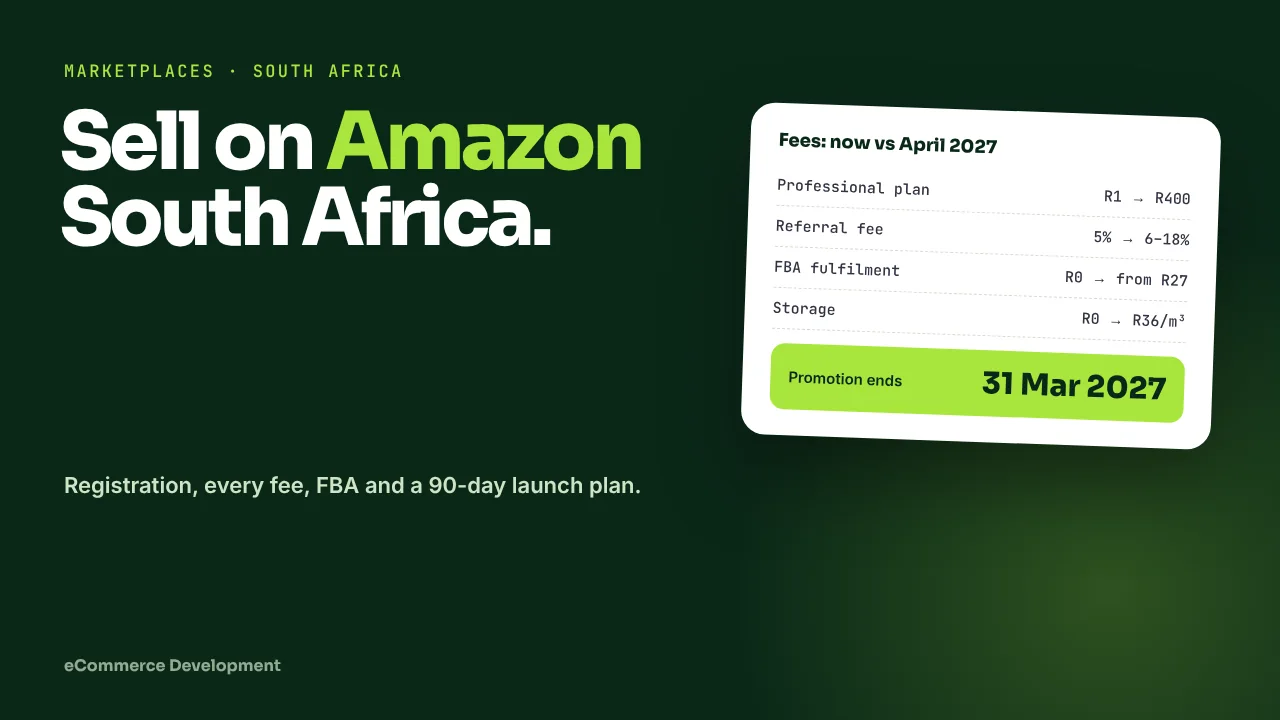
Amazon.co.za is the cheapest it will ever be to start selling on: R1 a month, a 5% referral fee and free FBA fulfilment on most categories until 31 March 2027. This guide walks through registration, the Individual and Professional plans, every fee now and after the promotion, how Fulfilled by Amazon works in South Africa, how to list products that sell, and a 90-day launch plan. Includes a free fee calculator and launch checklist.
The short answer
Register on Amazon Seller Central South Africa with the Professional plan. You need an ID or passport, proof of address, a credit card, a phone number and a bank account that can receive rand. Verification usually takes a few business days.
Use FBA for most products. Fulfilment is free on most categories during the promotion, your products become eligible for Prime, and Amazon handles delivery and returns.
Price for April 2027, not just for today. When the promotion ends, referral fees go to 6% to 18% and FBA fees apply. Use the promotion to build reviews and sales history, and make sure every product still makes money at standard fees.
Amazon fee calculator and launch checklist
See each product’s profit now and after the promotion, the price you’ll need from April 2027, and a 17-step launch checklist.
Is Amazon worth it for South African sellers?
Amazon launched in South Africa on 7 May 2024. It’s still much smaller than Takealot: 12.7% of South African online shoppers used Amazon in 2025, against 35.3% for Takealot. But it’s growing fast, it launched Prime in June 2026 (R59 a month or R399 a year), it has more than 4,000 pickup points, and it’s open to individuals and new brands that Takealot may not accept.
For most sellers the answer is to sell on both, with stock synced to your own store. If you’re deciding between them, see our side-by-side comparison: Takealot vs Amazon.co.za: which is cheaper to sell on? and how to sell on Takealot.
Individual or Professional plan?
| Individual | Professional | |
|---|---|---|
| Monthly fee | None | R1 until 31 Mar 2027, then R400 (ex VAT) |
| Per-item fee | R10 per item sold | None |
| Referral fees | Yes | Yes |
| Best for | Selling a handful of items a month | Anyone selling more than about 40 items a month, and everyone during the promotion |
While the Professional plan costs R1, there’s little reason to choose Individual. After the promotion, Professional pays for itself once you sell more than about 40 items a month (40 × R10 = R400).
How to register, step by step
ID or passport, proof of address (last 90 days), credit card, phone, bank account.
Create your account on Seller Central South Africa and choose Professional.
Complete identity verification, usually in 3 business days or less.
Add products by barcode, or create new listings for your own brand.
Send stock to FBA, or set up Easy Ship or your own delivery.
You don’t need to be VAT-registered to apply, and both individuals and businesses can sell. Have your CIPC registration and VAT number ready if you have them, and make sure every detail matches your documents exactly: mismatched names and addresses are the most common cause of verification delays.
Amazon.co.za fees: now vs after the promotion
| Fee | Until 31 March 2027 | From 1 April 2027 |
|---|---|---|
| Professional plan | R1 a month | R400 a month |
| Referral fee | 5%, all categories | 6% to 18% by category, R10 minimum |
| FBA fulfilment | Waived, except apparel | R27 (under 250 g) to R87 (20 to 30 kg) |
| FBA storage | Waived | R36 per cubic metre per month |
| Inbound shipping | 90% off with Amazon’s partner carrier (to 31 Dec 2026) | Your cost |
| Easy Ship | R20 flat when items are under R500, weight-based above | Same |
All fees exclude VAT. Referral fees are calculated on the price excluding VAT, according to Amazon’s fee page. Standard referral fees by category include 8% for wireless, 9% for computers, 13% for home and kitchen, beauty and consumer electronics, and 15% for sports and apparel. The full list is in our Takealot vs Amazon comparison.
What the promotion ending means for your profit
R399 kitchen appliance, 2 to 5 kg, via FBA
Profit per unit, VAT-registered seller, R140 cost, R8 inbound
Amazon fees go from 4.3% to 19.8% of the selling price. To keep R181.61 profit, the price would need to rise to about R481. Calculated with our Amazon fee calculator; excludes returns, storage and ads.
FBA, Easy Ship or ship it yourself?
| Fulfilled by Amazon (FBA) | Easy Ship | Self-fulfilled | |
|---|---|---|---|
| Who stores stock | Amazon | You | You |
| Who delivers | Amazon | Amazon collects from you and delivers | You, with your own courier |
| Prime eligible | Yes | Depends on Amazon’s rules | Generally no |
| Cost now | Free fulfilment on most categories | From R20 per parcel | Your courier costs |
| Best for | Steady sellers, small and light items | Bulky, slow or high-value items | Made-to-order or very bulky goods |
Amazon says sellers see a 3x uplift in sales on average after adopting FBA, based on its own global data. Whatever the exact figure in South Africa, Prime eligibility and fast delivery matter: they help you win the Buy Box and show up for Prime members.
Preparing stock for FBA
- Create a shipment in Seller Central, choosing the products and quantities you’re sending.
- Label every unit with the Amazon barcode label, unless Amazon lets you use the manufacturer barcode.
- Pack to Amazon’s prep rules: polybags for loose items, bubble wrap for fragile goods, sets bundled and marked.
- Label each carton with the shipment labels Seller Central generates.
- Book delivery with Amazon’s partner carrier while the inbound discount lasts, or your own courier.
- Send a small first batch. Learn how fast each product sells before committing more stock.
Listings that sell on Amazon
Title
- Brand first, then product type
- Key features: size, colour, quantity
- No promotional words or symbols
Images
- Main image on a pure white background
- Lifestyle and detail shots
- A size or scale image
Bullets and description
- Benefits first, then specifications
- Answer common questions
- Words shoppers search for
If your product already sells on Amazon, you’ll add your offer to the existing listing using its barcode and compete on price and delivery for the Buy Box. For your own brand, you create a new listing, which needs a GTIN barcode or an approved exemption. Some categories need approval before you can list.
Don’t build your business on the promotion. A product that only makes money at 5% referral and free fulfilment will lose money from April 2027. Run every product through the fee calculator at standard rates before you send stock.
A 90-day launch plan
| When | Focus | Actions |
|---|---|---|
| Days 1 to 14 | Set up | Register, get verified, list your 5 to 20 best products, send a first FBA shipment |
| Days 15 to 45 | First sales and reviews | Run Sponsored Products ads on your best sellers, request reviews from buyers, fix listing gaps |
| Days 46 to 90 | Scale what works | Restock winners, cut slow products, add variations, connect stock to your own store and Takealot |
| Before March 2027 | Prepare for standard fees | Reprice products, move bulky or slow items to Easy Ship, drop products that don’t make money |
Common mistakes
| Mistake | Why it hurts | Fix |
|---|---|---|
| Pricing only for the promotion | Margins vanish in April 2027 | Check every product at standard fees now |
| Sending too much stock at first | Cash tied up, storage fees later | Start small, restock what sells |
| Separate stock for each channel without sync | Overselling hurts your account health on Amazon and Takealot | Sync stock from one source |
| Weak main images | Fewer clicks, possible listing suppression | Pure white background, product fills the frame |
| Forgetting apparel | FBA fees still apply to apparel during the promotion | Price apparel with fulfilment fees included |
Questions
How do I start selling on Amazon in South Africa?
Register on Amazon Seller Central South Africa, choose the Professional plan, and complete identity verification with your ID or passport, proof of address, credit card, phone number and a bank account that can receive rand. Then list your products and send stock to FBA or set up Easy Ship.
How much does it cost to sell on Amazon South Africa?
Until 31 March 2027: R1 a month, a 5% referral fee and no FBA fulfilment or storage fees on most categories. After that: R400 a month (or R10 per item on the Individual plan), referral fees of 6% to 18% with a R10 minimum, FBA from R27 per unit and storage of R36 per cubic metre per month.
Can individuals sell on Amazon South Africa?
Yes. Both individuals and businesses can sell, and you don’t need to be VAT-registered to apply.
How long does Amazon seller verification take?
Amazon says identity verification usually takes 3 business days or less, provided your documents and details match.
Is FBA worth it in South Africa?
During the promotion, fulfilment is free on most categories, so yes for most products. After March 2027, FBA is still usually cheaper than Takealot’s fulfilment fees for small and light items, but bulky or slow sellers may be better on Easy Ship.
Should I sell on Amazon or Takealot?
Most sellers should sell on both. Takealot has about three times more shoppers; Amazon is far cheaper during the promotion and open to new brands. See our full comparison.
Sources
- Amazon Seller Central South Africa (promotion to 31 March 2027)
- Amazon.co.za: selling fees
- Amazon: selling fees South Africa 2026 (PDF)
- Amazon.co.za: Fulfilment by Amazon
- Amazon.co.za: how to register as a seller
- World Wide Worx / Mastercard: Online Retail in South Africa 2026
- BusinessTech: Amazon launches in South Africa
- BusinessDay: Amazon launches Prime in SA

We have built 400+ online stores for South African businesses since 2014. Read more about eCommerce development in South Africa.