How to sell on Takealot: the complete 2026 guide for South African sellers
Takealot is where South Africans shop online first. Getting onto it is easy; making money on it is not. This guide covers registration, every fee, worked profit examples on four real product types, stock-at-Takealot vs Leadtime, listings, the Buy Box, ads, VAT and how to run Takealot alongside your own Shopify or WooCommerce store. It comes with a free fee and profit calculator.
The short answer
Anyone with a South African ID or business, a bank account and products that meet Takealot’s rules can apply. Takealot reviews applications within about 10 business days, and most sellers are live two to three weeks after applying.
You pay a R400 monthly subscription, a success fee of roughly 5% to 18% of the VAT-inclusive price depending on category, and a per-unit fulfilment fee by size and weight. In our worked examples, Takealot’s fees take 23% to 32% of the selling price. Products under about R150 struggle; products from R300 to R1,500 that are light and compact do best.
Takealot fee and profit calculator
Success fee, fulfilment, subscription, storage, VAT, returns and ads in one place, plus a side-by-side with your own store.
Is selling on Takealot worth it in 2026?
Takealot Group reported revenue of R17.7 billion for the year to March 2026, up 18%, with more than 6.2 million active customers and over 60 million orders. It also posted its first adjusted operating profit (R171 million). In plain terms: the traffic is there and the platform is investing to keep it.
The catch is margin. Takealot takes a meaningful cut, you compete on price with other sellers on the same listing, and you do not own the customer relationship. The sellers who do well treat Takealot as a sales channel next to their own store, not as their whole business.
Why sellers use Takealot
- Millions of shoppers who already trust the platform
- No need to build traffic from zero
- Takealot handles delivery, payments and customer service when stock is at its DC
- Strong for Black Friday and festive peaks
- Works well for testing demand before you invest in your own store
What makes it hard
- Fees of roughly a quarter to a third of the selling price
- Price competition on shared listings (the Buy Box)
- You do not get the customer’s email or a repeat relationship
- Storage charges on slow stock
- Strict performance, packaging and compliance rules
What you need before you apply
| Requirement | Individual seller | Registered business |
|---|---|---|
| Identity | South African ID | CIPC registration documents |
| Bank account | SA account in your name | Business bank account |
| Proof of address | Yes | Yes |
| Tax | Tax number | Tax number; VAT number if registered |
| VAT registration | Not required to apply | Not required to apply |
| Product information | Category, expected monthly sales, short business description | Same |
Some products need regulatory approval before Takealot will list them. Check this first, because it is the most common reason listings get rejected:
| Product type | What you need | Issued by |
|---|---|---|
| Wireless and radio products (Bluetooth, Wi-Fi, chargers with radios) | Type approval | ICASA |
| Many electrical products (appliances, plugs, lights) | Letter of Authority | NRCS |
| Health products, some supplements, medical devices | Registration or documentation | SAHPRA |
| Liquor | Liquor licence | Provincial liquor authority |
How to register as a Takealot seller, step by step
Fill in the seller application on Takealot’s sell page.
About 15 minutes
Takealot reviews your application. Prepare photos and product data meanwhile.
Up to 10 business days
Set up your Seller Portal profile, banking and warehouse address; complete the training.
1–3 days
Stock at a Takealot DC, or Leadtime where you hold stock.
Same day
Match existing products by barcode, or submit new ones with a loadsheet.
1 day to 2 weeks for approval
Book a delivery to the DC, or set your Leadtime stock levels.
Depends on DC booking
Offers show as in stock and you start selling.
2–3 weeks after applying
Track Buy Box share, fees and returns weekly.
Ongoing
Tip: before creating a new listing, search the barcode in the Seller Portal. If the product already exists, you add your offer to the existing listing instead of creating a duplicate, which gets you live faster.
Takealot seller fees explained
There are three fees every seller pays, plus storage if stock sits too long. Takealot also charges VAT on its fees: VAT vendors claim it back, everyone else carries it as a cost.
| Fee | How it works | Typical amount |
|---|---|---|
| Subscription | Fixed monthly fee per seller account | R400 a month, ex VAT |
| Success fee | % of the VAT-inclusive selling price (excl. delivery), set by category | About 5% to 18% |
| Fulfilment fee | Per unit, based on size and weight | From about R32 for small items to R360 for bulky ones |
| Storage | Free for stock that sells within about 35 days; charged on older stock by volume | Rises the longer stock sits |
| Other | Removal orders, some return handling, optional ads | Varies |
Success fees by category
| Category | Typical success fee range (2026) |
|---|---|
| Computers, gaming and electronics | 5% – 8% |
| Cellphones and accessories | 5% – 8% |
| Office and stationery | 8% – 12% |
| Baby | 8% – 15% |
| DIY and tools | 10% – 12% |
| Home and kitchen | 10% – 15% |
| Beauty and personal care | 10% – 15% |
| Toys, sport and outdoors, pets | 10% – 15% |
| Fashion and footwear | 10% – 18% |
Fulfilment fees by size and weight
| Size | Weight | Indicative fee per unit (ex VAT) |
|---|---|---|
| Standard (fits 40 x 30 x 20 cm) | Up to 1 kg | R32 |
| Standard | 1 – 2 kg | R42 |
| Standard | 2 – 5 kg | R62 |
| Standard | 5 – 15 kg | R85 |
| Standard | 15 – 30 kg | R120 |
| Oversize | Up to 5 kg | R90 |
| Oversize | 5 – 15 kg | R130 |
| Oversize | 15 – 30 kg | R200 |
| Oversize | Over 30 kg | R360 |
Takealot does not publish one public rate card; these ranges come from seller-reported 2026 data, and Takealot raised fulfilment fees by 7% across all bands from 1 April 2026. Comparing marketplaces? See Takealot vs Amazon. For the exact fee on a specific listing, use the Fee Estimator in your Seller Portal. Weigh products in their packaging: crossing a weight band by 50 grams can add R10 to R20 to every unit.
What you actually keep: four worked examples
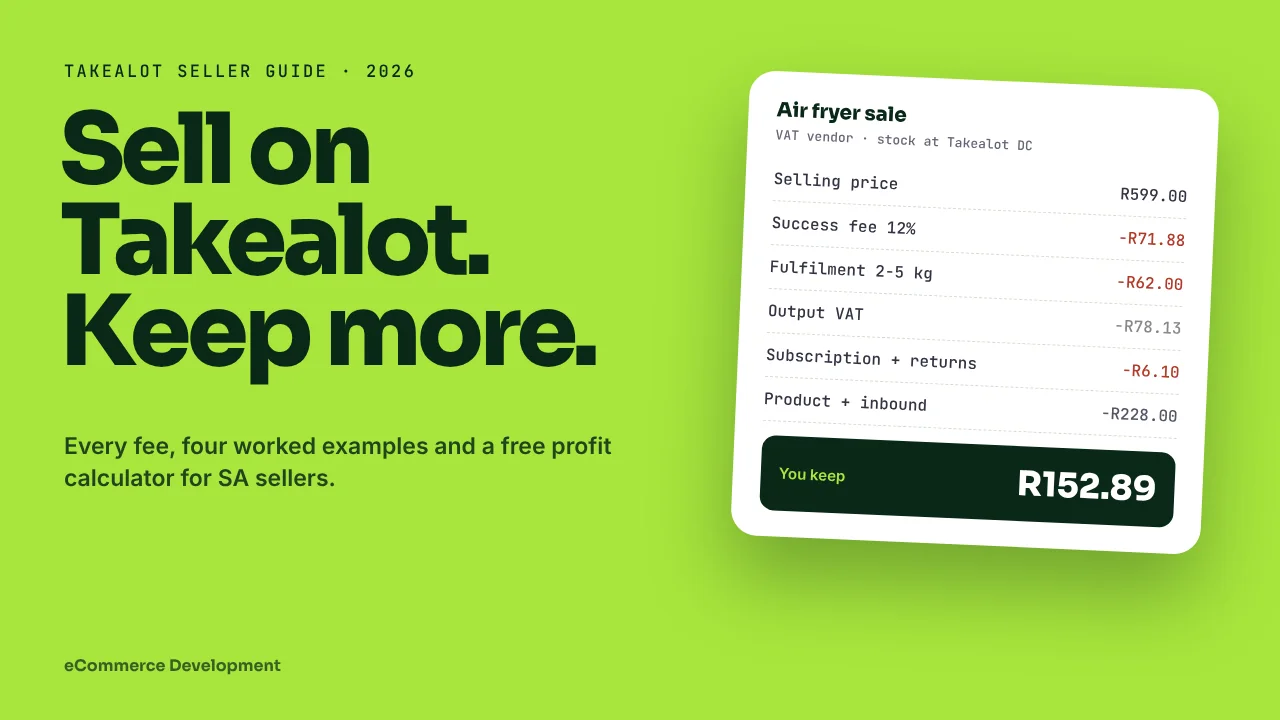
Here is what a VAT-registered seller keeps on four typical products, with stock at a Takealot DC, 100 units a month, a 3% return rate, R8 per unit to get stock to the DC, and no ads.
| Phone case | Sneakers | Air fryer | Patio chair | |
|---|---|---|---|---|
| Selling price (incl. VAT) | R149 | R349 | R599 | R1,299 |
| Assumed success fee | 7% | 15% | 12% | 12% |
| Size / fulfilment fee | Standard, <1 kg / R32 | Standard, 1–2 kg / R42 | Standard, 2–5 kg / R62 | Oversize, 5–15 kg / R130 |
| Less output VAT | -R19.43 | -R45.52 | -R78.13 | -R169.43 |
| Success fee | -R10.43 | -R52.35 | -R71.88 | -R155.88 |
| Fulfilment fee | -R32.00 | -R42.00 | -R62.00 | -R130.00 |
| Subscription share + returns | -R5.20 | -R5.50 | -R6.10 | -R8.14 |
| Inbound to DC | -R8.00 | -R8.00 | -R8.00 | -R8.00 |
| Product cost | -R40.00 | -R120.00 | -R220.00 | -R520.00 |
| Profit per unit | R33.94 | R75.63 | R152.89 | R307.55 |
| Margin on price | 22.8% | 21.7% | 25.5% | 23.7% |
| Takealot fees as % of price | 32.0% | 28.6% | 23.4% | 22.6% |
| Break-even price | R106.56 | R243.90 | R395.03 | R888.70 |
Cheaper products lose a bigger share to fees
Takealot fees (success, fulfilment, subscription share, returns) as % of the selling price.
Assumptions as in the table above. Success fee rates are typical, not exact; check the Fee Estimator for your listing.
The pattern is clear: the fulfilment fee is a fixed rand amount, so it eats cheap products alive. On a 1 kg item it is about a third of a R100 price but only 3% of a R1,000 price.
The same R32 fulfilment fee at different prices
Small standard item under 1 kg. Lower is better.
Indicative fee, ex VAT. One fix for cheap items: sell them as bundles so one fulfilment fee covers several units.
Will your product make money on Takealot?
Plug in your price, cost, category and size. The calculator shows profit, break-even price and the price you need for your target margin.
Stock at Takealot or Leadtime?
You can send stock to a Takealot distribution centre (Johannesburg or Cape Town), or keep it yourself and deliver each order to the DC within a set lead time.
| Stock at Takealot DC | Leadtime (you hold stock) | |
|---|---|---|
| Who stores the stock | Takealot | You |
| Shown to shoppers as | In stock, fast delivery | Ships in a set number of days |
| Conversion | Higher | Lower |
| Storage fees | Yes, on stock older than about 35 days | No |
| Your workload | Batch deliveries to the DC | Pack and deliver every order on time |
| Risk | Slow stock builds storage fees | Late deliveries can get Leadtime suspended |
| Best for | Proven sellers with steady demand | Testing new products, bulky or slow items |
Most sellers start new products on Leadtime, then move proven sellers to the DC once they know the weekly run rate. Send two to four weeks of stock at a time to stay inside the free storage window.
Choosing products that work on Takealot
| Factor | Good sign | Warning sign |
|---|---|---|
| Price | R300 to R1,500 | Under R150 (fixed fees dominate) |
| Size and weight | Fits 40 x 30 x 20 cm, under 2 kg | Oversize or heavy for its price |
| Competition | Your own brand or exclusive listing | Many sellers on the same barcode |
| Gross margin before fees | 50% or more | Under 35% |
| Returns risk | Simple, durable, no sizing | Fragile, sized clothing, complex electronics |
| Compliance | No permits needed | Needs ICASA, NRCS or SAHPRA approval you don’t have |
| Demand | Steady all year with festive peaks | One short season |
Listings that sell
- Title: brand and product type first, then the key feature, size or quantity. Write for search, not for style.
- Main image: clean product on a white background, filling most of the frame.
- Extra images: lifestyle, scale (in a hand or room), detail and what’s in the box.
- Attributes: fill every field. Takealot’s filters run on attributes, and empty fields hide you from filtered searches.
- Description: what it is, who it is for, dimensions, box contents and care instructions.
- Variants: group colours and sizes on one listing so reviews add up.
- Reviews: include a small insert card that thanks the buyer and explains how to get help.
Pricing and the Buy Box
When several sellers offer the same product, Takealot shows one offer as the default “Add to cart”. Winning it depends mainly on price, stock availability (DC stock beats Leadtime), delivery speed and your seller performance. Undercutting by R1 is a race to the bottom: price to your break-even plus margin, and compete on availability and performance first. Our calculator gives you the floor price for any product.
Advertising with Sponsored Products
Takealot’s Sponsored Products puts your listings at the top of search results and on product pages, and you pay per click. Start with your best-converting products, set a daily budget, and track advertising cost as a share of the sales it drives. If ads cost more per sale than your profit per unit, pause them. Add your ad spend per unit to the calculator to see the effect on margin.
Getting stock to Takealot
- Create a shipment in the Seller Portal with products and quantities.
- Book a delivery slot at the Johannesburg or Cape Town DC.
- Label every unit with the correct barcode and pack to Takealot’s packaging rules. Non-compliant stock can be rejected or delayed.
- Use a reliable courier or your own vehicle. Factor the cost per unit into your pricing; it is the “getting stock to Takealot” line in the calculator.
- Check the receiving report and query any variances quickly.
Performance, cancellations and returns
Takealot tracks cancellations, late Leadtime deliveries and returns. Poor performance can cost you the Buy Box or get Leadtime suspended. Keep stock levels accurate, never sell stock you don’t have, and read return reasons weekly: repeated “not as described” returns usually mean the listing needs fixing, not the product.
VAT and tax for Takealot sellers
You don’t need to be VAT-registered to sell on Takealot, but VAT changes your numbers. VAT vendors charge 15% output VAT on each sale and claim back the VAT on Takealot’s fees. Non-vendors keep the full selling price but cannot claim back VAT on fees. Once your turnover passes SARS’s compulsory registration threshold you must register. Read VAT for South African online stores for the details, and switch the VAT setting in the calculator to compare.
Running Takealot alongside your own store
The strongest sellers use Takealot for reach and their own Shopify or WooCommerce store for margin and repeat customers. To make that work without overselling:
- Keep one source of stock truth. Use the Takealot Seller API or an integration tool such as Stock2Shop to sync stock and prices between Takealot and your store.
- Price for each channel. Your own store doesn’t carry Takealot’s success fee, so you can offer a better price or a bundle there.
- Build your list from your own store. Takealot buyers belong to Takealot; your store’s buyers can join your email list.
- Use brand search. Shoppers who discover you on Takealot often search your brand name next. Make sure your own store ranks for it.
Takealot vs your own store vs Amazon.co.za
| Takealot | Your own store | Amazon.co.za | |
|---|---|---|---|
| Traffic | Built in, the largest SA marketplace audience | You build it | Built in, growing |
| Fees | R400/month + success fee + fulfilment | Platform plan + gateway fee (about 3%) | Referral fee by category + fulfilment |
| Customer data | Not yours | Yours | Not yours |
| Brand control | Limited | Full | Limited |
| Typical role | Volume and discovery | Margin, loyalty, brand | Extra reach |
On our R599 air fryer example, the same sale on your own store keeps about R144 after a 2.85% gateway fee, R60 delivery and R80 marketing per order, against R153 on Takealot with no ads. The difference is smaller than most sellers expect. Read own store vs Takealot for the full comparison.
Your first 90 days on Takealot
| When | Focus | Actions |
|---|---|---|
| Weeks 1–3 | Get approved and listed | Apply, run every product through the calculator, prepare images and attributes, list 5–10 products |
| Weeks 4–6 | First sales | Start on Leadtime, test small Sponsored Products budgets, collect the first reviews |
| Weeks 7–9 | Prove the winners | Move the best sellers to the DC with 2–4 weeks of stock; drop products under target margin |
| Weeks 10–13 | Scale | Add variants and bundles, tighten Buy Box pricing, sync stock with your own store |
Common mistakes new sellers make
- Pricing from the success fee alone. The fulfilment fee, VAT and subscription often matter more. Run the full numbers.
- Listing cheap, heavy products. A R99 item that weighs 2 kg rarely makes money.
- Sending too much stock. Anything past about 35 days of cover starts paying storage.
- Ignoring compliance. Products without ICASA or NRCS approval get rejected or delisted.
- Racing to the bottom on price. Know your break-even price and never go below it.
- Weighing the product, not the package. The packed weight sets your fulfilment fee.
- Relying on Takealot alone. Build your own store and email list alongside it.
Frequently asked questions
How much does it cost to sell on Takealot?
A R400 monthly subscription (ex VAT), a success fee of about 5% to 18% of the VAT-inclusive price depending on category, and a fulfilment fee per unit based on size and weight. Storage is free for stock that sells within about 35 days. In our examples, total Takealot fees came to 23% to 32% of the selling price.
Can I sell on Takealot without a registered company?
Yes. Individuals can apply with a South African ID, bank account, proof of address and tax number. A registered business uses its CIPC documents and business bank account instead.
Do I need to be VAT-registered to sell on Takealot?
No. You can sell without VAT registration, but you must register once your turnover passes SARS’s compulsory threshold. VAT vendors can claim back the VAT on Takealot’s fees.
How long does it take to start selling on Takealot?
Takealot reviews applications within about 10 business days. With onboarding, listing approval and getting stock in, most sellers are live two to three weeks after applying.
Is the success fee calculated on the price including VAT?
Yes. The success fee is a percentage of the VAT-inclusive selling price, excluding delivery.
What sells best on Takealot?
Products priced between about R300 and R1,500 that are compact, light, durable and not sold by many other sellers on the same listing. Products under R150 often lose most of their margin to the fixed fulfilment fee.
Can I sell on Takealot and my own website at the same time?
Yes, and most successful sellers do. Sync stock between the two with the Takealot Seller API or an integration tool so you never oversell.
Sources
- TechAfrica News: Takealot reaches profitability (Takealot Group results, FY to March 2026)
- Netcash: how to sell on Takealot (subscription, success fee basis, storage)
- EasySel: Takealot seller fees explained 2026 (R400 subscription, checked against Takealot’s seller page)
- Takealot Repricer: seller fees 2026 (indicative fulfilment fee bands)
- Takealot: sell on Takealot
- Takealot Seller Portal Fee Estimator (for exact per-listing fees)

We have built 400+ online stores for South African businesses since 2014. Read more about eCommerce development in South Africa.