Agentic commerce in South Africa: what changes when AI does the shopping
Visa has signed up South African banks to process purchases made by AI agents. None of them has switched it on. Shoppers are already asking ChatGPT what to buy, and most still refuse to let it pay. That gap, between rails that exist and behaviour that has not caught up, is where every South African online store sits right now. This is the first of five articles on what to do about it.
I run an eCommerce agency, I build the AI tooling my own sites run on, and I spend my working week inside payments. For the past year the same question has come up in every client meeting in one form or another: is this AI shopping thing real, and do I need to do anything about it yet?
The short answer is that it is real, it is early, and the useful work this year is unglamorous. This article is the overview. It explains what agentic commerce is, what has actually launched, where South Africa stands against the United States, which parts are known and which are guesswork, and what a store should do before the end of the year. The four articles that follow go deeper on the risks, on payments, on strategy, and on the opportunity for small stores.
What agentic commerce actually means
Strip the jargon and there are three levels. The difference between them is how much of the buying decision a person hands over.
- AI assists. A shopper asks ChatGPT, Gemini or Grok which air fryer to buy under R2,000, reads the answer and clicks through to a store. The store sees a referral. This is already common. Shopify reported that AI-driven traffic to its stores grew eight times year on year in the first quarter of 2026, and orders from AI searches grew nearly thirteen times.
- AI acts, with approval. The agent finds the product, fills the cart, enters the delivery details and stops. The shopper looks at the total and taps confirm. The money moves on a card the shopper has already linked. This is where the live products are today.
- AI acts on its own. The shopper sets rules up front (reorder dog food when it runs low, never spend more than R800 a month on it) and the agent buys without asking each time. This is what the card networks are building the plumbing for. Almost nobody is doing it at scale yet.
When people say agentic commerce, they usually mean levels two and three. When they quote numbers about how many people already use it, they are usually counting level one. Keep that distinction in mind every time you read a headline about it.
What has launched, and what has been pulled back
The last fourteen months have been a run of launches, and one notable retreat. The table is deliberately boring. It is the record, as best I can verify it.
| When | What | Status now |
|---|---|---|
| April 2025 | Visa announces Intelligent Commerce; Mastercard announces Agent Pay. Both let a registered AI agent pay with a tokenised card under limits the cardholder sets. | Live in the US with partners. Rolling out by region. |
| September 2025 | OpenAI launches Instant Checkout inside ChatGPT with Etsy, and open-sources the Agentic Commerce Protocol (ACP) it built with Stripe. | In-chat checkout was withdrawn in March 2026. The protocol is still in use; merchants keep their own checkout. |
| January 2026 | Google and Shopify announce the Universal Commerce Protocol (UCP) with Walmart, Target and others. Google’s Agent Payments Protocol (AP2) handles the payment leg. | Live in Google’s AI shopping surfaces in the US. Expanding. |
| March 2026 | Shopify switches on Agentic Storefronts by default for eligible US merchants. | Live. Not every product type is supported. |
| June 2026 | Visa enrols South African banks in its Agentic Ready programme. | Banks enrolled, none live in South Africa. |
| September 2026 | Six banks (Bank of America, Capital One, ING, NatWest and others) publish shared principles for trusted agentic commerce. Shopify lets browser-based agents fill and submit checkout once the buyer approves the total. | Principles, not rules. Shopify feature live for eligible merchants. |
| October 2026 | American Express publishes a merchant playbook and says it intends to cover charges caused by errors from registered agents. | Announced intent, not a live product. |
The OpenAI reversal is the one to study. ChatGPT reaches several hundred million people a week. It opened in-chat buying to every US user in February 2026 and quietly removed it a few weeks later, reportedly over data quality problems with early merchants. The lesson for a store owner is that the biggest player in the room tried the most aggressive version of this and backed off. The direction is not in doubt. The pace is.
Where South Africa stands
Two things are true at the same time. South Africans use AI for shopping more than most people assume, and the checkout side has not arrived.
On the first point: Visa’s 2026 Stay Secure study found that 77% of South African consumers surveyed had used AI tools for a shopping-related task, from comparing prices to checking reviews. Stitch’s 2026 consumer payments research puts the share of South Africans who have used an AI chatbot for search at around 70%. Local grocers have gone further than most international retailers. Pick n Pay added an AI assistant inside its asap! app in July 2026, and Woolworths launched an AI cooking and shopping assistant in its app around the same time. Those are level-two experiences, built by the retailer, inside the retailer’s own app.
On the second point: the same Visa study found that trust in AI-enabled payment at checkout is still low. The rails are being prepared. Visa’s country head said at a Sandton media briefing that local banks have been enrolled in the Agentic Ready programme, and that none has gone live. Mastercard’s Agent Pay has no announced South African launch date that I can find. So a South African shopper can ask an agent what to buy, and can be walked to a cart, and then has to pay the way they always have.
That matters because of where the money is. South African online retail is forecast to reach R159 billion in 2026, growth of 22.5%, and to pass 10% of total retail for the first time. The sector is growing roughly five times faster than retail as a whole. Any change in how that R159 billion is discovered and paid for is a change worth preparing for, even if it arrives a year later here than in the US.
South African online retail turnover
Rand billions. 2026 is the forecast.
Source: Online Retail in South Africa 2026, World Wide Worx with Mastercard, Peach Payments and Ask Afrika.
One more South African point, and I will expand on it in the payments article in this series: agent payments as designed today run on tokenised cards. A large share of South African online spend runs on EFT, instant payments and cash on collection. The US playbook assumes everyone has a card on file. Ours cannot.
The protocols, in plain words
You will see four acronyms in anything written about this. You do not need to implement any of them yourself, but you should know what each one is for, because your platform will support some and not others.
| Name | Who | What it does | Who it matters to |
|---|---|---|---|
| ACP (Agentic Commerce Protocol) | OpenAI and Stripe | How an agent sends a cart to a merchant, and how the merchant accepts and fulfils it. Includes a product feed spec. | Merchants wanting to appear in ChatGPT shopping. Stripe is building the WooCommerce and BigCommerce adapters. |
| UCP (Universal Commerce Protocol) | Google and Shopify | How an agent discovers products, checks price and stock, and runs checkout, with the merchant staying merchant of record. Merchants publish a profile at a standard web address. | Shopify merchants get it built in. Others integrate once and are reachable by any UCP agent. |
| AP2 (Agent Payments Protocol) | Google, with Visa, Mastercard, PayPal, Adyen and about sixty others | Cryptographic proof that a person authorised an agent to spend, within limits. It is about permission, not about which rail moves the money. | Banks, wallets and payment providers. Indirectly, every merchant who wants to win a dispute. |
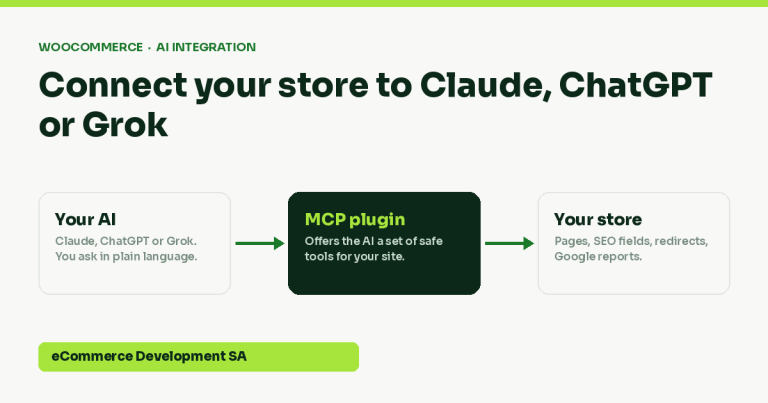
| MCP (Model Context Protocol) | Anthropic, now an open standard | A general way for an AI to call tools. WooCommerce added native support in version 10.3. It is what I use to let AI manage my own stores. | Anyone connecting an AI to a store’s back end, for selling or for running the shop. |
On top of these sit the card network programmes: Visa Intelligent Commerce, Mastercard Agent Pay and the American Express ACE kit. Their job is to register agents, issue them tokens and tell a merchant that the agent on the other end is who it says it is. Mastercard added a score in September 2026 that estimates how likely it is that a transaction was started by an agent. Expect that signal to reach South African acquirers before the full programmes do.
What changes for an online store
Here is the shopping journey as it works today, and as it works when an agent is in the middle. The store’s job changes at every step.
Who does the work, and what the store sees
The store loses most of the signals it used to rely on, and gains a buyer that never gets tired of comparing.
Five practical consequences follow.
Your product data becomes your storefront. An agent does not look at your hero banner. It reads structured data: title, price, variants, stock, dimensions, shipping cost, delivery time, return window. If that data is wrong or thin, the agent either skips you or recommends you and then fails at checkout, which is worse. Shopify’s own guidance is that Agentic Storefronts work off its Catalog data layer, and the UCP and ACP specs both start with a product feed. This is the single most valuable thing a South African store can fix in 2026, and most have not.
Traffic will fall before orders do. If an agent compares five stores and sends the shopper to one, four stores get nothing, and the one that wins may get an order without a visit. Analytics built on sessions will look like decline. The firms tracking this in the US are already reporting that agents navigating websites directly, rather than using a formal protocol, account for the large majority of identified agent orders, and that share jumped from about 1% in late July to about 70% in mid-October 2026. Those visits look like bots, because they are.
The block-or-allow decision is now yours. Most bot protection treats an automated visitor as an attacker. Jefferies found that about a third of sites it tested were blocking Meta’s shopping agent outright. Some of those sites meant to. Most did not know. You need to decide, on purpose, which agents you let in, and tell your security tooling.
Your fraud evidence disappears. Merchants win chargebacks with session data: device, IP, browsing behaviour, time on page. An agent order has none of that. There is, as of today, no card network rule that says who is liable when an agent buys the wrong thing. By default it is the merchant. The second article in this series is about this.
Support becomes machine-readable or it becomes a cost. Agents answer “what is your return policy” by reading your policy page. If the answer is buried in a PDF or contradicts your checkout page, the agent either gets it wrong or escalates to a human on your side. Clear, consistent, plain-text policies stop being a nice-to-have.
What we know, and what is still guesswork
Most writing on this topic blends the two. I would rather separate them, because the decisions are different.
Reasonably established
- AI-assisted discovery is already a meaningful share of how people shop, in South Africa as elsewhere.
- Structured, accurate product data is what agents run on. Fixing it pays now, regardless of how agent checkout develops.
- The card networks, Google, OpenAI, Shopify and Stripe have all committed engineering and partnerships to agent checkout. It is not going away.
- Liability for agent-initiated disputes is unresolved and currently falls on merchants.
- South African banks are preparing, and none is live.
Still open
- Whether shoppers will actually let an agent pay. Checkout.com’s survey of UK and US merchants found 89% preparing for agentic commerce and only 3% of transactions involving one. Trust, not technology, is the limiter.
- Which protocol wins, or whether several coexist. ACP and UCP overlap. Both have serious backers.
- Whether in-chat checkout returns. OpenAI tried it and pulled it. Google and Shopify are pressing on. Walmart runs its own mini-storefront inside ChatGPT with its own checkout.
- How agents pay in a market like ours, where a large share of online spend is not on a card.
- Timing for South Africa. Enrolled banks suggest 2027. Nobody has said so publicly.
I will update this section as those answers arrive. Treat anything you read elsewhere that states the open items as settled with some caution.
The rest of this series
Each of these goes deep on one question the overview raises.
- Who pays when a bot buys? The risks of AI transactions for SA merchants. Chargebacks, lost evidence, spoofed agents, POPIA, and the block-or-allow decision.
- Cards, PayShap and cash: can AI agents pay the South African way?. Where the US card-first design meets a market that pays differently.
- When machines become customers: how SA enterprise and entrepreneurs should prepare. What breaks, what to build, and where the new businesses are.
- How AI shopping agents could level the field for small SA online stores. Why clean data beats a big ad budget, with a case study of a two-person store run by a team of AI agents.
What to do before the end of 2026
None of this requires a budget line. It requires an afternoon and some honesty about your data.
- Audit your product data as if you were a machine. Export your catalogue. Check every product has a real title, accurate price, current stock, weight or dimensions, shipping cost and delivery time. Fix the gaps. If you sell on Google Shopping already, your Merchant Center feed is a good starting point.
- Put your policies in plain text on plain pages. Returns, delivery times, warranty, who to contact. One version, consistent with checkout.
- Find out what AI already does on your site. Check your analytics for referrals from chatgpt.com, perplexity.ai, gemini.google.com and copilot. Check your server logs or bot protection for AI crawlers. You may be surprised in either direction.
- Decide your agent policy. Allow, block, or allow with limits. Write it down. Tell whoever manages your firewall or Cloudflare rules.
- If you are on Shopify, read the Agentic Storefronts settings. If you are on WooCommerce, update to a version with MCP support and join the Stripe Agentic Commerce Suite waitlist. Neither commits you to anything.
- Start capturing order context you will need for disputes. If an order arrives through an agent or protocol, record that it did, and keep everything the protocol gives you.
If you want the discovery side specifically, my GEO playbook for South African stores covers how to get recommended by AI search. If you want to see what connecting an AI to a store looks like in practice, I wrote up how I connected my own WooCommerce store to Claude, ChatGPT and Grok.
Agentic commerce FAQs
Can a South African shopper buy through ChatGPT today?
They can be recommended products and walked to a store. In-chat checkout is not live for South African merchants, and OpenAI withdrew it in the US in March 2026. Payment still happens on the merchant’s site.
Do I need to implement ACP or UCP myself?
No. Your platform or payment provider will. Shopify has UCP built in. Stripe is building ACP adapters for WooCommerce and BigCommerce. Your job is the product data and policies those integrations read.
Will AI agents reduce my traffic?
Probably, over time, for the discovery part of the journey. Whether they reduce orders depends on whether you are the store the agent picks. That comes down to data quality, price, stock and delivery.
Who is liable when an AI agent orders the wrong thing?
As of now, there is no card network rule for it, so disputes fall under existing rules and the merchant usually pays. Visa, Mastercard and Amex are all working on it. Amex has announced an intention to cover errors by registered agents, but it is not live.
Should I block AI bots from my store?
Block scrapers that cost you money and give nothing back. Do not block shopping agents by accident. Most bot protection cannot tell the difference without configuration, so check yours.
When will agent payments go live in South Africa?
Visa has enrolled local banks and none is live. No bank has announced a date. My working assumption is 2027, and I will update this page when that changes.

We have built 400+ online stores for South African businesses since 2014. Read more about eCommerce development in South Africa.