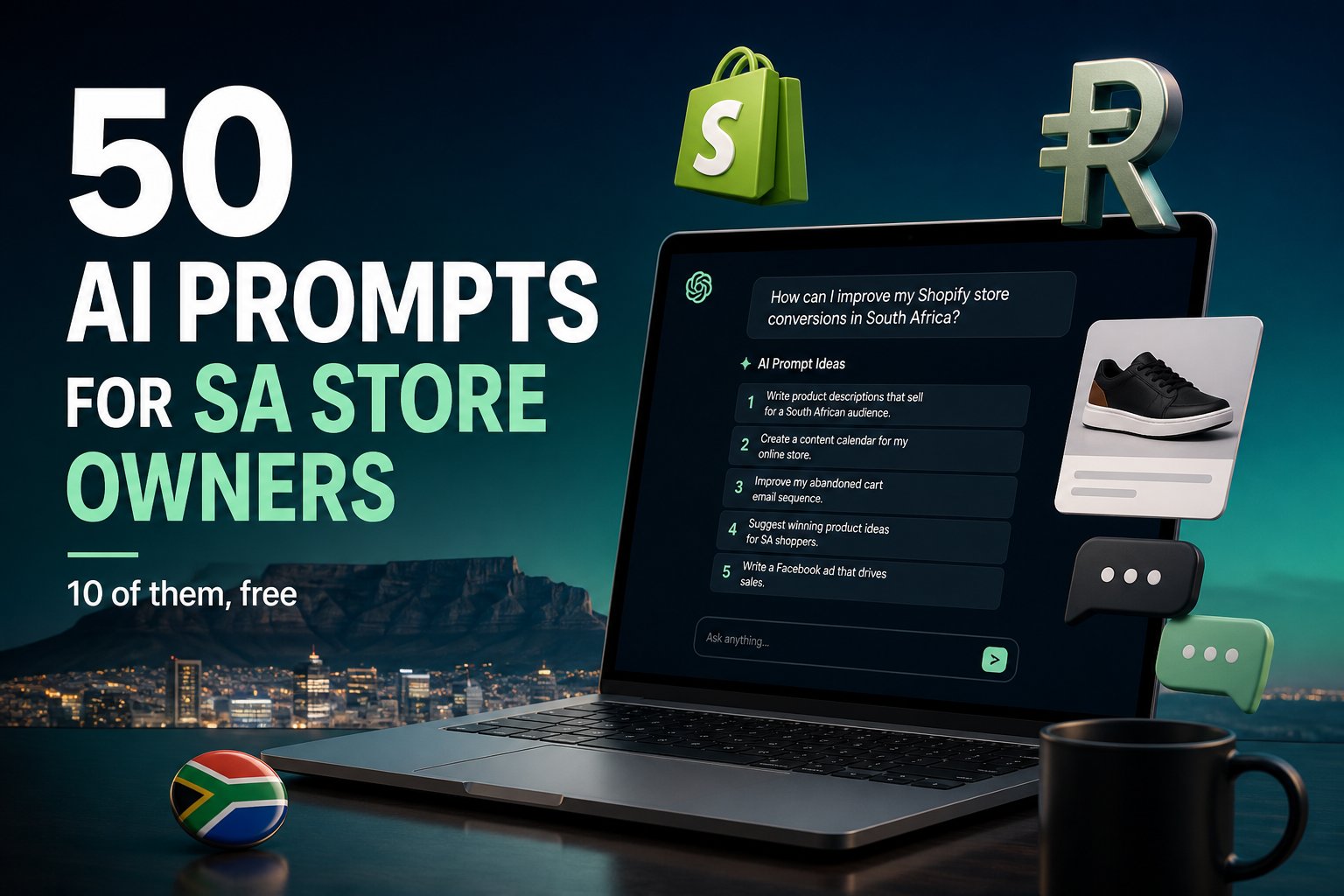

Most AI prompt lists you find online were written for American stores. They assume Stripe, they assume USPS, they assume a customer who has never heard of load-shedding or lay-by. Feed them to ChatGPT and you get copy that reads like it was written in Ohio, because it was.
We built a library of 50 prompts specifically for South African store owners as part of the SA eCommerce Bundle 2026. Below are ten of them, free, in full. Copy them, paste them, use them today.
A note before you start: every one of these prompts is a starting point, not a finish line. AI writes the first draft. You supply the specifics only you know – your actual courier rates, your actual return rate, the thing your customer said on the phone last week. That is the part that makes it yours.
1. Product descriptions that account for a South African buyer
You are writing product copy for a South African online store. Write a 120-word product description for [PRODUCT]. The buyer is price-conscious and will compare against Takealot before buying. Lead with the single strongest benefit, not features. Use South African English spelling. Do not use the words “elevate”, “unleash”, “game-changer” or “seamless”. End with one line that addresses the most likely objection, which is [OBJECTION].
The banned-words list matters more than anything else in that prompt. Without it you get the same four adjectives on every product page in the country.
2. Rewrite a thin description without inventing facts
Here is an existing product description: [PASTE]. Rewrite it to be more persuasive. You may only use facts present in the original text. If a claim would strengthen the copy but you cannot verify it from what I have given you, list it separately under “FACTS I NEED FROM YOU” instead of writing it into the copy.
This one prompt kills the hallucination problem for product pages. The model cannot invent a warranty length if you have explicitly told it to ask instead.
3. Bulk SEO titles and meta descriptions
For each product name below, write an SEO title under 60 characters and a meta description under 155 characters. Target South African search intent – include “South Africa” or “SA” only where a buyer would plausibly type it. Return as a markdown table with columns: Product, SEO Title, Meta Description, Character Counts. Products: [PASTE LIST]
Asking for the character counts back is the trick. It forces the model to actually check its own work, and you can spot the overruns at a glance instead of pasting 200 titles into RankMath and finding out later.
4. A POPIA-aware privacy policy first draft
Draft a privacy policy for a South African online store that complies with the Protection of Personal Information Act. The store collects: [LIST DATA]. It shares data with: [LIST PROCESSORS – e.g. PayFast, Courier Guy, MailerLite]. Write it in plain language a customer can read. Include sections on the eight POPIA conditions for lawful processing, the information officer, and the data subject’s right to object. Flag anything you are unsure about in square brackets.
Have a lawyer look at whatever comes out. But it will save you the R4,000 you would otherwise spend having one write it from a blank page.
5. Courier comparison for a specific parcel
I ship a parcel that is [DIMENSIONS] and weighs [WEIGHT]. I ship roughly [N] per month, mostly from [CITY] to major metros, with about [X]% going to outlying areas. Build me a comparison table of the trade-offs between courier-to-door, courier-to-locker, and Postnet-to-Postnet for this profile. Do not quote prices – I will fill those in. Instead give me the decision factors and which parcel profile favours which option.
Notice what this prompt refuses to ask for. Courier pricing changes constantly and AI models are confidently wrong about it. Ask for the reasoning framework, not the numbers. Get the numbers from the courier.
6. Google Ads copy variants that survive review
Write 15 responsive search ad headlines (max 30 characters each) and 4 descriptions (max 90 characters each) for a South African store selling [PRODUCT CATEGORY]. Avoid superlatives that Google’s ad policies flag as unsubstantiated – no “best”, “number one”, “cheapest”. Include at least three headlines that mention delivery, and three that address price. Return as a numbered list with character counts.
The character limits these prompts enforce
Maximum characters per field, from prompts 3, 6 and 8.
Asking the model to return character counts lets you spot overruns at a glance.
7. Turn one customer review into three assets
Here is a genuine customer review: [PASTE]. Produce three things from it, without adding claims the customer did not make: (1) a 20-word pull quote for a product page, (2) a 40-word social caption written in the store’s voice not the customer’s, (3) a suggestion for which product page objection this review answers, and where on that page it should sit.
Point three is where the value is. Reviews are wasted when they sit in a widget at the bottom of the page. Put the one that answers the sizing question next to the size chart.
8. Abandoned cart email sequence
Write a three-email abandoned cart sequence for a South African store. Email one sends after 1 hour, email two after 24 hours, email three after 72 hours. Email one must not mention a discount. Email two may address delivery cost, which is the most common SA abandonment reason. Email three may include a discount of [X]%. Each email: subject line under 45 characters, preview text, body under 120 words, one call to action. No exclamation marks.
The no-discount-in-email-one rule is deliberate. Train your customers that abandoning a cart produces a coupon, and they will abandon every cart.
The discount comes last, not first
Timing of the three emails in prompt 8, counted from when the cart is abandoned.
Each email: subject under 45 characters, body under 120 words, one call to action.
9. Collection page copy that ranks
Write 150 words of collection page copy for [COLLECTION NAME] on a South African store. It must sit above the product grid and read as useful to a human, not as SEO filler. Naturally include the phrase “[TARGET KEYWORD]” once. Answer the one question a buyer has before they start browsing this category, which is [QUESTION]. Do not describe individual products.
10. The audit prompt: find what is broken
Here is the full text of a product page: [PASTE]. You are a sceptical first-time buyer in South Africa who found this page from Google. List every question you still have that the page does not answer, in the order you would think of them. Then list every claim on the page you would not believe without proof. Be harsh.
Run this on your five best-selling product pages. It is the single most uncomfortable and most useful thing on this list. We have never run it on a client store without finding at least three missing answers – delivery timeframe, return process, and whether the price includes VAT, almost every time.
What the other 40 cover
The full library in the Bundle runs across nine areas: product copy, SEO, email flows, Google and Meta ad copy, customer service replies, POPIA and legal drafting, supplier and courier negotiation, financial modelling, and market research. Each one is written and tested against a South African store context, with the banned-word lists, character limits, and anti-hallucination guardrails already built in.
It ships alongside the 19-chapter Playbook, the SA eCommerce Report, an Excel toolkit with five live-formula sheets, and three editable legal templates covering POPIA, the CPA and ECTA.
Get all 50 prompts
The AI Prompt Library is part of the SA eCommerce Bundle 2026 – R500 R299 special, instant download, lifetime updates.
If you would rather not do any of this yourself, that is what we are for. Ask for a quote and tell us what you are selling.

We have built 400+ online stores for South African businesses since 2014. Read more about eCommerce development in South Africa.