
What WooCommerce maintenance actually costs in South Africa
Everyone budgets for building the store. Almost nobody budgets for keeping it running. Here is what WooCommerce maintenance genuinely costs a South African business per month, what you can do yourself, and where paying someone is cheaper than not.
The build quote is the number people compare. It is also the smaller number over any reasonable time horizon. A store that runs for three years will typically spend more on hosting, tools and maintenance than it did on the original build — and the businesses that plan for that do noticeably better than the ones that treat it as an unpleasant surprise.
This is a companion to our full breakdown of what it costs to run an online store in South Africa. That one covers everything. This one is specifically the WooCommerce maintenance line.
The fixed monthly costs
These happen whether or not anyone touches the site.
| Item | Typical monthly | Notes |
|---|---|---|
| Hosting | R129 – R520 | Depends on store size. Most real stores sit at R209 – R309. |
| Domain | ~R5 – R10 | Annual, amortised. Often free in year one with hosting. |
| SSL | R0 | Let’s Encrypt is included by every decent host. |
| Transactional email (SMTP) | R0 – R200 | Free tiers cover most small stores. Essential, not optional. |
| Premium plugin renewals | R150 – R600 | The line that surprises people. See below. |
| Backup service (independent) | R0 – R100 | Cloud storage. Cheap insurance. |
| Email marketing | R0 – R500 | Free until your list grows past the threshold. |
Realistic fixed cost for a small to medium store: roughly R400 to R1,200 a month, before anyone does any work.
Plugin renewals and hosting are the biggest fixed lines
Typical monthly cost per item, low to high end, in rand.
SSL is R0 with Let’s Encrypt. Most real stores pay R209–R309 for hosting. Realistic total: R400 to R1,200 a month.
The plugin renewal trap
This is the cost that catches most store owners, because it is invisible for the first year.
Premium WooCommerce extensions are almost always sold as an annual licence. You pay once at build time, it gets bundled into the project cost, and you forget about it. Twelve months later four or five renewals land in the same month, and suddenly the store has a R3,000 bill nobody planned for.
Worse, an expired licence usually means no updates. Which means, within a few months, a plugin that is a known security liability. The renewal is not really optional on anything touching checkout.
Two things help. Keep a simple list of every paid plugin, its renewal date and its annual cost, so the total is visible. And be ruthless about whether each one still earns its place — the plugin you bought for a promotion two years ago is still billing you.
The work that has to happen
Maintenance is not one thing. It splits into three, with quite different economics.
Routine upkeep
Updates tested on staging, backup verification, uptime monitoring, security scanning, database cleanup. Roughly one to two hours a month for a typical store. This is genuinely doable yourself if you are comfortable with a staging environment and you actually do it on schedule.
Reactive fixes
A plugin update breaks the cart. The payment gateway stops reconciling. The site goes down. Unpredictable in timing, urgent when it happens. This is where doing it yourself gets expensive in a way that does not show up as an invoice — a checkout that is broken for six hours on a Saturday because nobody technical was available costs more than a retainer would have.
Improvement work
New features, conversion optimisation, seasonal campaigns, catalogue changes. Optional, discretionary, and the only category that grows revenue rather than protecting it.
What it costs to have someone else do it
We charge R600 an hour for work on existing stores, or a fixed quote for defined projects. Most South African agencies sit in a broadly similar range, with cheaper freelance options below and larger agencies above.
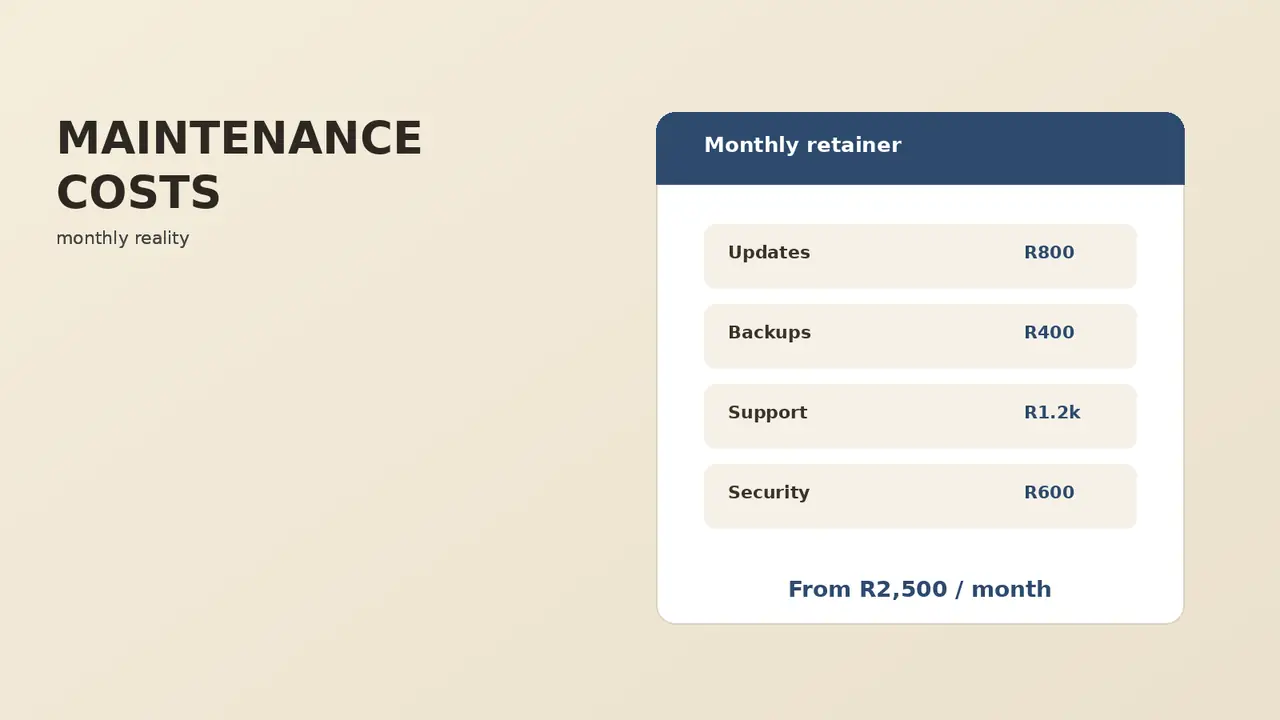
For routine upkeep on a typical store, that works out to roughly R600 to R1,200 a month. Add reactive capacity and you are looking at R1,500 to R3,000 depending on how much of a response guarantee you want.
Adding reactive cover costs 2.5 times routine upkeep
Per month, in rand. Agency work priced at R600 an hour. Labour is on top of fixed costs.
Routine upkeep is roughly one to two hours a month on a typical store.
Whether that is worth it comes down to one question, and it is not a technical one: what does an hour of your time cost, and what does a broken checkout cost you? A store doing R30,000 a month can reasonably self-manage. A store doing R300,000 a month where the owner is also the only person who can fix the site has a business continuity problem, not a maintenance problem.
What you can genuinely do yourself
- Updates on staging. Clone, update, click through a checkout, push live. Most hosts make this a two-click process now.
- Backup verification. Once a quarter, actually restore a backup somewhere and confirm it works.
- Uptime monitoring. Free services will email you when the store goes down. Set it up once.
- Plugin audits. Twice a year, look at what is installed and delete what you no longer use.
- Content and product updates. Obviously. This is what WordPress is good at.
What is usually worth paying for
- Anything touching checkout or payments. The cost of getting it wrong is immediate and measurable.
- Major version migrations and PHP upgrades. Low frequency, high risk, easy to get badly wrong.
- Compromise recovery. Cleaning a hacked store properly requires knowing where to look. Reinfection after a DIY cleanup is very common.
- Performance work. Diagnosing whether you have a hosting, caching or plugin problem takes experience, and guessing wrong wastes money on the wrong fix.
A realistic three-year picture
For a small South African WooCommerce store, self-managed, with modest premium plugin usage:
| Year 1 | Year 2 | Year 3 | |
|---|---|---|---|
| Hosting | R2,500 | R2,700 | R3,000 |
| Domain | R0 (free) | R120 | R120 |
| Plugin renewals | Included in build | R3,000 | R3,200 |
| Tools (email, SMTP) | R0 – R2,000 | R2,000 | R3,000 |
| Ad-hoc dev support | R3,000 | R4,000 | R4,000 |
| Total | ~R6,000 | ~R12,000 | ~R13,000 |
Year two costs twice as much as year one
Approximate annual total for a small self-managed store, in rand. From the table above.
Year one is lower because plugin licences are included in the build. Renewals of R3,000 to R3,200 a year start in year two.
These are illustrative and your numbers will differ, particularly on plugins and support. The point is the shape: year one is cheap because the build absorbed the licences, and years two onward settle into a real recurring cost. Budget for the second year, not the first.
WooCommerce maintenance FAQs
How much does WooCommerce maintenance cost per month in South Africa?
Roughly R400 to R1,200 a month in fixed costs for a small to medium store. Add R600 to R3,000 if you want someone managing it for you, depending on scope and response expectations.
Is WooCommerce really free?
The core plugin is. Running a store on it is not. Hosting, premium extensions, transactional email and someone’s time to maintain it are all real costs. WooCommerce being free changes where the money goes, not whether there is any.
Do I need a maintenance retainer?
Not necessarily. If you are comfortable with staging updates and your store is small, self-managing is reasonable. The trigger for a retainer is usually order volume — when a few hours of downtime costs more than a month of support, the maths changes.
What happens if I never update my store?
It keeps working, until it does not. The typical sequence is a plugin incompatibility after a PHP upgrade, or a compromise through a known vulnerability. Both are far more expensive to fix than the updates would have been.
Can I cancel premium plugin licences and keep using the plugin?
The plugin usually keeps functioning, but you stop receiving updates. On anything involved in checkout, payments or customer data, that is a security liability rather than a saving.
Is WooCommerce cheaper than Shopify long-term?
Often, but not automatically. WooCommerce has no monthly platform fee and no transaction fee, which is a real advantage at volume. It has higher maintenance overhead and you carry responsibility for hosting and updates. We compare them properly in our WooCommerce South Africa guide.
How do I reduce my WooCommerce running costs?
Audit plugins annually and cancel what you no longer use. Right-size hosting rather than defaulting to the biggest plan. Use free tiers on email and SMTP until you genuinely outgrow them. Do routine updates yourself and pay for the specialist work only.

We have built 400+ online stores for South African businesses since 2014. Read more about WooCommerce development in South Africa.