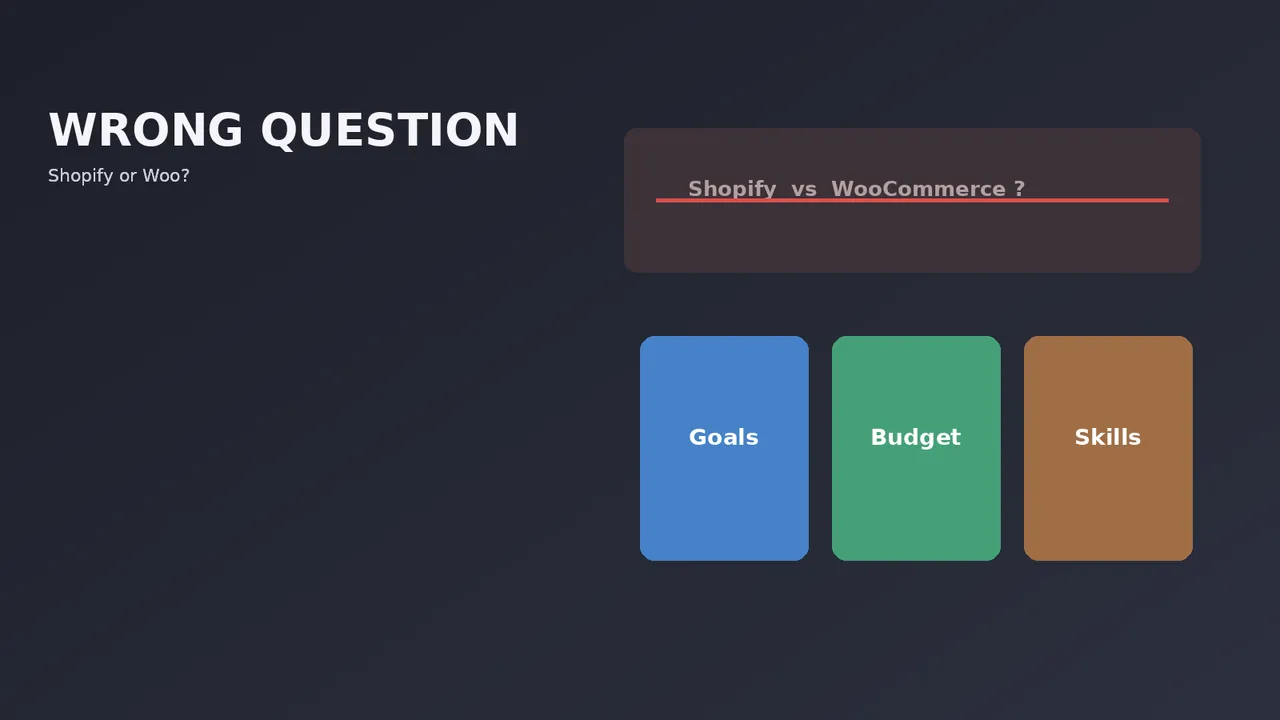

Shopify or WooCommerce? The question is wrong.
Almost every “which platform” article compares features. Features are not why stores fail. The right question is not which platform is better — it is which one fits how you actually run your business.
We build on both. That is worth saying upfront, because it means we have no reason to push you either way, and we have seen enough stores on each to know that the platform is rarely the thing that determines whether a business works.
The eCommerce Platform Picker exists because the honest answer to “which platform should I use” is six questions long, and nobody wants to read a 4,000-word comparison to find out.
Why feature comparisons mislead
Pick any two major platforms and list their features side by side. You will find that both do product variants, both do discount codes, both do abandoned cart recovery, both integrate with the couriers and gateways you need. The lists are nearly identical, because the market forced them to be.
What the lists do not tell you is the thing that matters: what happens when you need something the platform did not anticipate.
That is where the platforms genuinely differ, and it is invisible in a feature table. On one, you install an app. On another, a developer writes code. On a third, you discover it is not possible at all without moving to a higher tier.
The four questions that actually decide it
Four questions, not a feature list
Question 1 predicts the outcome best. Each is covered below.
1. Who maintains this in two years?
The single most predictive question, and the one nobody asks.
If the answer is “me, and I am not technical”, a hosted platform is almost certainly right. You are paying a monthly fee to make updates, security and hosting somebody else’s problem. That is a good trade.
If the answer is “we have a developer, or an agency on retainer”, self-hosted opens up and the monthly saving becomes real. We costed the ongoing side in what WooCommerce maintenance actually costs.
2. How weird is your business?
Standard retail — products, variants, cart, checkout — runs well anywhere. The platform choice barely matters.
The moment you need customer-specific pricing, approval workflows, complex product configuration, quote requests, or integration with an ERP that predates the internet, the calculation changes sharply. Self-hosted handles idiosyncratic requirements without asking permission. We went through what that looks like in WooCommerce B2B and wholesale.
3. What is your realistic 24-month volume?
Transaction fees and platform fees scale with revenue. Maintenance overhead scales with complexity, not revenue.
At low volume, a monthly platform fee is trivial and the hands-off convenience is worth a lot. At high volume, a percentage on every transaction becomes a meaningful line item and self-hosting starts paying for itself. Where that crossover sits depends on your margin, which is why the profit calculator is a more useful input here than any comparison article.
4. What is your tolerance for things breaking?
Hosted platforms break less. Updates are tested centrally, hosting is managed, and you cannot install a plugin that takes the site down.
Self-hosted gives you control, and control includes the ability to break things. If a store being down for two hours is a genuine emergency for your business and there is nobody on hand to fix it, that risk has a real cost.
Where each genuinely wins
| Situation | Usually better | Why |
|---|---|---|
| First store, non-technical owner | Hosted | Hosting, security and updates handled |
| Existing WordPress site adding a shop | WooCommerce | One system, one login, content and commerce together |
| B2B or wholesale pricing | WooCommerce | Customer-specific pricing without a premium tier |
| High volume, simple catalogue | Hosted | Reliability and scale without infrastructure work |
| Heavy content plus commerce | WooCommerce | WordPress is still the better publishing system |
| No technical support at all | Hosted | The maintenance burden has to go somewhere |
| Tight ERP or accounting integration | WooCommerce | Open API, no platform gatekeeper |
| Selling internationally, multi-currency | Hosted | Handled natively rather than bolted on |
Notice that these are situations, not features. That is the point.
The South African wrinkle
One thing that genuinely differs here and gets missed in international comparisons: payment gateway support.
Shopify Payments is not available in South Africa, which means you use a local gateway and Shopify adds its own fee on top of the gateway’s on every plan: 2% on Basic, 1% on Grow, 0.6% on Advanced and 0.2% on Plus. That is a real cost that does not exist on self-hosted, and it does not appear in any global comparison because it is a South Africa-specific quirk. We covered the workaround in how to accept payments on Shopify in South Africa.
Shopify’s extra fee is highest on the cheapest plan
Third-party transaction fee by plan, on top of the gateway fee. Self-hosted stores pay none.
Applies because Shopify Payments is not available in South Africa.
Local hosting is the other one. A self-hosted store can sit in a Johannesburg data centre; a hosted platform serves from wherever its infrastructure lives. For a store selling only to South African customers, that latency difference is real — the detail is in our hosting guide.
Use the picker, then sanity-check it
Six questions, about 45 seconds, no email required. It weighs your answers across platform, stage, technical support and requirements, and returns a recommendation with the reasoning attached rather than just a logo.
Then apply one sanity check: does the recommendation match who maintains the store in two years? If the tool says self-hosted and you have nobody technical, take that seriously before committing. That mismatch is the most common reason a platform choice goes wrong, and no quiz can weigh it as well as you can.
If you have already chosen and you are having doubts
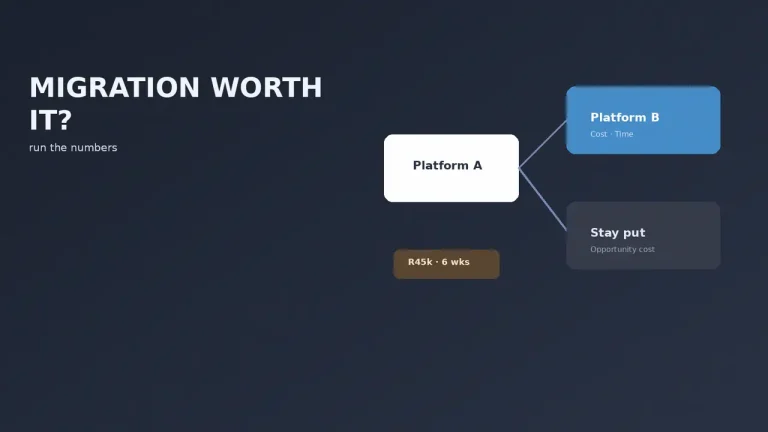
Doubt about your platform is usually doubt about something else. Before you consider moving, check whether the actual complaint is the theme, the hosting or the plugin stack — those are all far cheaper to fix. And if you are seriously weighing a move, cost it properly with the Migration ROI Estimator before anyone starts quoting.
For the deeper comparison, we go platform by platform in Shopify vs WooCommerce vs 8 other platforms.

We have built 400+ online stores for South African businesses since 2014. Read more about eCommerce development in South Africa.