Fraud orders and chargebacks: how South African online stores spot them, stop them and win disputes
Digital banking fraud in South Africa hit R2.4 billion in 2025, and online stores sit right in the firing line. One bad order can cost you the money, the stock, the courier fee and a dispute fee. This guide shows the warning signs to check before you ship, how chargebacks actually work, how to win the ones you can, and the setup that keeps fraud off your store, with a free risk checker and chargeback cost calculator.
The short answer
Most fraud is visible before you ship. Failed payment attempts, several cards on one account, mismatched names and addresses, high-value resellable goods and a rush to deliver are the patterns that show up again and again. Hold any order with several of these signs and confirm it first.
A refund is always cheaper than a chargeback. If you can’t confirm a suspicious order, refund it. A lost chargeback costs the order value, the goods, the delivery and a dispute fee, often close to double what the customer paid.
3D Secure is your best shield. When a card payment is authenticated, fraud liability shifts to the card issuer. Keep it on, keep proof of delivery, and you’ll win most of the disputes worth fighting.
Order fraud risk checker
Tick the warning signs on a suspicious order, get a ship, review or hold decision, and work out what chargebacks cost your store each year.
How big is the fraud problem in South Africa?
The South African Banking Risk Information Centre (SABRIC) reported R2.4 billion in digital banking crime losses for 2025, up 29.2% from about R1.9 billion the year before, across 110,074 incidents. Banking apps accounted for about 89% of digital banking cases. Card fraud also grew, by about 18%, and card-not-present fraud, the kind that happens online, remains the largest category of card fraud.
For online stores this matters in two ways. Stolen card details and hijacked bank accounts are used to buy goods that can be resold quickly. And as more South Africans shop online, more disputes come from genuine customers too: parcels that went missing, goods that weren’t what they expected, or a purchase they simply don’t recognise on their statement.
Card fraud losses in South Africa, 2025
Gross losses by card type, rand millions
Source: SABRIC Annual Crime Statistics 2025.
The fraud types SA stores actually see
| Type | What happens | Who pays | Best defence |
|---|---|---|---|
| Stolen card | A fraudster uses someone else’s card details to buy goods they can resell. | You, unless the payment passed 3D Secure | 3D Secure, risk checks before shipping |
| Card testing | Bots run hundreds of small payments to find which stolen cards work. | You pay gateway fees on every attempt, plus chargebacks | CAPTCHA on checkout, rate limits, gateway velocity rules |
| Account takeover | A criminal logs in to a real customer’s account or banking app and pays from it. | Usually the bank or customer, but disputes still reach you | Strong passwords, login alerts, watch for address changes |
| Fake proof of payment | A buyer sends a doctored EFT “proof of payment” screenshot and asks you to ship. | You, in full | Ship only when the money shows in your bank account, or use instant EFT |
| Friendly fraud | A real customer gets the goods, then disputes the charge as “not received” or “not authorised”. | You, unless you have evidence | Proof of delivery, clear billing name, fast support |
| Refund and return abuse | Returns of used, swapped or empty items, or claims that the box arrived empty. | You | Weighed parcels, sealed packaging, clear returns policy |
| Interception and redirection | The buyer asks to change the delivery address or collect at a different point after paying. | You | Refuse address changes on risky orders without re-verifying |
Watch out for fake proof of payment. This is one of the most common scams on South African stores that accept manual EFT, especially for sellers on WhatsApp and social media. A screenshot or emailed PDF proves nothing: payments can be reversed, and “proof” can be edited in minutes.
Only ship once the money has cleared in your own bank account, or switch to instant EFT, Capitec Pay or PayShap so payment is confirmed in real time.
13 warning signs to check before you ship
No single sign proves fraud. A new customer ordering express delivery is often just a new customer in a hurry. What matters is how many signs stack up on one order. These are the ones our risk checker scores:
| Warning sign | Risk | Why it matters |
|---|---|---|
| Several failed payment attempts before one went through | High | Classic card testing, or someone working through stolen cards |
| More than one card tried on the order or account | High | Genuine buyers rarely switch between several cards |
| Several orders to one address with different names or cards | High | Often a drop address used to collect fraudulent orders |
| Order far above your average order value | High | Fraudsters maximise each stolen card |
| Billing and delivery addresses differ | Medium | Common with gifts, so check it with other signs |
| Easy-to-resell goods: phones, laptops, sneakers, vouchers, airtime | Medium | Fast cash for fraudsters |
| Foreign card, or IP location far from the delivery address | Medium | Card and buyer may not be in the same place |
| Pressure to ship urgently, or an address change after paying | Medium | Fraudsters want goods out before the cardholder notices |
| Name doesn’t match the email or cardholder | Medium | Can be innocent, worth a quick check |
| Express delivery on a high-value first order | Medium | Shrinks your window to spot the problem |
| Phone number unreachable or doesn’t match | Medium | Real customers answer delivery calls |
| High-value order to a pickup point or locker | Low to medium | Harder to tie to a real person |
| Random-looking free email, or brand-new customer | Low | Weak on its own, adds up with others |
What to do with a flagged order
Low risk: ship
One or two minor signs. Ship as normal, with tracking and proof of delivery.
Review: confirm first
Call or WhatsApp the customer on the number given, confirm the order and the name on the card, and hold shipping until you’re comfortable. Offer instant EFT if the card looks off.
High risk: hold or refund
Don’t ship. Contact the customer through details you can verify. If you can’t confirm the order, refund it in full. A refund costs only the gateway fee.
How a chargeback works
A chargeback is when a cardholder disputes a payment with their bank instead of with you, and the bank takes the money back from your account while it investigates. You don’t get a say before the money goes. You only get the chance to respond with evidence afterwards.
The cardholder tells their bank they don’t recognise or aren’t happy with a payment.
The bank reverses the funds and your gateway debits your account, usually with a dispute fee.
Your gateway notifies you with a reason and a deadline to respond.
You submit proof: order, authentication, delivery, communication.
The issuing bank decides. Fraud disputes can take 30 to 90 days.
Cardholders generally have months, not days, to raise a dispute: card schemes typically allow up to about 120 days from the transaction. That’s why you keep order records, delivery proof and messages for at least six months.
What a chargeback really costs
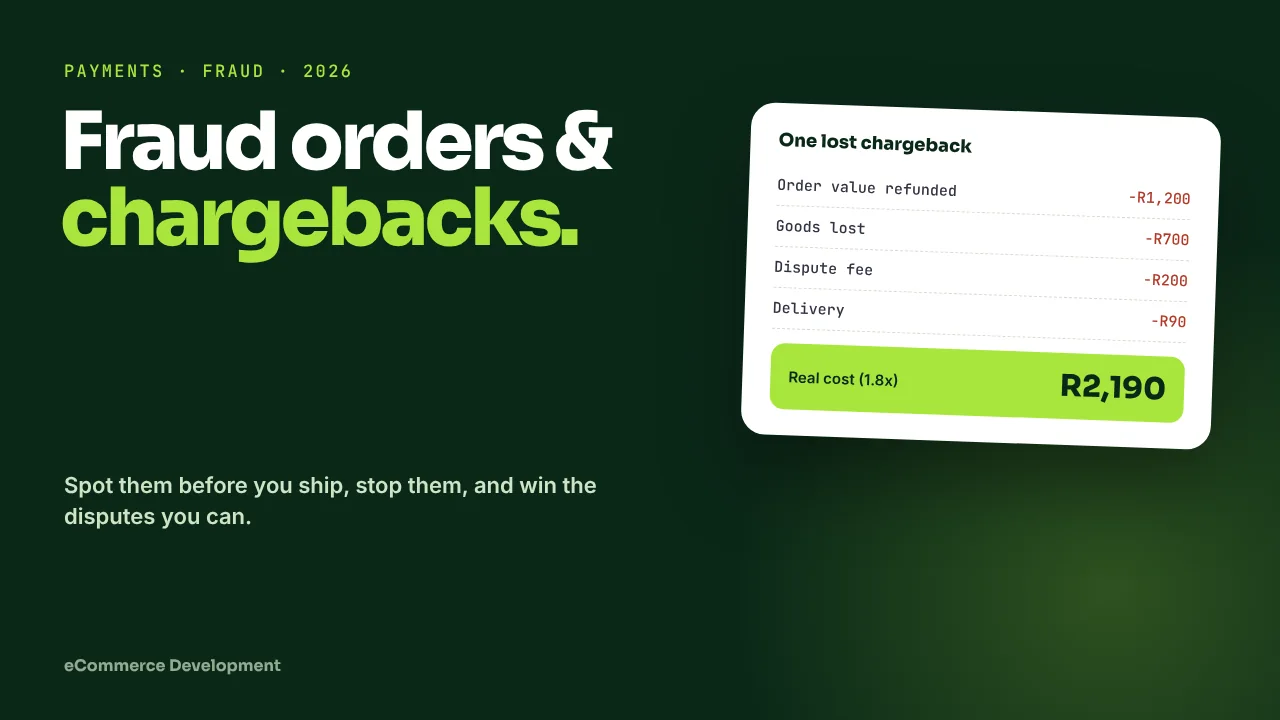
Using the defaults in our calculator, a R1,200 order on goods that cost you R700, with R90 delivery and a R200 dispute fee, costs R2,190 when you lose. That’s 1.8 times the order value. Three of those a month adds up to almost R79,000 a year.
Cost of one lost chargeback
Example: R1,200 order, rand
Illustrative. Dispute fees at SA gateways typically run about R150 to R300; check your own agreement. Run your numbers in the chargeback cost calculator.
There’s a hidden cost too. Gateways and card schemes watch your chargeback ratio, the share of transactions that end in a dispute. Around 1% is the line where many providers start asking questions, adding reserves or, in the worst case, closing the merchant account.
Chargeback reasons, and the evidence that wins
| Reason | What the cardholder says | Evidence that wins | Winnable? |
|---|---|---|---|
| Fraud / not authorised | “I didn’t make this payment.” | 3D Secure authentication record, matching IP and device, delivery to the cardholder’s address, past orders from the same customer | Usually, if 3DS was used (liability shifts to the issuer) |
| Item not received | “I never got my order.” | Courier tracking with a delivery scan, signature, photo, or locker collection record | Yes, with proof of delivery |
| Not as described | “It’s not what I ordered” or “it’s faulty.” | Product page screenshot, photos before dispatch, returns policy, your offers to fix it | Sometimes |
| Cancelled or refund not processed | “I cancelled or returned it and wasn’t refunded.” | Refund confirmation, or proof the return never arrived | Yes, if you refunded |
| Duplicate charge | “I was charged twice.” | Proof the two charges were separate orders | Yes, if they were |
| Subscription | “I cancelled this.” | Signed-up terms, cancellation policy, reminder emails, usage records | Sometimes |
Merchants who respond with strong, organised evidence win somewhere around 20 to 40% of disputes. Merchants who don’t respond lose all of them by default.
Your evidence pack checklist
- Order confirmation with date, items, amount and the customer’s details
- Payment record showing 3D Secure authentication (from your gateway)
- IP address and device of the order, if your platform logs them
- Courier tracking with delivery confirmation, signature or photo
- All emails and WhatsApp messages with the customer
- Your product page as it looked at the time, and your terms and returns policy
- Any earlier orders from the same customer that weren’t disputed
- A short, plain summary of what happened, in date order
The prevention setup we use on SA stores
1. Keep 3D Secure on, and use a gateway with EMV 3DS
3D Secure is mandatory for South African online card payments, and it’s the single biggest shield against fraud chargebacks. Modern EMV 3DS (3DS2) approves most low-risk payments without an OTP, so you keep the protection without hurting conversion. We cover this in detail in is 3D Secure killing your checkout?
2. Offer payment methods that can’t be charged back like cards
Instant EFT, Capitec Pay and PayShap are confirmed by the customer’s own bank in real time, and don’t carry card-style chargebacks. Cash-based options, like paying at a till, remove card fraud entirely. Offering these alongside cards gives risky-looking buyers a safer way to pay.
3. Turn on your platform’s fraud tools
| Platform | What’s built in | What to add |
|---|---|---|
| Shopify | Fraud analysis on every order with a low, medium or high risk level and the reasons behind it | Shopify Flow rules to tag or hold high-risk orders, and a fraud app for higher volumes |
| WooCommerce | Depends on your gateway; some include risk scoring and fraud filters | A fraud screening plugin, checkout CAPTCHA, and limits on failed payment attempts |
| Gateway | Most SA gateways offer 3DS, velocity rules and dispute notifications | Ask for fraud rules, blocklists and alerts to be switched on |
4. Stop card testing at the door
If you see dozens of small failed payments in a short time, you’re being card tested. Add a CAPTCHA to checkout, limit payment attempts per session, and ask your gateway to block the source. Card testing burns gateway fees and can get your account flagged even if no order ships.
5. Make your shipping prove delivery
Use tracked couriers, ask for signatures on high-value orders, and send expensive items to the cardholder’s address rather than a third-party pickup point. Weigh and photograph parcels before dispatch to answer “the box was empty” claims.
6. Make your business easy to recognise
Many “fraud” disputes are genuine customers who don’t recognise the charge. Make sure the name on card statements matches your store name, send clear order and shipping emails, and answer messages fast. A customer who can reach you won’t go to their bank.
Black Friday and peak season
Fraud rises with order volume. During Black Friday and the festive season, stores are busy, staff are rushed, and checks get skipped. Before peak:
- Set clear rules for which orders get held for review, and who reviews them
- Check that 3D Secure, CAPTCHA and gateway fraud rules are active
- Agree a cut-off: high-value orders from new customers get confirmed before dispatch
- Watch your gateway dashboard daily for spikes in failed payments
- Keep every order and delivery record for at least six months
Questions
Who pays when an online order is fraudulent?
If the card payment was authenticated with 3D Secure, fraud liability generally shifts to the card issuer, so you shouldn’t lose a fraud chargeback. If it wasn’t, or if the dispute is about delivery or quality rather than fraud, the merchant usually pays.
How much is a chargeback fee in South Africa?
It depends on your gateway, but dispute fees typically run about R150 to R300 per chargeback, charged whether you win or lose. Check the fee schedule in your gateway agreement.
How long can a customer take to dispute a payment?
Card schemes typically give cardholders up to about 120 days from the transaction, sometimes longer for goods that were never delivered. Keep records for at least six months.
Can EFT payments be charged back?
Not in the same way as cards. The bigger EFT risk is fake proof of payment, so only ship when the money has cleared in your own account, or use instant EFT, Capitec Pay or PayShap, which confirm payment in real time.
Should I cancel an order I think is fraud?
If you can’t confirm it, yes: refund it in full and don’t ship. A refund costs you only the gateway fee, while a lost chargeback costs the order, the goods, the delivery and a dispute fee.
Do I have to accept a chargeback?
No. You can respond with evidence through your gateway before the deadline. Fight disputes where you have proof of authentication or delivery, and accept ones where you clearly made a mistake.
Sources
- SABRIC: 2025 Annual Banking Crime Statistics report
- BusinessTech: R2.4 billion stolen from South Africans
- BusinessTech: alarm bells for banking app users
- TechCentral: criminals go digital
- Kolonell: chargeback and refund management for card payments in South Africa
- Kolonell: fraud velocity checks for online orders
- PASA: 3D Secure consumer FAQ
- Stitch: card payment failure in South Africa

We have built 400+ online stores for South African businesses since 2014. Read more about eCommerce development in South Africa.