Is 3D Secure killing your checkout? Card declines, OTPs and failed payments in South Africa
Nearly one in four online card payments in South Africa fail, and most shoppers who hit a failure never come back. Card declines are now the number one checkout problem SA retailers report. Here is why payments fail, what 3D Secure really does, and the fixes that win sales back, with a free calculator to price your own leak.
The short answer
3D Secure isn’t the main problem, and you can’t switch it off. In Stitch’s 2026 data only about 5% of failed card payments are abandoned at the 3D Secure step. Most fail because of insufficient funds, wrong card details, card limits or bank declines.
The fix is choice, not removing security. Add instant EFT, Capitec Pay and digital wallets so shoppers whose card fails have another way to pay, use a gateway with EMV 3DS and smart retries, and follow up failed payments within the hour.
Checkout leak calculator
See what failed card payments cost your store each month and how much the fixes below could win back.
What 3D Secure is, and why it’s mandatory in SA
3D Secure (3DS) is the extra check your bank runs on online card payments: an OTP by SMS, an approval in your banking app, or a silent risk check. The Payments Association of South Africa (PASA) required all South African online merchants to use it from 28 February 2014, with the Reserve Bank’s backing.
- You can’t turn it off. Banks and card schemes can fine merchants for transactions that skip it.
- It protects you. Authenticated transactions shift fraud liability to the card issuer. Without 3DS, you carry the fraud loss.
- Some payments are exempt, such as recurring or stored-card transactions set up correctly.
- Overseas cards without 3DS can fail at South African checkouts.
Old 3DS vs EMV 3DS (3DS2)
Shopper enters card details.
EMV 3DS shares device and transaction data with the bank.
Low risk: approved with no OTP. Mastercard says about 90% of EMV 3DS payments go this way.
Higher risk: OTP or app approval. Payments fail if the shopper doesn’t respond in time.
SA banks have moved this way for years. FNB replaced SMS OTPs with in-app approvals in November 2020, and approves purchases it judges secure without any step. Capitec introduced EMV 3DS with risk scoring in 2022: low-risk payments go straight through, high-risk ones get an in-app prompt or biometrics. Ask your gateway whether it supports EMV 3DS for all major SA banks.
Why card payments really fail
Why SA online card payments fail
Share of failed card attempts by reason, Q1 2026.
Source: Stitch platform data, Q1 2026.
| Reason | What’s happening | What helps |
|---|---|---|
| Insufficient funds | Peaks on the 1st and stays high to about the 6th of the month | Instant EFT, BNPL, payday timing for promotions |
| Invalid card details | Typos on small phone screens | Wallets (no typing), card autofill, clear field errors |
| Withdrawal or card limits | Online or daily limits set too low | Tell shoppers how to raise limits in their banking app; offer EFT |
| Bank declined, false declines | Risk rules block genuine buyers. Capitec data puts false declines from 3DS checks at 10–15% of genuine transactions | EMV 3DS, smart retries, alternative methods |
| Online or international payments switched off | Some cards need online use enabled in the app, or a virtual card | Clear decline message with steps |
| 3DS abandoned or timed out | OTP not received, bank app not opened in time, network drop | App-based approval, retry button, alternative method |
What SA retailers say
The World Wide Worx Online Retail in South Africa 2026 report surveyed 201 retailers. Card declines jumped to the top of the list of abandonment causes.
| Top causes of cart abandonment | Retailers citing it |
|---|---|
| Card declines | 61.2% (27.9% a year earlier) |
| Shipping fees | 51.7% |
| Required account creation | 43.8% |
| Checkout too long or complicated | 40.3% |
| Site or checkout errors | 31.3% |
| Causes of unsuccessful payments | Retailers citing it |
|---|---|
| Checkout or website errors | 60.7% |
| Insufficient funds | 50.7% |
| Abandonment during authentication | 50.7% |
| Suspected fraud | 30.8% |
| Issuer-side declines | 25.9% |
Note the difference: half of retailers name authentication abandonment as a cause, but Stitch’s transaction data shows it’s about 5% of failures. It happens at many stores, but it isn’t the biggest reason for failures.
The fixes that work
1. Give shoppers a second way to pay
| Method | Why it helps | Retailers offering it (2026) |
|---|---|---|
| Instant EFT / Pay by Bank | No card limits or card details; bank-native methods succeed about 20 points more often than cards (Stitch) | 40.8% offer instant EFT or PayShap |
| Capitec Pay | Approve in the Capitec app with a phone number or ID; about 40% of payment value at some processors | Growing fast |
| Apple Pay, Google Pay, Samsung Pay | Tokenised and biometric; about 96% success for Apple Pay vs about 80% for cards, done in seconds | 36.8% |
| Buy now, pay later | Helps when the shopper is short of funds before payday | 54.7% |
| PayShap | Real-time payments; 136m+ transactions worth over R100bn since 2023 | 6.5% |
Compare gateways that bundle these methods in our payment gateway cost breakdown and Pay@ Gateway review, and BNPL options in our BNPL guide.
2. Use a gateway that fights declines for you
- EMV 3DS (3DS2): more payments approved without an OTP.
- Smart retries and routing: soft declines are retried through another route. Peach (Smart Retry) and Stitch (smart routing) both offer this.
- Success rates by method in the dashboard, so you can see where payments fail.
3. Fix the checkout itself
- Cut fields. Baymard finds the average checkout has 23 form fields; it recommends about 12.
- Allow guest checkout. 43.8% of SA retailers say forced account creation causes abandonment.
- Show delivery costs early. Shipping fees are the second biggest abandonment cause.
- Write human decline messages. “Your bank declined this payment. Try again, use instant EFT or check your online limit in your banking app” beats “Transaction failed”.
- Add a one-tap retry and an alternative-method button on the failure screen.
- Design for mobile first. Baymard puts mobile abandonment at about 80% vs 66% on desktop.
- Avoid unexpected redirects. 57% of SA shoppers treat surprise pop-ups or redirects as a red flag (Stitch).
4. Recover failed payments
71% of shoppers abandon after a single failed attempt. Send a failed-payment email or WhatsApp within the hour with a direct payment link and an alternative method. It works like abandoned cart recovery, with a warmer lead. See our abandoned cart recovery playbook.
5. Plan around payday
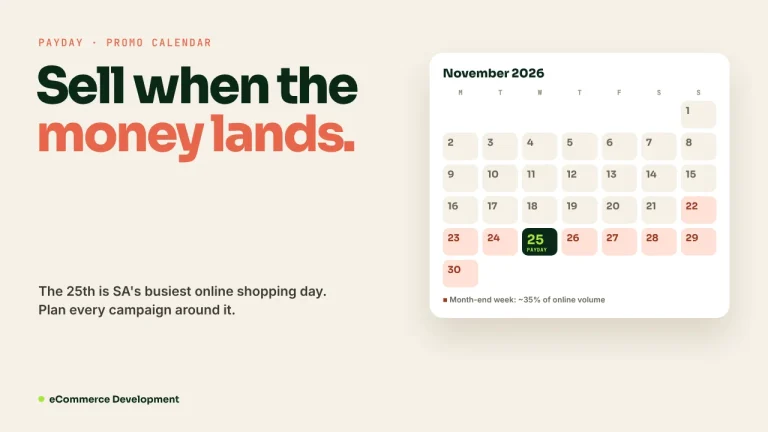
Insufficient funds failures peak in the first days of the month. Time big promotions for just after payday (around the 25th) and promote EFT and BNPL near month-end.
What is your checkout leak worth?
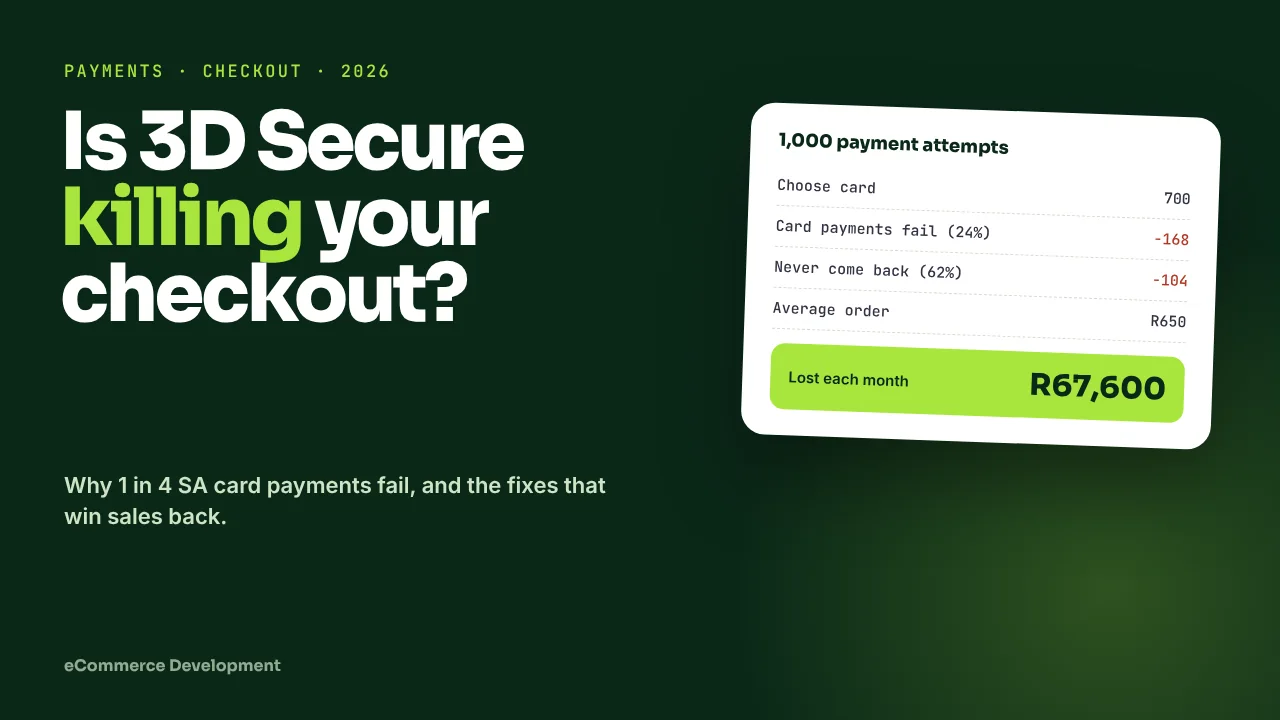
On 1,000 payment attempts a month at R650, failed cards can cost about R68,000 in lost sales. See yours.
Common mistakes
- Offering card only. One in four card attempts fails; a card-only checkout has no plan B.
- Blaming 3D Secure and trying to bypass it. You lose the liability shift and can be fined.
- Not measuring success rate by method. You can’t fix what you don’t track.
- Generic error messages that leave the shopper guessing.
- No follow-up on failed payments, which are your warmest lost sales.
Want us to fix your checkout? We audit payment success rates, add the right methods and set up recovery flows. See our Shopify and WooCommerce services, read our CRO guide, or get a quote within 24 hours.
Frequently asked questions
Why do so many online card payments fail in South Africa?
Mostly not because of 3D Secure. Stitch’s Q1 2026 data shows the main reasons are insufficient funds (about 37% of failures), invalid card details (27%), withdrawal limits (15%) and bank declines (10%). Abandoned 3D Secure is about 5%.
Can I turn off 3D Secure on my store?
No. PASA has required 3D Secure for South African online card payments since 2011. Transactions without it carry no liability shift, and merchants can be fined.
What is frictionless 3D Secure?
With EMV 3DS (3DS2), the bank risk-scores each payment using device and transaction data. Low-risk payments are approved with no OTP. Mastercard says about 90% of EMV 3DS transactions are frictionless.
Which payment methods fail least?
Digital wallets: Stitch reports about 96% success for Apple Pay against about 80% for cards. Bank-native methods like instant EFT and Capitec Pay succeed about 20 percentage points more often than cards.
How do I recover a failed payment?
Show a clear message with a retry button and an alternative method, then send an email or WhatsApp within the hour with a payment link. Most shoppers who hit a failure won’t try again on their own.
Sources
- PASA: 3D Secure consumer FAQ
- Peach Payments: is 3D Secure mandatory?
- Stitch: card payment failure in South Africa (Q1 2026 data)
- Stitch: how South Africans shop in 2026
- Stitch: the state of consumer payments in South Africa
- Stitch: the state of PayShap in 2026
- TechCentral: World Wide Worx Online Retail in South Africa 2026
- Peach Payments: 2026 Online Retail Report
- IT-Online: etailers urged to safeguard Black Friday payments (Oct 2026)
- BusinessTech: FNB app-based payment approvals
- IT-Online: Capitec EMV 3-D Secure
- Mastercard: EMV 3-D Secure
- Baymard Institute: cart abandonment rate
- Peach Payments: Smart Retry

We have built 400+ online stores for South African businesses since 2014. Read more about eCommerce development in South Africa.