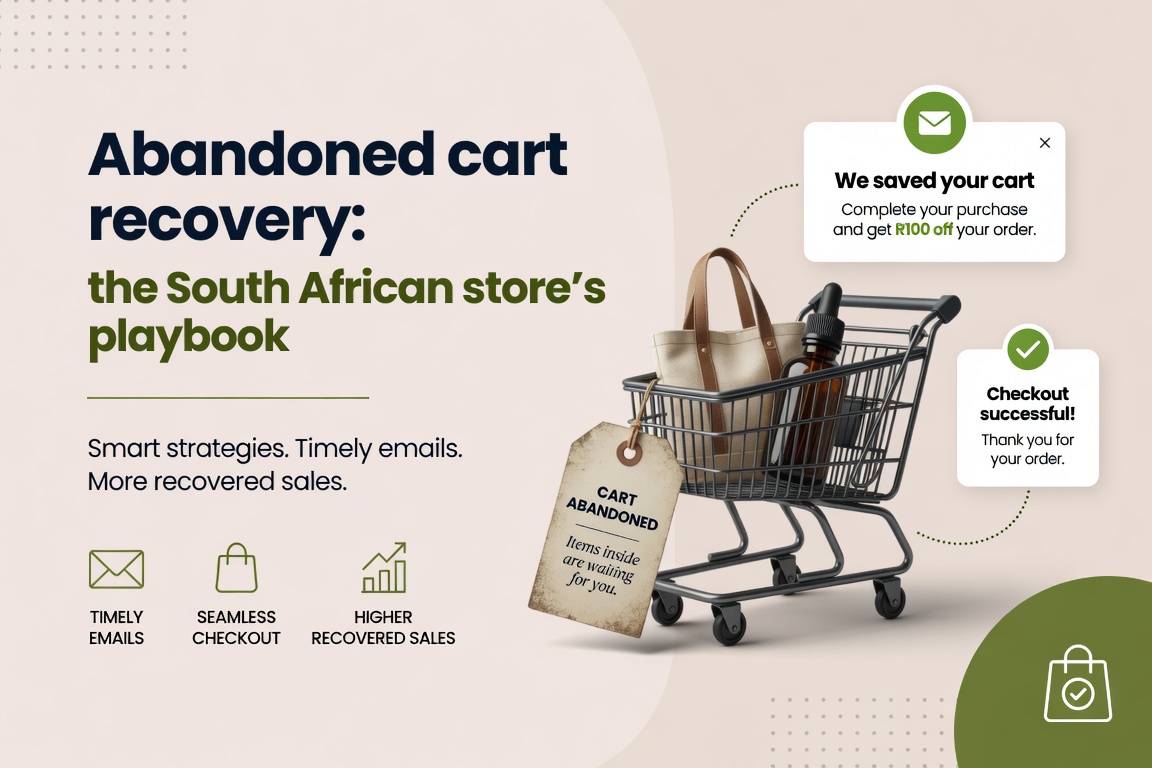

Abandoned cart recovery: the South African store’s playbook
Roughly 7 in 10 online carts get abandoned before checkout. That’s not lost demand — it’s interested buyers who got that close and stopped. Recovering even a fraction of them is the cheapest sales growth available to your store. Here’s how to do it, SA-specific.
Cart abandonment is the most under-worked growth lever in ecommerce. The global average abandonment rate sits around 70% — meaning for every ten people who add to cart, seven leave without buying. The instinct is to chase more traffic, but recovering carts you already have is far cheaper than acquiring new visitors: these are people who were interested enough to add to cart and got within a step of paying. You don’t need to convince them your product is good; you need to remove whatever stopped them.
This is the playbook we use with SA stores — first reducing why carts get abandoned, then recovering the ones that still slip away. The order matters: fixing the leak beats bailing water.
First, understand why South Africans abandon carts
Recovery starts with cause. The big reasons carts get abandoned, with the SA-specific ones flagged:
- Shipping cost shock — the single biggest cause globally and acutely so in SA, where courier costs are high. A customer who sees an unexpected R99 delivery fee at the final step often just leaves.
- Being forced to create an account — making people register before they can pay kills conversions. Guest checkout is essential.
- A long or confusing checkout — every extra field and step loses people.
- Limited payment options — SA shoppers expect more than cards: instant EFT, and increasingly Buy Now Pay Later. A card-only checkout loses the large share of buyers who prefer EFT.
- No trust — no clear returns policy, no contact details, no security cues. SA shoppers are cautious about online fraud and need reassurance.
- Just browsing / not ready — some abandonment is natural; these are the carts recovery emails are built for.
Fix the leak first, then recover what still slips
The four steps of this playbook, in order.
Step 1: Fix the checkout (stop the leak first)
Before you send a single recovery email, plug the obvious holes. The highest-impact fixes for SA stores:
- Show shipping costs early. Don’t spring them at the final step. Better still, offer free shipping above a threshold — it removes the shock and lifts average order value at the same time.
- Enable guest checkout. Let people pay first and optionally create an account after. Never force registration.
- Offer the payment methods SA shoppers want. Cards plus instant EFT at minimum; add Buy Now Pay Later for considered purchases. Our BNPL guide and Payment Gateway Comparator cover the options — offering a pay-later choice directly recovers carts abandoned on price.
- Shorten the checkout. Remove every non-essential field. Fewer steps, fewer drop-offs.
- Add trust at the checkout. Visible returns policy, secure-payment cues, contact details. Reassurance converts cautious SA buyers.
Every main abandonment cause has a checkout fix
Causes from the list above, matched to the fix for each.
| Why they leave | The fix |
|---|---|
| Shipping cost shock | Show shipping early, or offer free shipping above a threshold |
| Forced account creation | Guest checkout, optional account after payment |
| Long or confusing checkout | Remove every non-essential field and step |
| Card-only payment | Add instant EFT, and BNPL for considered purchases |
| No trust | Visible returns policy, secure-payment cues, contact details |
These fixes lift conversion across every visitor, not just the ones you email later — which is why they come first.
Step 2: Set up abandoned cart recovery flows
For the carts that still slip away, an automated recovery sequence is the workhorse. When someone adds to cart and reaches checkout but doesn’t complete (you capture their email at the email-entry step), an automated series of reminders goes out. A proven structure:
| Timing | Message | Angle |
|---|---|---|
| ~1 hour after | “You left something behind” | Helpful reminder, show the product |
| ~24 hours after | Reminder + reassurance | Address objections: shipping, returns, reviews |
| ~48–72 hours after | Final nudge, optional incentive | Light urgency or a small discount/free shipping |
A few principles that make these work: send the first one fast (intent decays quickly), show the actual product they left with a one-click link back to their cart, and address the likely objection rather than just nagging. Save the discount for the final email — if you lead with one, you train customers to abandon carts on purpose to get money off.
Step 3: Capture more carts to recover
You can only email abandoned carts where you captured an email. Two ways to capture more: collect the email early in checkout (most platforms let the email field come first), and run an email-capture popup or sign-up offer so you’re building a list of people you can remarket to even before they reach checkout. A modest welcome incentive for first-time subscribers pays for itself in recovered and repeat sales.
Step 4: Add the supporting tactics
- Retargeting ads. Pair email recovery with retargeting (Meta/Google) so abandoners also see your product as they browse elsewhere. Belt and braces — some people respond to the ad, some to the email.
- WhatsApp recovery. Increasingly effective in SA given how dominant WhatsApp is. A polite, opted-in WhatsApp nudge can outperform email for local audiences.
- On-site exit reminders. A subtle prompt as someone goes to leave the cart page can catch the “wait, let me think” abandoners before they’re gone.
Which tools to use
On Shopify, your email platform usually handles cart recovery flows — MailerLite for most stores, Klaviyo when you need advanced segmentation and the strongest recovery automations. Both have proven abandoned-cart sequences you can switch on. For WooCommerce, similar plugins and integrations cover the same ground. Don’t add a dedicated cart-recovery app on top of an email tool that already does it — that’s the app bloat we warn about in how many apps you actually need. Get a tailored set from the App Stack Recommender.
What recovery is actually worth
Cart recovery flows typically recover a meaningful single-digit-to-low-double-digit percentage of abandoned carts — and because the cost is essentially an email, almost all of that recovered revenue is profit. On a store doing decent volume, that’s real money for a one-time setup. The maths is simple: if you’re abandoning 70% of carts and recover even a tenth of them, you’ve added a chunk of revenue at near-zero marginal cost. That’s why it’s the cheapest growth in ecommerce — and why leaving it switched off is leaving money on the table.
Recovering a tenth of abandoners turns 30 sales into 37
Out of 100 carts, at the 70% abandonment rate in this post.
Recovery rates vary: the post puts them at a single-digit to low double-digit share of abandoned carts. One in ten is used here.
Frequently asked questions
The bottom line
Abandoned carts aren’t lost causes — they’re your warmest prospects, one step from buying. The playbook is simple and high-return: first fix the checkout friction that causes abandonment (shipping shock, forced accounts, limited payment options, weak trust), then recover the rest with an automated email flow, capture more emails to recover, and back it with retargeting and WhatsApp. Because the marginal cost is almost nothing, nearly all recovered revenue is profit.
If your checkout is leaking and you want it fixed — or recovery flows set up properly on your Shopify or WooCommerce store — that’s exactly the kind of conversion work we do. It’s usually the fastest payback of anything on a store.

We have built 400+ online stores for South African businesses since 2014. Read more about eCommerce development in South Africa.