VAT for South African online stores: when to register and how it works
VAT is one of the most misunderstood parts of running an SA online store — and getting it wrong, in either direction, is expensive. Here’s a plain-English guide to when you must register, how VAT works for an online store, and the pricing trap that catches growing stores off guard.
VAT — Value-Added Tax — is the 15% tax on most goods and services in South Africa, and at some point every growing online store has to deal with it. The trouble is that VAT is widely misunderstood by store owners: some register too early and create needless admin, others ignore it until they blow past the threshold and face a nasty surprise, and many price their products as if VAT doesn’t exist and then have to absorb 15% they can’t recover. Understanding the basics saves you all three mistakes.
This is a plain-English guide to VAT for an SA online store: when you have to register, when you might choose to, how it actually works day to day, and the pricing trap to avoid. Note: this is general information to help you understand the landscape, not tax or accounting advice — for your specific situation, speak to an accountant or tax practitioner.
When you must register for VAT
The key number: VAT registration becomes compulsory once your business’s taxable turnover exceeds R1 million in any consecutive 12-month period (or you expect it to within the next 12 months under a contract). “Turnover” here means your total sales, not your profit — so a store selling R1m of goods must register even if its actual profit is modest. This is a rolling 12-month test, not a calendar-year one, so you need to watch your trailing twelve months as you grow. Cross the threshold and you’re legally required to register with SARS.
When you can choose to register (voluntary)
Voluntary VAT registration is available once your taxable turnover exceeds a lower threshold (R50,000 in the past 12 months). Why would you register before you have to? Because once registered, you can claim back the VAT you pay on your business purchases (input VAT) — stock, equipment, services. For a store with significant VAT-bearing costs, voluntary registration can make sense. The trade-off is that you must then charge VAT on your sales and handle the admin (returns, records). It’s a genuine judgement call — exactly the kind to discuss with your accountant.
Where your turnover puts you on VAT
Taxable turnover (sales, not profit) over any rolling 12 months.
Under R50k
turnover
Below the voluntary threshold.
Over R50k
turnover
Voluntary registration available. Worth it if claiming input VAT suits your costs.
Over R1m
turnover
Registration with SARS is compulsory.
Registered
ongoing
Charge 15% on sales, claim input VAT, file returns typically every two months.
Also compulsory if you expect to pass R1m within 12 months under a contract. General information, not tax advice.
How VAT actually works for a store
Once registered, the mechanics in simple terms:
- You charge VAT on sales (output VAT). Your prices now include 15% VAT, which you collect from customers on SARS’s behalf.
- You claim VAT on purchases (input VAT). The VAT you paid on legitimate business expenses, you can deduct.
- You pay SARS the difference. Output VAT collected minus input VAT paid, submitted via regular VAT returns (typically every two months for smaller vendors).
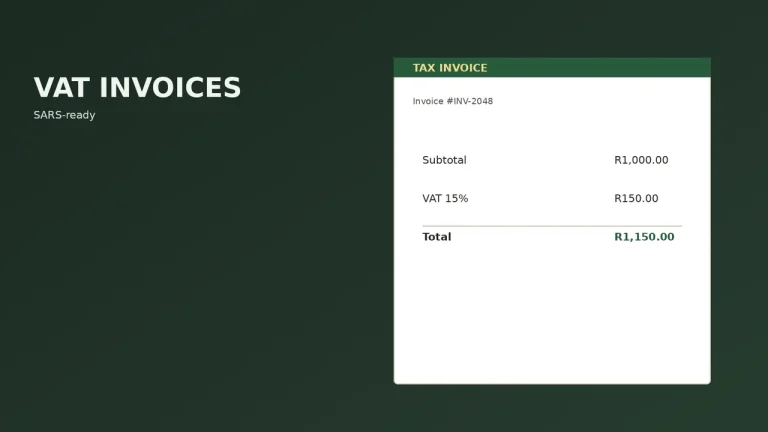
- You issue proper tax invoices. VAT-registered businesses must issue compliant tax invoices — which is exactly why invoicing apps matter (see our Sufio review), since Shopify’s native documents aren’t fully compliant tax invoices.
- You keep records. Proper records of sales and purchases, kept for the required period.
In essence, a VAT-registered store acts as a collector of tax for SARS — the VAT isn’t yours, you’re holding and remitting it — while recovering the VAT on your own costs.
How VAT moves through a registered store
The cycle you repeat every return period.
General information, not tax advice.
The pricing trap that catches growing stores
Here’s the mistake that hurts most. A store that isn’t VAT-registered prices its products at, say, R100. As it grows and crosses the R1m threshold, it must register — and now that R100 price has to include 15% VAT. The owner faces a choice: raise the price to R115 (and risk looking more expensive) or keep it at R100 and absorb the VAT, effectively cutting their own revenue to about R87 per sale. Either way it hurts, and it’s a shock precisely because they priced as if VAT would never apply.
Keep the R100 price and you keep about R87
One sale, before and after VAT registration. Rand per sale.
R100 including 15% VAT is R86.96 to you and R13.04 VAT. Rounded to R87 and R13 as in the text.
The fix is foresight. If you’re growing toward R1m, factor your future VAT position into your pricing before you’re forced to register, so the transition isn’t a sudden margin hit. This is exactly the kind of thing the Profit Margin Calculator and our margin breakdown help you plan for — VAT is one of the costs that quietly reshapes your economics as you scale.
Displaying VAT on your store
For a normal consumer-facing (B2C) SA store, prices are shown VAT-inclusive — the price the customer sees is the price they pay. For B2B selling, business customers often prefer to see prices excluding VAT (since they reclaim it), which is one of the considerations in our B2B guide. Either way, be clear on your store about whether prices include VAT, and once registered, display your VAT number and issue compliant tax invoices.
Frequently asked questions
The bottom line
VAT becomes compulsory at R1 million of turnover (not profit) over a rolling 12 months, with voluntary registration available above R50,000 if claiming input VAT suits your costs. Once registered, you charge 15% on sales, reclaim VAT on purchases, remit the difference to SARS, and must issue compliant tax invoices. The big mistake to avoid is pricing as though VAT will never apply and getting ambushed at the threshold — plan your VAT position into your pricing as you grow. Handled with foresight, VAT is just another part of running a scaling store; ignored, it’s a margin shock.
This is general information, not tax advice — speak to an accountant for your situation. If you’d like your store set up to handle VAT properly — compliant tax invoicing, correct price display, B2B VAT handling — that’s part of building a store right, which is what we do. Model the impact first with the Profit Margin Calculator.

We have built 400+ online stores for South African businesses since 2014. Read more about eCommerce development in South Africa.