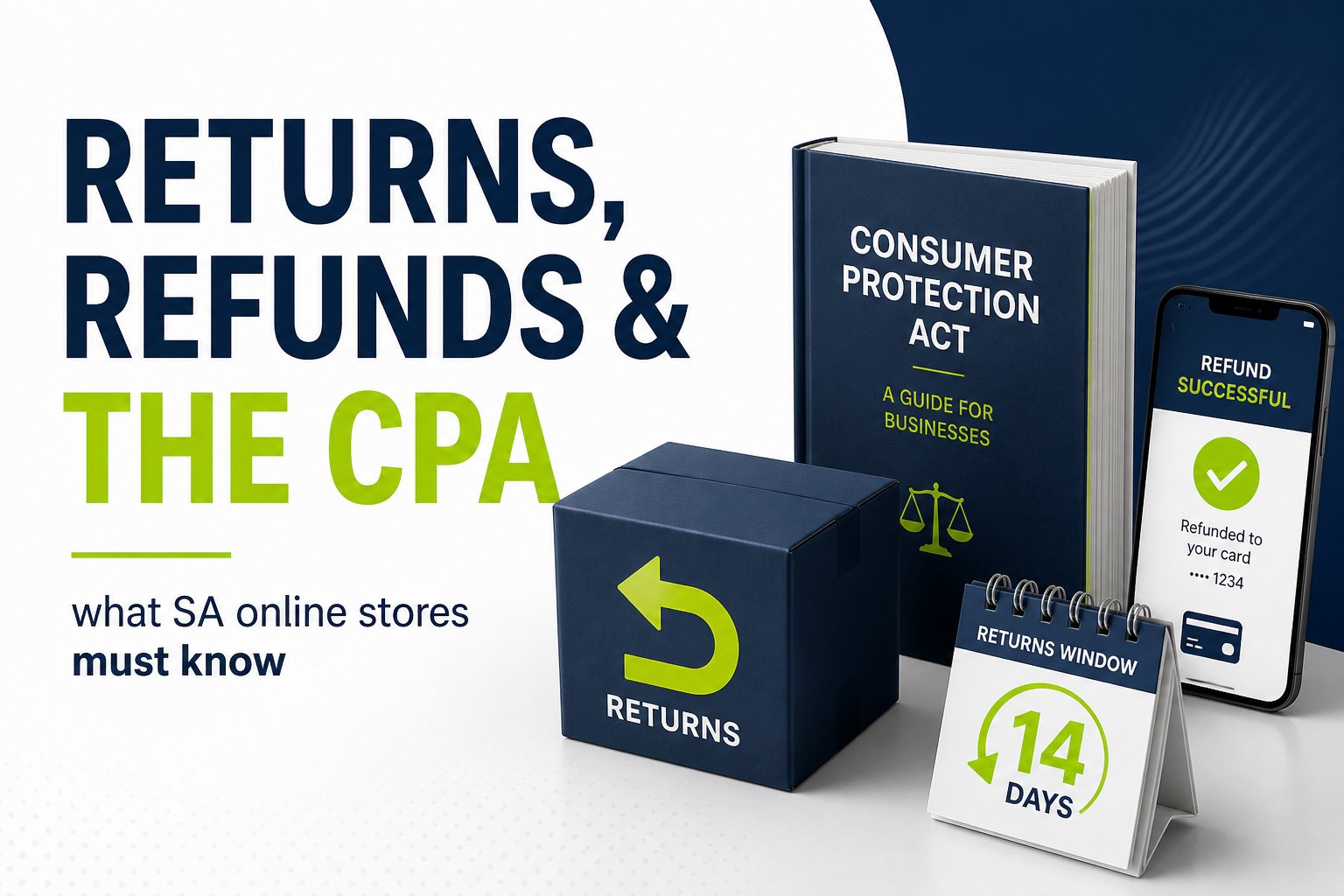

Returns, refunds & the Consumer Protection Act: what SA online stores must know
South African customers have real, legally-protected rights to return goods — and a returns policy that ignores them isn’t just bad service, it’s unenforceable. Here’s what the Consumer Protection Act and the ECT Act require of your store, and how a good returns policy actually wins you sales.
Returns are the part of ecommerce nobody enjoys, and the part SA store owners most often get wrong — usually by writing a restrictive “no refunds” policy that they think protects them but which actually isn’t enforceable, because it contradicts the rights South African law gives consumers. Understanding what the law actually requires does two things: it keeps you compliant, and — counterintuitively — it helps you sell, because a clear, fair returns policy is one of the strongest trust signals you can show a cautious online shopper.
This is a plain-English guide to returns and refunds for SA online stores: what the Consumer Protection Act (CPA) and the Electronic Communications and Transactions (ECT) Act require, and how to turn returns from a grudge into a competitive advantage. Note: this is general information, not legal advice — for your specific situation, consult a professional.
Two laws shape SA online returns
Two pieces of legislation matter for online stores:
- The Consumer Protection Act (CPA) — gives consumers broad rights around the quality of goods, including the right to return defective, unsafe or poor-quality items and get a refund, repair or replacement.
- The Electronic Communications and Transactions (ECT) Act — specific to online and other distance selling, it gives consumers a “cooling-off” right to cancel certain online purchases within a set period after delivery, even if there’s nothing wrong with the product.
Together these mean SA online shoppers have stronger return rights than many store owners realise — and your policy has to work with them, not against them.
Two laws, two kinds of return
What each Act covers for an online store, as described in this guide.
| CPA | ECT Act |
|---|---|
| Covers: defective, unsafe or poor-quality goods | Covers: online and other distance purchases |
| Applies when: something is wrong with the product | Applies when: the customer changes their mind within the cooling-off period after delivery |
| Customer gets: their choice of refund, repair or replacement | Customer gets: cancellation and a refund on returned goods |
| Policy can override it: no | Policy can override it: no, apart from exceptions such as perishable, personalised or hygiene-sealed items |
General information, not legal advice.
The cooling-off right (online-specific)
This is the one unique to online selling and the one stores most often miss. Because the customer buys without seeing the product in person, the ECT Act gives them a cooling-off period — a window after delivery in which they can cancel the purchase and return the goods for a refund, even if the item is perfectly fine and they’ve simply changed their mind. There are sensible exceptions (certain perishable, personalised, or unsealed items, for example), but the general principle holds: for many online purchases, “I changed my mind” within the cooling-off window is a valid return. A blanket “no change-of-mind returns” policy conflicts with this.
Defective goods (the CPA)
Separately, the CPA protects customers when something is wrong with the product. If goods are defective, unsafe, or not of acceptable quality, the consumer is generally entitled to return them within a protected period and choose a refund, repair or replacement — and you can’t contract out of this with a “sold as-is, no returns” clause for normal retail sales. This applies regardless of your stated returns policy, because it’s a statutory right. The customer doesn’t lose it just because your website says otherwise.
Why “no refunds” signs don’t work
You’ve seen “no refunds” signs in physical shops; many are not actually enforceable for defective goods, and the same logic applies online. You cannot use your terms and conditions to strip customers of rights the CPA and ECT Act give them. A policy that says “all sales final, no returns under any circumstances” is, for the situations the law covers, unenforceable — and worse, it signals to shoppers that you’re difficult to deal with, costing you sales. The law sets a floor of consumer rights you can’t go below; your policy operates above that floor.
What your returns policy should actually say
A good SA returns policy is clear, fair, and compliant. It should cover:
- Change-of-mind returns: your cooling-off terms — the window, the condition goods must be in, and how to start a return.
- Faulty/defective goods: how you handle them (refund, repair, replacement) in line with the CPA.
- The process: exactly how a customer initiates a return — who to contact, how the item gets back to you, timelines.
- Who pays return shipping: be clear and fair. For defective goods the cost generally shouldn’t fall on the customer; for change-of-mind returns, policies vary — state yours plainly.
- Refund method and timing: how and when the customer gets their money back.
- Reasonable exclusions: the legitimate exceptions (perishables, personalised items, hygiene-sealed products), stated honestly.
Write it in plain language and make it easy to find — in your footer and near the checkout. A clear policy reassures buyers and reduces the support queries and disputes that vague policies create.
How a return should run
The four steps your returns policy should spell out.
General information, not legal advice.
Returns as a sales tool, not just a cost
Here’s the mindset shift. A generous, clearly-stated returns policy isn’t only a legal obligation — it’s a conversion lever. Online shoppers, especially cautious SA ones, hesitate because they can’t touch the product. A visible, fair returns policy removes that risk from their decision: “if it’s not right, I can send it back.” That reassurance lifts conversion, as we discuss in the conversion guide. Stores that hide or restrict returns lose the sale to the hesitation; stores that make returns easy and visible win the trust. The returns you fear are often the price of the sales you’d otherwise never make.
Operationally, plan for returns properly: a smooth reverse-logistics process (see the shipping guide), clear internal steps, and prompt refunds. A returns process that’s painful for the customer generates bad reviews; one that’s smooth generates repeat buyers.
Frequently asked questions
The bottom line
South African consumers have real, legally-protected return rights — the CPA covers defective goods, and the ECT Act gives online shoppers a cooling-off right to change their mind — and your returns policy has to work with those rights, not pretend they don’t exist. A restrictive “no refunds” policy is both unenforceable and bad for business. A clear, fair, compliant policy keeps you on the right side of the law and doubles as one of your strongest trust signals, lifting conversion among cautious buyers. Treat returns as a sales tool, plan the logistics, and they stop being a threat.
This is general information, not legal advice — check your specifics with a professional. If you’d like your store set up with a compliant, conversion-friendly returns policy and a smooth returns process, that’s part of building a store properly, which is what we do. Pair it with the conversion guide to see how trust drives sales.

We have built 400+ online stores for South African businesses since 2014. Read more about eCommerce development in South Africa.