
Shopify and Sage in South Africa: how to connect your store to your accounting
An order comes in on Shopify. Someone copies it into Sage. Stock is updated by hand. By month end the two systems do not match. Connecting your store to Sage fixes most of that. Here is how it works, in plain terms.
What a Shopify and Sage connection does
A good setup moves four things between the two systems:
- Orders: each Shopify order becomes an invoice or sales order in Sage.
- Customers: new customers are created in Sage, so you do not capture them twice.
- Stock: stock levels from Sage update your store, so you do not sell what you do not have.
- Payments: payments are matched to invoices, which makes reconciling easier.
Which Sage do you have?
This matters more than anything else. “Sage” covers several products in South Africa, such as Sage Business Cloud Accounting and the Sage 200 and Sage 300 family. Each one connects differently. Some have ready-made apps. Others need a connector tool or custom work.
Before you ask for a quote, find out your exact Sage product and version. That one answer changes the price and the timeline.
Three ways to connect
- A ready-made app. Fastest and cheapest, if one supports your version of Sage. It works well for simple stores.
- A connector platform. A middle layer that moves data between the two systems on a schedule. Good when you need rules, such as different price lists for trade customers.
- A custom integration. Built for your exact process. It costs more, but it suits businesses with complex pricing, many warehouses or a lot of trade accounts.
Mistakes I see often
- Product codes that do not match. If your SKU in Shopify is different from the item code in Sage, nothing syncs properly. Clean this up first.
- Deciding too late which system is in charge. Pick one place where stock and prices are “true”. Usually that is Sage.
- Not testing with real orders. Test refunds, discounts and part payments, not just a simple order.
- Forgetting tax and rounding rules. Totals that differ by a few cents will break your reconciliation.
What it costs
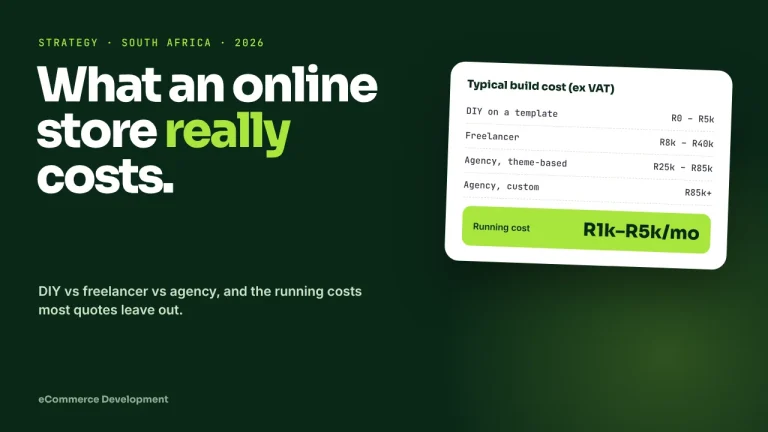
It depends on your Sage version, how many products you have and how much data must move. A simple app setup costs far less than a custom integration for a wholesaler with trade pricing. I give a fixed price in writing after a short call, once I know your setup.
Is it worth it?
Add up the hours your team spends capturing orders and fixing stock each week. For most businesses with regular order volume, those hours cost more within a year than the integration itself.
If you also sell to trade customers, read B2B ecommerce in South Africa. For integrations, migrations and Shopify Plus, see enterprise ecommerce development.

We have built 400+ online stores for South African businesses since 2014. Read more about Shopify development in South Africa.