How to build an email list for your South African online store (and what it’s worth)
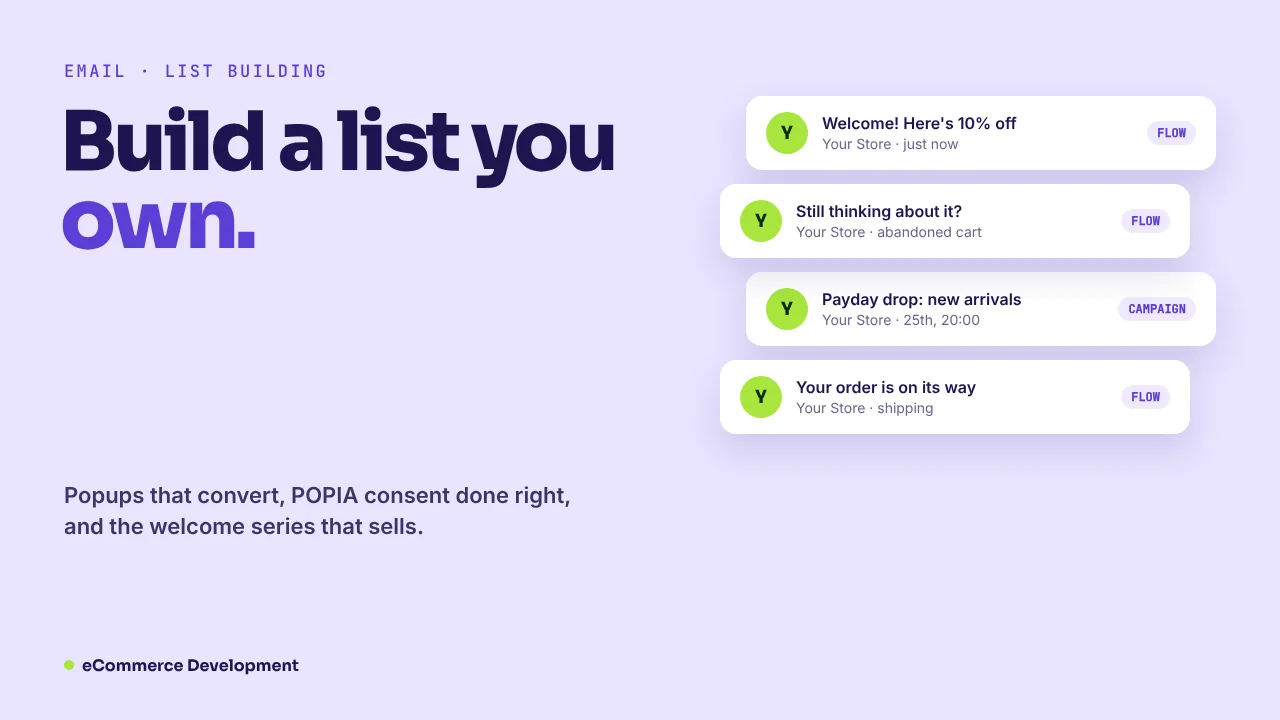
Ads get more expensive every year and social reach keeps shrinking, but an email list is an audience you own. Most South African stores collect far fewer emails than they could, because they rely on a footer box nobody sees. This guide covers where to capture emails, what popups really convert at, the incentives that work, POPIA consent done properly, and the welcome series that turns sign-ups into sales. Includes a free list value forecaster.
The short answer
Use a timed popup with a clear reason to sign up, such as a first-order discount, free delivery or early access, plus an opt-in at checkout. That’s where most sign-ups come from. Expect around 2% to 5% of visitors who see a good popup to subscribe.
Get consent the POPIA way. An unticked opt-in box with clear wording, a record of when and where people agreed, and an easy unsubscribe in every email.
Send a welcome series straight away. Automated flows earn far more per email than campaigns: in Klaviyo’s 2026 data they drove 41% of email revenue from about 5% of sends.
Email list value forecaster
See how fast your list grows from your traffic and what it could earn from a welcome series and campaigns.
Why your own list matters
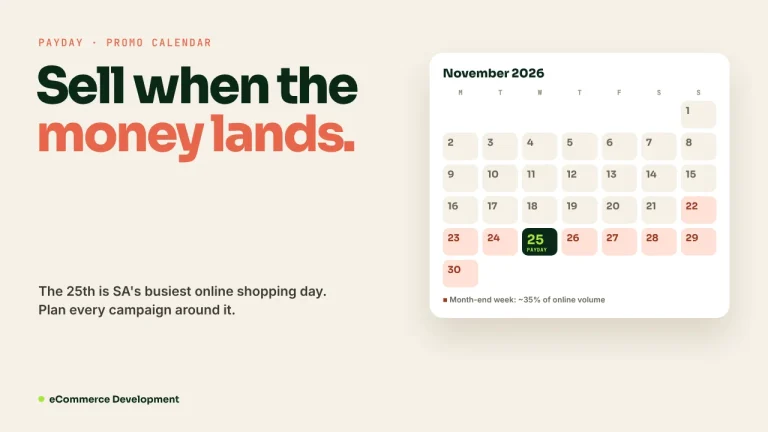
Every rand you spend on ads buys attention once. A subscriber can be reached again and again for the cost of an email. For South African stores the list also matters for timing: you can be in inboxes at 20:00 on payday, when shoppers are actually buying, instead of hoping an algorithm shows your post. See payday shopping spikes and the SA promo calendar.
Flows vs campaigns: share of sends and revenue
Klaviyo 2026 email benchmarks
Source: Klaviyo email marketing benchmarks, February 2026. Flows also drive about 48% of their revenue from new buyers, against 16% for campaigns.
POPIA: getting consent right
Under POPIA, direct marketing by electronic message, including email, needs the person’s consent, unless they’re an existing customer receiving marketing about your own similar products and were given a chance to opt out when you collected their details. Either way, every email needs an easy way to unsubscribe.
More detail in POPIA compliance for online stores.
10 places to collect email addresses
| Where | How | How well it works |
|---|---|---|
| Timed popup | Appears after a few seconds or some scrolling, with an offer | Usually your biggest source |
| Exit-intent popup | Shows when a desktop visitor moves to leave | Catches people who weren’t going to buy |
| Checkout opt-in | Unticked box at checkout | High-intent buyers; vital for repeat sales |
| Spin-to-win or quiz | A game or product finder that ends with an email field | Often converts well; make sure the prize is real |
| Back-in-stock alerts | “Email me when available” on sold-out products | Small volume, very high intent |
| Embedded forms | Footer, blog posts and product pages | Low volume, but always on |
| Competitions | Giveaways on social media that need an email to enter | Big spikes; filter out prize hunters later |
| WhatsApp and social | Links in bios and replies to a sign-up page | Moves followers onto a list you own |
| In-store or events | QR code or tablet at markets and pop-ups | Great for local brands |
| Lead magnets | Size guides, recipes, care guides or lookbooks for an email | Builds an engaged list, not just discount seekers |
What popups really convert at
Popup platforms publish different averages because they measure differently, but the patterns agree:
| Factor | What the data shows | Source |
|---|---|---|
| Average sign-up rate | 2.1% to 2.3% of popup views for email; up to about 5% on some platforms | Omnisend 2025, Klaviyo, Wisepops |
| Offer | 2.4% with a discount vs 1.7% without, a 41% relative lift | Omnisend |
| Timing | Popups delayed 6 to 10 seconds converted 2.4% vs 1.9% for immediate ones | Omnisend |
| Device | Mobile popups often convert better than desktop: 4.98% vs 3.67% | Wisepops |
| Multi-step | Asking a simple question first lifted sign-ups: 2.3% vs 2.0% | Omnisend |
Most South African traffic is mobile, so design your popup for phones first: small enough not to cover the whole screen, easy to close, and compliant with Google’s guidance on intrusive interstitials. More on mobile in mobile commerce in South Africa.
Incentives that work
| Incentive | Works best for | Watch out for |
|---|---|---|
| 10% to 15% off the first order | Most stores; simple and proven | Build it into your margins, and limit it to one use |
| Free delivery on the first order | Low-price products where delivery is a big share of the total | Courier cost on small orders |
| Free gift with first order | Beauty, food and consumables | Gift stock and cost |
| Early access and VIP drops | Fashion and limited releases | You must actually deliver early access |
| Competition entry | Fast list growth | Lower-quality subscribers |
| Useful content | Higher-priced or technical products | Slower growth, better subscribers |
The welcome series that turns sign-ups into sales
Deliver the promised offer, say who you are, link to best sellers.
Your story or what makes you different, with reviews and photos.
Best sellers or a buying guide; answer delivery and returns questions.
Reminder that the offer expires soon, then move them to campaigns.
Stop the series as soon as someone buys, and move them to a post-purchase flow. Then add an abandoned cart flow, which is usually your highest-earning automation. See abandoned cart recovery and the email flows that make money.
Keep your list healthy
- Authenticate your domain with SPF, DKIM and DMARC. Gmail and Yahoo require it for bulk senders, and it keeps you out of spam.
- Send from your own domain, not a free Gmail address.
- Remove hard bounces straight away, and re-engage or remove people who haven’t opened in six months or more.
- Keep a steady rhythm. A list you email once a quarter forgets who you are.
- Segment by behaviour, such as buyers vs non-buyers and big spenders, instead of sending everything to everyone.
- Honour unsubscribes immediately.
Don’t buy lists or scrape addresses. It breaks POPIA, it gets your sending domain blacklisted, and those people never asked to hear from you. A smaller list of people who opted in is worth far more.
Choosing an email platform
| Platform | Good for | Notes |
|---|---|---|
| Shopify Email | Shopify stores starting out | Built in; basic automations |
| Klaviyo | Growing Shopify and WooCommerce stores | Strong segmentation and flows; price rises with list size |
| Omnisend | Email plus SMS in one tool | Ecommerce-focused automations |
| MailerLite | Smaller stores on a budget | See our MailerLite review |
Questions
How do I build an email list for my online store?
Add a timed popup with a clear offer, an unticked opt-in at checkout, and back-in-stock alerts. Promote sign-ups on social media and WhatsApp, and send every new subscriber a welcome series automatically.
What is a good email sign-up rate?
For a popup, about 2% to 5% of visitors who see it. Klaviyo reports a median of 2.3% for popups and flyouts. Popups with an offer, a short delay and a mobile-friendly design do better.
Do I need consent to email customers in South Africa?
Yes, for marketing. POPIA requires consent for direct marketing by email, except for existing customers receiving marketing about your own similar products who were given a chance to opt out. Every email must include an easy way to unsubscribe.
Should I offer a discount for signing up?
It usually lifts sign-ups. Omnisend’s data shows popups with a discount convert at 2.4% vs 1.7% without. Free delivery, a gift or early access can work as well if discounts don’t suit your brand.
How much is an email subscriber worth?
It depends on your traffic, order value and how well your emails convert. Use our list value forecaster with your own numbers.
How often should I email my list?
Most stores do well with one to two campaigns a week plus automated flows. Keep it regular, and increase around payday and sales events.
Sources

We have built 400+ online stores for South African businesses since 2014. Read more about eCommerce development in South Africa.