
What does a WooCommerce store cost in South Africa? (2026)
The software is free — but a WooCommerce store isn’t. Here’s the honest, full rand breakdown of what you’ll actually pay to build and run one, from a team that has built 400+ stores.
A small WooCommerce store runs from around R150–R900 per month once you add hosting, a domain and payment fees — the WooCommerce plugin itself is free, and it takes no cut of your sales. A professional build costs from R20,000 excl VAT one-off. That’s often cheaper month-to-month than Shopify, with one trade-off: you own the maintenance.
Unlike Shopify’s fixed subscription, WooCommerce costs are “pick your own adventure” — they depend almost entirely on your hosting and how many premium plugins you run. Here’s exactly where the money goes.
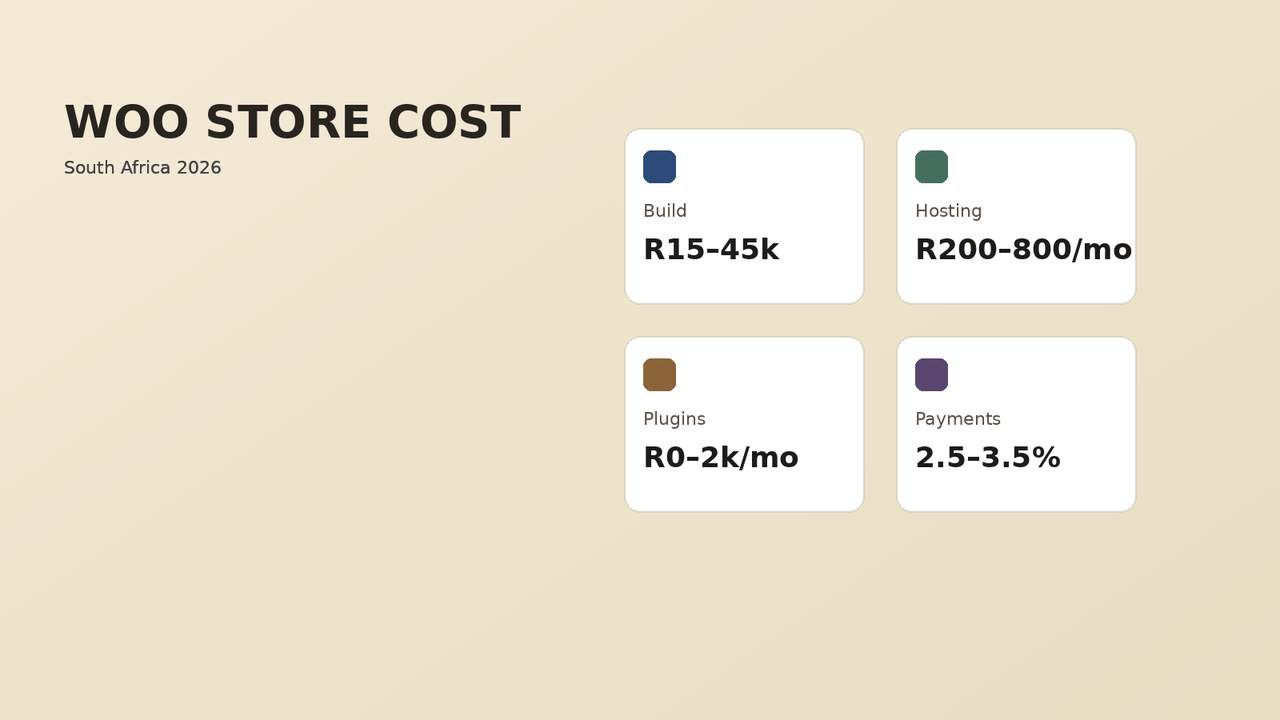
Every WooCommerce cost, in rands
Hosting and maintenance are the real cost
Because WooCommerce is self-hosted, two lines quietly decide whether your store is cheap-and-painful or well-run: hosting and maintenance. Cheap R100/month shared hosting is where most “my WooCommerce store is slow” complaints come from. Decent managed WordPress hosting (R300–R700/month) with proper caching makes a WooCommerce store genuinely fast.
Maintenance is the other one. WordPress core, WooCommerce and plugins all need regular updates and security, and things occasionally break after an update. You either do that yourself or budget for it — we handle it at R600/hr as needed. Factor it in and WooCommerce is still often cheaper than Shopify; ignore it and it costs you in downtime and lost sales instead.
Cheaper than Shopify?
Often, yes — especially at higher sales volumes. WooCommerce has no monthly platform fee and no per-sale platform cut, whereas Shopify charges both a subscription and (in South Africa) an extra transaction fee because Shopify Payments isn’t available here. A store doing decent volume can save meaningfully on WooCommerce. The trade-off is the maintenance you take on. See the full picture in Shopify’s monthly cost in SA and our platform comparison.
WooCommerce cost FAQs
Is WooCommerce really free?
The WooCommerce plugin is free and takes no cut of your sales. But running a store isn’t free — you pay for hosting, a domain, any premium plugins or theme, and payment gateway fees. Budget from around R150–R900/month all-in for a small store.
How much does it cost to build a WooCommerce store?
A professional WooCommerce build starts from R20,000 excl VAT, similar to a Shopify build — including design, SA payment gateways, courier integrations and setup. You can build it yourself for less in cash, but it costs you time and is where most speed and security problems start.
Does WooCommerce charge transaction fees?
No — WooCommerce itself takes no cut of your sales. You only pay your payment gateway’s fee (~3%). This is a genuine advantage over Shopify, which adds an extra platform transaction fee in South Africa on top of your gateway.

We have built 400+ online stores for South African businesses since 2014. Read more about WooCommerce development in South Africa.