
GEO for online stores in South Africa: the complete 2026 playbook
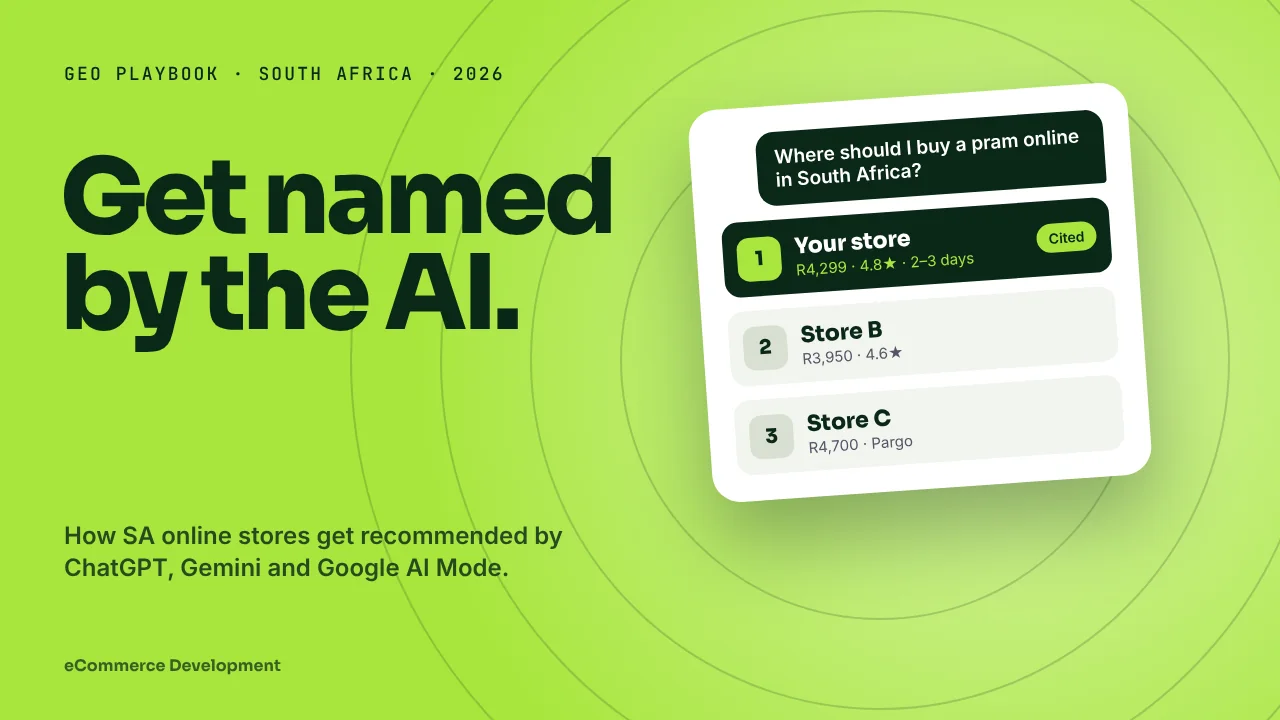
When a shopper asks ChatGPT, Gemini or Google AI Mode “where should I buy a pram online in South Africa?”, the answer names three to five stores. This guide covers how those stores get chosen, what you can control, what is not yet available in South Africa, and how to measure whether it is working. It comes with five free tools in our GEO toolkit.
The short answer
GEO (generative engine optimisation) is the work of getting your store and products named, cited or linked inside AI-generated answers. For a South African store it comes down to seven jobs:
1. Let the AI search crawlers in, including through Cloudflare and your security plugin. 2. Put plain, checkable facts on product pages. 3. Mark those facts up with structured data that matches the page. 4. Run a clean Google Merchant Center feed, because in South Africa it is the closest thing you have to a direct line into ChatGPT Shopping and Google AI Mode. 5. Publish buying guides that are the best answer to a real question. 6. Collect reviews on more than one independent platform. 7. Get mentioned on sites you do not own.
Then measure it with Search Console’s generative AI report, Bing’s AI Performance report, a GA4 AI channel and a monthly prompt check. GEO sits on top of SEO. A store with weak SEO will have weak GEO.
Score your store first
Before reading the rest, count up what your store already has. The score is weighted by how much each item affects AI visibility in our experience and in the research cited below. Every check has its own section further down.
GEO readiness score
Fifteen checks, 100 points. Add up the ones your store already has. 80+ is AI-ready, 55 to 79 is visible but leaky, under 55 means start with the highest-point items. The interactive version scores you and returns a prioritised fix list.
| Check | Points |
|---|---|
| robots.txt allows the AI search crawlers (OAI-SearchBot, Claude-SearchBot, PerplexityBot, Bingbot, Googlebot) | 15 |
| Checked that Cloudflare, the host firewall and security plugins are not blocking AI crawlers | 10 |
| Sitemap submitted in both Google Search Console and Bing Webmaster Tools | 6 |
| Product name, rand price, stock status and specs are in the page HTML as text | 8 |
| Top 20 product descriptions rewritten in our own words (no supplier copy) | 8 |
| Product schema with price in ZAR and availability passes the Rich Results Test | 7 |
| Shipping and returns policy declared in schema or Merchant Center | 4 |
| Google Merchant Center feed live, free listings on, almost no disapprovals | 12 |
| Feed prices match website prices exactly, including sales | 6 |
| GTINs or barcodes added where products have them | 3 |
| Product reviews showing on product pages | 5 |
| Reviews on at least one independent platform (Google, Hellopeter, Trustpilot) | 6 |
| At least three buying guides or comparisons for your main category | 5 |
| Business name, address and contact details identical across the web | 3 |
| GA4 reports AI referrals as their own channel | 2 |
What GEO is, and what it is not
GEO is getting your brand and products named, cited or linked inside answers that AI tools generate. SEO is ranking your pages in a list of results. They overlap heavily because most AI assistants still look things up on the web before they answer, and they lean on search indexes to do it.
The term comes from a 2023 paper by researchers at Princeton, Georgia Tech, the Allen Institute and IIT Delhi, presented at KDD 2024. They tested nine ways of rewriting a web page and measured how much of an AI answer could be traced back to it. Adding quotations, statistics and cited sources helped most. Keyword stuffing was the only method that did worse than leaving the page alone. More on what that means for a store in Step 5.
| Term | Where it shows up | What winning looks like | Main lever |
|---|---|---|---|
| SEO | Google and Bing results pages | Your page ranks and gets the click | Relevance, links, technical health |
| AEO | Featured snippets, voice answers | Your sentence is read out as the answer | Short, direct answers to questions |
| GEO | ChatGPT, Gemini, AI Mode, AI Overviews, Copilot, Perplexity, Claude | Your store is named or cited in the answer | Facts, feeds, reviews, third-party mentions |
| Agentic commerce | Buy buttons and checkout inside AI apps | The AI completes the order with you as merchant | Platform integrations, feed accuracy |
Two things GEO is not. It is not geo-targeting, which means showing ads to people in a location. And it is not a replacement for SEO. If anything, the research on ChatGPT Shopping (below) shows AI answers lean harder on Google’s own data than most people assumed.
Why it matters for South African stores now
AI search reached South Africa at the same time as most other markets. Google switched on AI Mode for South African users in August 2025, in English, as part of a 180-country launch. AI Overviews already sat above many ordinary results before that.
Usage is climbing steadily. Microsoft’s AI Economy Institute measures the share of people aged 15 to 64 who used a generative AI tool in a given period. South Africa is the highest in Africa and still rising.
Generative AI use in South Africa keeps rising
Share of people aged 15 to 64 who used a generative AI tool in the period
Microsoft AI Economy Institute, Global AI Diffusion reports. Nigeria and Ghana were at 10.1% and Kenya at 8.7% in Q1 2026. Bar widths indexed to the largest value.
At the same time the market these shoppers buy from is growing fast. World Wide Worx put online retail at R96bn in 2024, 8% of all retail, with 2025 expected to pass R130bn and 2027 projected above R150bn. Our own SA eCommerce Report 2026 charts break that down by segment.
SA online retail turnover
Rand, billions
World Wide Worx, Online Retail in South Africa 2025 (with Mastercard, Peach Payments and Ask Afrika).
The honest part: AI traffic is still small, and the conversion data is mixed
Most guides quote one flattering statistic. Here are the main studies side by side, because they disagree and you should know that before you spend money.
| Study | What it found | Caveat |
|---|---|---|
| Adobe Digital Insights, April 2026 | AI-referred retail visitors in March 2026 were 42% more likely to buy and brought 37% more revenue per visit | Groups all AI tools together; large US retailers |
| Similarweb, Jul 2024 to Jun 2025 | ChatGPT referrals converted at about 11.4% vs 5.3% for organic search | Traffic panel estimates, not store checkout data |
| Kaiser and Schulze, academic study (973 sites, ~$20bn revenue) | ChatGPT was under 0.2% of ecommerce traffic; organic search converted about 13% better | Data from Aug 2024 to Jul 2025, an early phase |
| Shero Commerce, 96m sessions, Sep 2026 | Median store: AI visitors 1.27% conversion vs 1.09% organic, but orders 15% smaller | Agency client base; mostly US stores |
Our read: AI referrals are small in volume today, the visitors tend to arrive further down the funnel, and the trend is up. That is a reason to do the cheap foundational work now, not a reason to pay anyone a retainer to “rank in ChatGPT”. Almost everything in this guide also improves your Google rankings and your conversion rate, so the downside is close to zero.
How AI tools decide which stores to recommend
An AI shopping answer is built from three inputs. Your GEO work needs to cover all three, but they are not equally controllable.
Where an AI shopping answer comes from
Simplified. Each assistant weights these differently and none publish the formula.
2 to 6 cited sources
Product cards with price, rating and stock
Sometimes a buy button
ECD diagram based on Google’s AI features guidance, OpenAI’s crawler documentation and the Profound and Peec AI shopping studies cited in this guide.
Which assistant reads what
| Assistant | Live web source | Shopping data | What an SA store can do today |
|---|---|---|---|
| Google AI Overviews and AI Mode | Google’s search index (Googlebot) | Google Shopping data from Merchant Center | Rank in Google, run a Merchant Center feed with free listings |
| ChatGPT | OpenAI’s own index (OAI-SearchBot) plus partner search | Direct merchant feeds (US-first) and results that overlap heavily with Google Shopping | Allow OAI-SearchBot, run a strong Merchant Center feed |
| Microsoft Copilot | Bing’s index (Bingbot) | Microsoft merchant programmes, Shopify for US merchants | Verify Bing Webmaster Tools, claim Bing Places |
| Perplexity | Its own index (PerplexityBot) | Merchant partnerships, Shopify catalogue | Allow PerplexityBot, earn third-party mentions |
| Claude | Claude-SearchBot index and live fetches (Claude-User) | No dedicated shopping feed programme announced | Allow Claude-SearchBot and Claude-User |
| Gemini app | Google’s index | Google Shopping data | Same as Google AI Mode |
The South African shortcut. In March 2026 a Peec AI study of more than 43,000 ChatGPT product carousel listings, reported by Search Engine Land, found 83% matched Google Shopping’s organic results, with most coming from Google’s top ten. ChatGPT’s direct-feed programmes are US-first, but Google Merchant Center free listings are available to South African sellers. So for a store selling into South Africa today, the feed you send Google is very likely doing double duty in ChatGPT as well. That makes Merchant Center the single highest-value GEO task for most SA stores. This is our inference from the published data, not something OpenAI has confirmed.
What a good outcome looks like
Here is a typical shopping answer, with notes on why each store got its spot. The stores are illustrative; the pattern is what we see when we run these prompts for clients.
Anatomy of an AI shopping answer
Illustrative example. Store names are placeholders.
Here are three well-reviewed options that deliver to Durban and come in under R1,500:
Why: exact rand price, stock and Durban delivery time stated on the page and in the feed
Why: detailed reviews on two independent sites that mention newborn use
Why: featured in a local gift guide and publishes a “how to choose a carrier” guide
Tip: check the weight range and whether it supports a newborn without an insert.
Notice what is missing: none of the three got in on brand slogans. Each one was chosen for a checkable fact, independent proof, or a third-party mention.
Every step below feeds one of those three reasons.
Step 1: Let the AI crawlers in
An assistant cannot recommend a page it is not allowed to read. This is the one GEO task where a single mistake makes everything else pointless, and it is more common than you would think. We regularly find SA stores blocking AI search crawlers by accident through an old robots.txt rule, a security plugin, or a CDN setting nobody remembers switching on.
Know the three jobs AI crawlers do
OpenAI, Anthropic and Perplexity each run separate crawlers for separate jobs, and each has its own robots.txt token. Blocking the training crawler does not remove you from the answers. Blocking the search crawler does.
| Token | Company | Job | Follows robots.txt? | Our default for a store |
|---|---|---|---|---|
| Googlebot | Search, AI Overviews, AI Mode | Yes | Allow | |
| Bingbot | Microsoft | Bing and Copilot answers | Yes | Allow |
| OAI-SearchBot | OpenAI | ChatGPT search index | Yes | Allow |
| Claude-SearchBot | Anthropic | Claude search index | Yes | Allow |
| PerplexityBot | Perplexity | Perplexity search index | Yes | Allow |
| Applebot | Apple | Siri and Spotlight search | Yes | Allow |
| ChatGPT-User | OpenAI | Live fetch when a user asks about a page | Not reliably | Allow |
| Claude-User | Anthropic | Live fetch when a user asks about a page | Yes | Allow |
| Perplexity-User | Perplexity | Live fetch on a user’s request | Generally not | Allow |
| GPTBot | OpenAI | Model training | Yes | Business decision |
| ClaudeBot | Anthropic | Model training | Yes | Business decision |
| Google-Extended | Control token for Gemini training and grounding; not a separate crawler | Yes | Business decision | |
| Applebot-Extended | Apple | Control token for Apple AI training | Yes | Business decision |
| CCBot | Common Crawl | Open dataset used by many model builders | Yes | Business decision |
Google states that blocking Google-Extended does not affect inclusion in Google Search, and AI Overviews and AI Mode run on Googlebot’s crawl. For most stores we recommend allowing the training crawlers too. Being known to the model is a form of brand awareness, and a product store has little to protect in its public product copy. Publishers selling content have a different calculation.
The Cloudflare trap
In July 2025 Cloudflare started blocking known AI crawlers by default for new domains and asks owners during setup whether to allow them. From 15 September 2026 it went further on pages carrying advertising: training and agent crawlers are blocked by default there, while search crawlers stay allowed. Cloudflare sits in front of roughly a fifth of all websites, and a lot of South African hosts and agencies put stores behind it for speed and DDoS protection.
Check this today. In the Cloudflare dashboard, open your domain and look under Security for AI Crawl Control (previously “Block AI bots” under Bots). Confirm the AI search crawlers are allowed. Then check your host’s firewall and any WordPress security plugin with bot blocking. A robots.txt that says “allow” means nothing if the request is stopped at the firewall first.
The robots.txt group trap most guides miss
Crawlers obey only the most specific group that names them. If your robots.txt has User-agent: * with Disallow: /checkout/, and you add a new group for OAI-SearchBot with Allow: /, OpenAI’s crawler now ignores the * group completely, including your checkout and cart rules. Any rules you want every bot to follow must be repeated inside each named group. Our robots.txt generator does that for you.
AI crawler robots.txt generator
Generates a robots.txt for WooCommerce, Shopify or other platforms that allows the AI search crawlers and repeats your private paths in every group. Free, runs in your browser, nothing is sent anywhere.
Open the robots.txt generator →The other technical checks
| Check | Why AI tools care | How to test |
|---|---|---|
| Product facts are in the HTML as text | Many AI fetchers do not run JavaScript. A price that only appears after a script runs may not exist to them | View the page source (not the inspector) and search for the price |
| Sitemap submitted to Google and Bing | Copilot runs on Bing’s index; ChatGPT search draws on partner indexes too | Search Console and Bing Webmaster Tools; Bing can import your sites from Search Console in minutes |
| IndexNow enabled | Pushes price and stock changes to Bing quickly instead of waiting for a recrawl | Rank Math has it built in; Cloudflare offers it too |
| Fast mobile pages | Slow pages get crawled less often. Most SA shoppers browse on mid-range Android phones | PageSpeed Insights, mobile tab. See our speed guide |
| No interstitials blocking content | Age gates, location pop-ups and newsletter walls can hide the page from fetchers | Fetch the URL in Search Console’s URL Inspection |
| Server logs show AI bots | Proof that crawlers are arriving and getting 200 responses | Ask your host for access logs and search for OAI-SearchBot, ChatGPT-User, Claude-SearchBot, PerplexityBot |
Step 2: Write product pages an AI can quote
AI tools pull out facts they can repeat with confidence and cross-check. “Premium quality, luxurious feel” gives them nothing. “Full-grain leather, 38cm wide, fits a 15-inch laptop” gives them three facts to match against a question. Pages that state facts plainly get quoted; pages full of slogans get skipped. Our longer guide on writing product descriptions that sell covers the conversion side; this section covers what AI needs on top.
The AI-ready product page
Seven blocks, in this order. Each one answers a question shoppers actually type into AI tools.
ECD layout. Use the description builder in the toolkit to draft blocks 1 to 7 for any product.
Before and after
| Supplier copy (what most stores use) | AI-ready copy |
|---|---|
| “Experience ultimate comfort with our premium ergonomic office chair, designed for the modern professional.” | “A mesh office chair with adjustable lumbar support and 4D armrests, for people who sit 6 or more hours a day. Supports up to 130kg. R4,999 incl. VAT, in stock, delivered in 3 to 5 working days nationwide.” |
| “Stylish and durable school shoes your kids will love.” | “Black leather school shoes with a stitched sole, sizes 10 (kids) to 8 (adults), compliant with most SA school uniform rules. Half sizes available. Free exchanges on unworn pairs within 30 days.” |
Use South African vocabulary
AI answers match the words in the question, and South Africans ask in South African English. Copy imported from a supplier rarely contains the phrases local shoppers type.
| Shoppers type | Not | Where it belongs |
|---|---|---|
| braai, potjie, cooler box | barbecue, stew pot, cooler | Titles, summaries, category intros |
| delivery to Gqeberha, Polokwane, Mbombela | “fast shipping” | Delivery block, FAQ, shipping page |
| Instant EFT, Ozow, PayJustNow, Payflex | “multiple payment options” | Product page payment line, FAQ |
| Paxi, Pargo, collection point | “pickup available” | Delivery block |
| load-shedding backup, inverter, solar | “power solution” | Electronics titles and guides |
| Highveld winter, Cape winter rain | “cold weather” | Seasonal category intros |
| incl. VAT, rand, R1,499 | prices without currency | Everywhere a price appears |
Category pages need the same treatment. A grid of products gives an assistant nothing to cite. Add 150 to 300 words above or below the grid that explain the range, who each type suits and how to choose. “How to choose a pram for South African roads and malls” on a pram category is exactly the kind of passage that gets quoted.
AI-ready description builder
Turns product facts into the seven-block structure as plain text and paste-ready HTML. Free, runs in your browser, nothing is sent anywhere.
Open the description builder →Step 3: Use structured data, and make it match the page
Structured data is JSON-LD code that labels your facts for machines: this is the product name, this is the price, this currency, this stock level. Google says you do not need any special markup to appear in AI Overviews or AI Mode. It still helps, because it removes guesswork and powers rich results in ordinary search. The rule that matters most is in Google’s own guidance: the markup must match what a shopper sees on the page. A schema price of R899 on a page showing R999 is worse than no schema at all.
| Schema type | Where | What it tells AI tools | Note |
|---|---|---|---|
| Product + Offer | Every product page | Name, brand, price, priceCurrency: ZAR, availability, condition | Essential |
| AggregateRating + Review | Products with genuine reviews | Proof of quality, review count | Only for reviews collected on your site. Never on the homepage |
| OfferShippingDetails | Product level | Shipping cost and delivery time to ZA | Or set it in Merchant Center |
| MerchantReturnPolicy | Product or organisation level | Return window, method, fees | See our CPA returns guide |
| Organization | Home or About page | Who you are, logo, contact, sameAs links to your profiles | Ties your mentions together |
| BreadcrumbList | Product and category pages | How your catalogue is organised | Most themes and SEO plugins output it |
| FAQPage | Pages with genuine FAQs | Question and answer pairs | Google restricted FAQ rich results in 2023. Write the FAQ for people; markup is optional |
Shopify themes usually output basic Product schema. It is often missing shipping, returns, GTIN and brand. WooCommerce relies on your SEO plugin; Rank Math and Yoast’s WooCommerce add-on both output Product schema, with gaps that depend on settings. On either platform, test five product URLs in Google’s Rich Results Test and the Schema Markup Validator, then fix what they flag.
Product schema generator (ZAR)
Builds Product JSON-LD with a rand offer, South African shipping and a returns policy, so you can see what your theme or plugin is missing. Free, runs in your browser, nothing is sent anywhere.
Open the schema generator →Step 4: Keep your product feeds accurate
A product feed is a structured file listing every product with its title, price, stock, images and identifiers. Through 2026 feeds moved from a Google Shopping concern to the centre of AI shopping. If you only do one thing from this guide, make it this.
ChatGPT Shopping switched to feeds almost overnight
Share of tracked ChatGPT Shopping product picks classified as feed-integrated
Profound, 1,757,723 tracked prompt runs in July 2026, reported by Search Engine Journal on 9 September 2026. One vendor’s tracked prompts, not official OpenAI figures, and ChatGPT Shopping is live in the US. A separate Profound analysis found review count was one of the strongest predictors of product card ranking.
Two findings matter for a South African seller. The feeds behind that jump come through OpenAI’s Agentic Commerce Protocol, and direct connections are US-first, with Shopify and a waitlist for others. Meanwhile the Peec AI study found 83% of ChatGPT’s carousel products matched Google Shopping’s organic results. Google Merchant Center free listings are open to sellers in South Africa. Put those together and your Merchant Center feed is the feed you can actually control today.
Feed channels and what is open to SA stores
| Channel | What it feeds | Open to SA stores? | Cost |
|---|---|---|---|
| Google Merchant Center (free listings) | Google Shopping tab, Search, Images, Lens, AI Overviews, AI Mode, Gemini; very likely ChatGPT’s carousel indirectly | Yes | Free |
| Google Merchant Center (Shopping ads) | Paid placements, including in AI surfaces | Yes | Pay per click. See our Google Ads service |
| Microsoft Merchant Center / Bing Places | Bing Shopping and Copilot | Check current country support for ZA in your account | Free to set up |
| ChatGPT merchant feeds (ACP) | ChatGPT Shopping directly | US-first; Shopify connected, others via waitlist | Free listing; fees on some checkout flows |
| Shopify Agentic Storefronts | ChatGPT, Copilot, Google AI Mode, Gemini | On by default for eligible US-selling merchants since March 2026 | No extra monthly fee |
| Takealot, Amazon.co.za listings | Marketplace pages that AI tools cite | Yes | Marketplace fees |
The feed attributes that matter for AI
| Attribute | Why AI cares | SA-specific tip |
|---|---|---|
| title | The first thing matched against the question | Brand + product type + key attribute: “Karoo 6-Burner Gas Braai with Wok Burner, Stainless Steel” |
| description | Context for matching narrow prompts | Use your rewritten copy, not the supplier’s. Include local terms |
| price / sale_price | Filters like “under R1,500” | ZAR, incl. VAT, identical to the page to the cent |
| availability | Out-of-stock items get dropped | Sync at least daily; hourly on fast movers |
| shipping | “Delivered to Durban” and “free delivery” prompts | Set ZA shipping rates and handling plus transit times |
| gtin / mpn / brand | Lets the AI match your listing to the same product elsewhere and to reviews | Use the real barcode; never invent one |
| product_highlight, product_detail | Short factual bullets the AI can lift | 3 to 6 highlights per product |
| image_link | Product cards show it | Clean main image, no text overlays or watermarks |
| product_type, google_product_category | Helps classify the product correctly | Mirror your store’s category tree |
Shopify stores connect Merchant Center through the Google & YouTube app; WooCommerce stores use Google for WooCommerce or a feed plugin. Either way, open Merchant Center weekly and clear disapprovals, price mismatches and missing shipping. Stale price and stock data is the specific failure that sank the first version of ChatGPT’s Instant Checkout. It will sink any future programme the same way.
Agentic checkout: ACP, UCP and Shopify, explained for SA sellers
“Agentic commerce” means the AI does not only recommend a product but completes the purchase. Three systems matter. None of them is fully open to South African stores yet, so treat this as a watch list rather than a to-do list.
| Agentic Commerce Protocol (ACP) | Universal Commerce Protocol (UCP) | Shopify Agentic Storefronts | |
|---|---|---|---|
| Who | OpenAI and Stripe, open standard | Google with retailers and platforms, open standard | Shopify |
| Where it shows | ChatGPT | Google AI Mode and Gemini | ChatGPT, Copilot, AI Mode, Gemini |
| History | Instant Checkout launched September 2025; scaled back in March 2026 so merchants run their own checkout. Extended to product discovery feeds in March 2026 | Announced January 2026. Merchants publish capabilities at /.well-known/ucp | Announced December 2025 in the Winter ’26 Edition; switched on by default for eligible US merchants in March 2026 |
| Requirements | Feed via an approved provider | Active Merchant Center account, eligible products, native_commerce attribute | A Shopify store; toggle channels in admin |
| SA availability, Oct 2026 | Not for SA-only merchants | US, Canada and Australia only | US-selling merchants |
| What to do now | Keep your catalogue clean | Keep Merchant Center healthy; it is the entry ticket | Shopify stores: watch the Sales channels screen for SA |
Do not pay anyone to “integrate ACP” for an SA-only store this year. The groundwork that will qualify you when these programmes reach South Africa is the same groundwork that wins visibility now: a complete, accurate catalogue and a healthy Merchant Center account.
Step 5: Publish content that gets cited
Product pages win “where to buy” prompts. Buying guides and comparisons win the research prompts that come first: “how do I choose”, “what is the difference”, “is X worth it”. These are the pages AI tools cite as sources, and the store that wrote the guide is often named in the shortlist that follows.
What the research actually says
Facts beat keywords in AI answers
Visibility score of a rewritten page inside generated answers, GEO paper (lab setting)
Aggarwal et al., GEO: Generative Engine Optimization (KDD 2024). Tested on a research engine built on GPT-3.5 with five sources per query; later benchmarks did not reproduce every gain. Treat it as direction, not a formula.
The practical lesson is not “add statistics”. It is that AI tools favour pages with specific, checkable claims and named sources, and penalise pages written to game them. Bing tightened its guidelines in February 2026 to cover language engineered for AI citation, alongside classic keyword stuffing. Google’s systems demote content produced mainly to manipulate rankings. Thin AI-written posts at volume are the fastest way to waste a content budget.
Bing’s own citation data adds one more lesson. One site sharing its AI Performance report found a single page earned 69% of all its Copilot citations. AI answers reward the best resource on a question, not the tenth decent one. Write fewer, better guides.
Content types that work for stores
| Type | SA example | Prompt it wins |
|---|---|---|
| Buying guide | How to choose a car seat in South Africa (with rand price bands) | “Which car seat should I buy?” |
| Comparison | Cotton vs bamboo baby blankets for Highveld winters | “Bamboo or cotton for a baby blanket?” |
| Best-of with criteria | Best inverters for a 3-bedroom home, tested | “Best inverter for my house” |
| Problem-solving how-to | How to clean a gas braai after the season | “How do I clean my gas braai?” |
| Local logistics answers | Delivery times to every province, with a table | “Do they deliver to Polokwane?” |
| Original data | Our 10 best-selling gifts under R500 this December | “Gift ideas under R500 South Africa” |
| Sizing and fit guides | School shoe size chart, SA vs UK vs EU | “What size school shoe for a 9-year-old?” |
Seven rules for citation-ready writing
- Answer the main question in the first two or three sentences.
- Open every section with a sentence that still makes sense if quoted on its own.
- Phrase H2 and H3 headings the way people ask: “How long does delivery to Durban take?”
- Use tables for specs and comparisons, and numbered lists for steps.
- Put a source and a date next to every figure that can change.
- Say who wrote it and why they know: years in the trade, products tested, orders shipped.
- Update important guides at least yearly and show the updated date.
If you want help drafting, our AI prompts for SA store owners include several built for buying guides. Use them for structure, then add the experience only you have.
Step 6: Build reviews in more than one place
AI tools treat reviews as evidence and cross-check them. A store with detailed reviews across several independent platforms looks far more trustworthy than one whose only praise is on its own product pages. Profound’s analysis of ChatGPT product cards found median review count was one of the two strongest predictors of ranking.
| Platform | Why it matters for GEO | Priority |
|---|---|---|
| Your product pages (Judge.me, Loox, Yotpo, or WooCommerce reviews) | Feeds AggregateRating schema and the Merchant Center product rating | High. See our review app comparison |
| Google Business Profile | Read by Google’s AI features and local results | High |
| Hellopeter | The SA trust site shoppers and AI tools check for complaints and resolutions | High |
| Trustpilot | Widely indexed, international credibility | Medium |
| Takealot and Amazon.co.za | Product-level proof on pages AI tools cite often | Medium, if you sell there |
| Facebook page reviews | Social proof; less weight in AI answers | Low |
Ask every customer once, a few days after delivery: three to five days for consumables, ten to fourteen for products that need using first. Prompt them to say what they used it for and how delivery went, because “used it for a family of 12 at a Durban braai” gives an AI tool more to match than “great service”. Reply calmly to negative reviews, especially on Hellopeter; a resolved complaint reads as evidence that you fix problems. Never buy, gate or fake reviews. Platforms detect the patterns, and the damage outlasts any short-term gain.
Step 7: Earn mentions beyond your own site, and stay consistent
When an assistant compiles a shortlist it leans on what independent sources say. A store mentioned in a gift guide, a Reddit thread, a local news piece and a YouTube review is a safer recommendation than one that only praises itself. This is the slowest step and the hardest to fake, which is exactly why it carries weight.
| Source | How to earn it | Effort |
|---|---|---|
| Seasonal gift guides | Pitch bloggers and publications 6 to 8 weeks before Mother’s Day, Black Friday and Christmas, with a sample and a clear price | Medium |
| Niche blogs and newsletters | Offer data, an expert quote or a product for honest review | Medium |
| Local and trade media | Share original numbers: what sold in load-shedding, delivery trends by province | High |
| Reddit and Facebook groups | Answer questions helpfully under your own name; do not spam links | Low, ongoing |
| YouTube and TikTok creators | Product demos and reviews are widely indexed and quoted | Medium |
| Directories and associations | Industry bodies, supplier “where to buy” pages, local business directories | Low |
| Brand collaborations | Bundles and giveaways with complementary SA brands that both promote | Medium |
Entity consistency checklist
AI tools need to know that every mention refers to the same business. If one directory says “Ubuntu Baby Store”, another “Ubuntu Baby (Pty) Ltd” and your Google profile “Ubuntu Baby Co”, they may be treated as three businesses.
- One trading name, used identically everywhere.
- One address format, one phone number, one support email.
- An About page with founding year, location, what you specialise in and who runs it.
- Organization schema with
sameAslinks to your Google Business Profile, Hellopeter, Facebook, Instagram and marketplace store pages. - Google Business Profile and Bing Places claimed and complete.
- The same logo and one-line description on every profile.
Takealot and Amazon.co.za
Marketplace listings are cited in AI shopping answers because they carry prices, stock and lots of reviews. Listing there can get your products recommended before your own store is known. The trade-off is that a citation to Takealot builds Takealot’s traffic and customer list as well as your sales.
| Own store | Marketplace listing | |
|---|---|---|
| Chance of being cited early | Lower until reviews and mentions build | Higher, thanks to marketplace authority |
| Margin | Yours | After commission and fees |
| Customer data | Yours, for email and remarketing | The marketplace’s |
| Control over facts AI quotes | Full | Limited to the listing fields |
Apply the same rules to listings: factual titles, every attribute filled, real reviews. Use marketplaces for reach and your store for margin and relationships. We go deeper in your own store vs Takealot.
llms.txt and the other files people tell you to add
There is a cottage industry selling files that supposedly unlock AI visibility. Here is what each one actually does.
| File | What it is | Do you need it? |
|---|---|---|
| robots.txt | Tells crawlers what they may fetch | Essential. Get it right (Step 1) |
| sitemap.xml | Lists your URLs for crawlers | Essential. Submit to Google and Bing |
| Merchant Center feed | Your structured catalogue | Essential for stores (Step 4) |
| llms.txt | A proposed plain-text summary of key pages for AI tools | Optional. Google says you do not need it for its AI features, and no major assistant has confirmed relying on it. Harmless if an app generates it |
| /.well-known/ucp | Google’s UCP capability manifest | Only if you implement UCP checkout, currently US, Canada and Australia |
| “AI schema” or special meta tags | Usually invented by whoever is selling them | No |
How to measure GEO
A year ago GEO measurement was guesswork. In 2026 both Google and Microsoft started reporting AI visibility directly, which changes what you can prove. Combine five sources rather than trusting one.
| Source | What it shows | What it does not | Cost |
|---|---|---|---|
| Search Console, Generative AI performance report | Impressions of your pages in AI Overviews and AI Mode, by page and query. Launched June 2026, rolled out to all sites worldwide by end of August | Clicks; it also lumps AI Overviews and AI Mode together | Free |
| Bing Webmaster Tools, AI Performance report | Copilot and Bing AI citations by page and grounding query, including citation share | Clicks; other assistants | Free |
| GA4 AI channel | Sessions, conversion rate and revenue from chatgpt.com, perplexity.ai, gemini.google.com and others | AI influence where the shopper later searched your name or typed your URL | Free |
| Monthly prompt panel | Whether you are named for the prompts that matter to you, and who is named instead | Scale; answers vary run to run | Free, about an hour a month |
| “How did you hear about us?” at checkout | AI influence that analytics cannot see | Precision; people misremember | Free |
Set up the GA4 channel
In GA4, go to Admin, Data display, Channel groups, and copy the default group. Add a channel called “AI assistants” with the condition Session source matches regex below, and drag it above Referral so these sessions are not swallowed. Then compare conversion rate and revenue per session against Organic Search each month.
Bing’s report is the most actionable of the free sources because it names the pages Copilot actually cites. Verify your site in Bing Webmaster Tools (import from Search Console takes a few minutes), then check AI Performance monthly. Pages that earn citations tell you what format AI tools trust on your site. Make more of those.
Run a monthly prompt panel
Pick 15 to 20 prompts your customers would type. Run each one in ChatGPT, Google AI Mode, Gemini, Copilot and Perplexity once a month, in a logged-out or fresh chat so your history does not skew the answer. Record whether you are named, in what position, whether you are linked, and who else appears. The prompt panel generator writes a South African prompt set and a CSV tracking sheet for your category.
Prompt panel generator
Writes 20 South African prompts for your category plus a CSV tracking sheet for Google Sheets or Excel. Free, runs in your browser, nothing is sent anywhere.
Open the prompt panel generator →Paid AI visibility tools
These run hundreds of prompts daily and track your share of mentions. Useful for larger catalogues and agencies; unnecessary for most stores in their first six months. Prices are vendor list prices as reported mid-2026, in US dollars, and change often.
| Tool | Entry price (approx.) | Good for |
|---|---|---|
| Otterly.AI | From $29/month | Small stores starting out; limited prompts |
| Peec AI | From about €89 to $95/month | Clean tracking across several engines; agencies |
| Semrush AI Visibility Toolkit | $99/month add-on to a Semrush plan | Teams already using Semrush for SEO |
| Profound | From roughly $399 to $499/month; enterprise above | Large retailers; deepest shopping data |
Shopify vs WooCommerce: the GEO checklist
| Task | Shopify | WooCommerce |
|---|---|---|
| robots.txt | Auto-generated and allows the main crawlers. Customise via robots.txt.liquid only if you need to | Edit in Rank Math or Yoast. Check for old “Disallow” rules and security plugin bot blocks |
| CDN / firewall | Shopify’s own; rarely an issue unless you add a proxy | Often Cloudflare. Check AI Crawl Control |
| Product schema | Theme output; check for missing shipping, returns, GTIN | Rank Math or Yoast WooCommerce SEO; check settings |
| Merchant Center feed | Google & YouTube app | Google for WooCommerce, or a feed plugin |
| Reviews with schema | Judge.me, Loox, Yotpo | Built-in reviews or a review plugin |
| AI sales channels | Agentic Storefronts in Sales channels (US-selling merchants first) | Through Stripe/ACP integrations; not yet relevant for SA-only stores |
| IndexNow | Not native | Rank Math Instant Indexing |
| llms.txt | Apps available; optional | Plugins available; optional |
Not sure which platform suits your catalogue? See Shopify in South Africa, WooCommerce in South Africa, and the SEO groundwork in WooCommerce SEO.
The 90-day GEO plan
A few hours a week covers the foundations. Work in this order because each phase depends on the one before.
Ninety days to an AI-ready store
Approximate effort: 3 to 5 hours a week for a store with up to a few hundred products
- robots.txt, Cloudflare, firewall
- Sitemaps to Google and Bing
- GA4 AI channel
- First prompt panel (baseline)
- Rewrite top 20 products
- Fix Product schema
- Merchant Center live, errors cleared
- Prices aligned everywhere
- Two buying guides
- Category intros on top 5 categories
- Review requests automated
- Hellopeter and Google profiles active
- Pitch three gift guides
- Entity consistency audit
- Read GSC and Bing AI reports
- Second prompt panel; compare
After day 90: one strong guide a month, weekly feed checks, a monthly prompt panel and a quarterly entity audit.
12 common GEO mistakes
| Mistake | How it shows up | Fix |
|---|---|---|
| Blocking OAI-SearchBot or PerplexityBot by accident | Never named in ChatGPT or Perplexity, despite ranking on Google | Step 1 generator; check logs |
| Cloudflare or a security plugin blocking AI bots | robots.txt looks fine but bots get 403s | Check AI Crawl Control and plugin settings |
| Adding a bot group that bypasses your * rules | AI bots crawl cart and checkout URLs | Repeat private paths in every group |
| Supplier copy on product pages | Hundreds of stores share the same text; no reason to pick you | Rewrite top sellers first |
| Price in an image or loaded by script | AI quotes no price, or the wrong one | Price in HTML text, in schema and in the feed |
| Feed, schema and page prices disagree | Products skipped or quoted wrongly | Daily feed sync; weekly Merchant Center check |
| No Merchant Center feed at all | Absent from Google Shopping and probably ChatGPT’s carousel | Set it up this month |
| Thin AI-written posts at volume | Lots of pages, no citations, possible demotion | Fewer, better, sourced guides |
| Reviews only on your own site | Little independent proof to cross-check | Google and Hellopeter first |
| Inconsistent business name and details | Mentions split across “different” businesses | Entity checklist in Step 7 |
| Paying for US-only programmes | Fees with nothing live in South Africa | Fundamentals first; watch for SA launches |
| Ignoring SEO | Weak Google rankings, weak AI visibility | GEO sits on SEO; fix both together |
Frequently asked questions
What does GEO stand for in marketing?
Generative engine optimisation: improving how often AI tools such as ChatGPT, Gemini and Google AI Mode mention, cite or recommend your brand. It is unrelated to geo-targeting, which is about showing ads to people in a location.
Is GEO replacing SEO?
No. Most AI answers are built from pages search engines have already indexed, and ChatGPT’s product results overlap heavily with Google Shopping. GEO adds attention to facts, feeds, reviews and third-party mentions on top of SEO.
Can a small South African store compete with Takealot and big retailers in AI answers?
Yes, on specific questions. AI tools try to match the exact request, so a specialist with detailed local information can be named for “eco-friendly nappies delivered in Cape Town” even if a big retailer wins “nappies”.
Is ChatGPT Shopping available in South Africa?
ChatGPT Shopping and its merchant feed programme are live in the United States first. South Africans can still get product recommendations from ChatGPT, and the evidence suggests those draw heavily on Google Shopping data, which South African stores can supply through Merchant Center today.
Should I block AI crawlers to protect my content?
Block the search crawlers and you disappear from AI answers. Training crawlers are a business decision; for most product stores the visibility is worth more than the protection.
How long does GEO take to work?
Unblocking crawlers and fixing feeds can show up within days to weeks. Reviews, guides and mentions take months. Treat it as a monthly habit.
Do I need an llms.txt file?
No. Google says no special AI files are needed for its AI features, and other assistants have not confirmed using it. It does no harm if an app adds one.
How do I know if AI is sending me sales?
Set up the GA4 AI channel above, check Search Console’s generative AI report and Bing’s AI Performance report, and add an “AI assistant” option to your checkout survey.
Sources
- Aggarwal et al., GEO: Generative Engine Optimization (arXiv / KDD 2024)
- Ecofin Agency: South Africa tops African generative AI adoption, Microsoft report (May 2026)
- AU-Startups: SA adoption trend, Q1 2025 to Q1 2026
- World Wide Worx: Online Retail in South Africa 2025
- Stuff: Google AI Mode launches in South Africa (August 2025)
- Practical Ecommerce: Mixed reports on AI ecommerce traffic (Adobe, Similarweb, Kaiser and Schulze)
- Shero Commerce: What 96 million sessions show about AI referral traffic
- Search Engine Journal: ChatGPT Shopping results lean hard on product feeds (September 2026)
- Summary of the Peec AI study: 83% of ChatGPT carousel products match Google Shopping (March 2026)
- WARC: How ChatGPT shopping works (Profound review-count finding)
- OpenAI: Overview of OpenAI crawlers
- Anthropic: ClaudeBot, Claude-User and Claude-SearchBot
- Google Search Central: AI features and your website
- Google Search Central: Google’s common crawlers and Google-Extended
- Search Engine Land: Cloudflare blocks AI crawlers by default (July 2025)
- Cloudflare’s September 2026 default change for pages with ads
- Google Merchant Center: free listings countries (includes South Africa)
- Google Merchant Center: Universal Commerce Protocol and UCP checkout
- Naturaily: What happened to ChatGPT Instant Checkout
- TrueProfit: Shopify Agentic Storefronts on by default (March 2026)
- Search Console Generative AI performance reports (June 2026)
- Practical Ecommerce: Bing’s AI Performance report
- Search Influence: What 20,000 Copilot citations taught us
- Dupple: AI visibility tool pricing, 2026
Figures checked October 2026. AI products change monthly; availability in South Africa is as published by each vendor at the time of writing. Chart bar widths are indexed to the largest value in each chart.

We have built 400+ online stores for South African businesses since 2014. Read more about eCommerce development in South Africa.