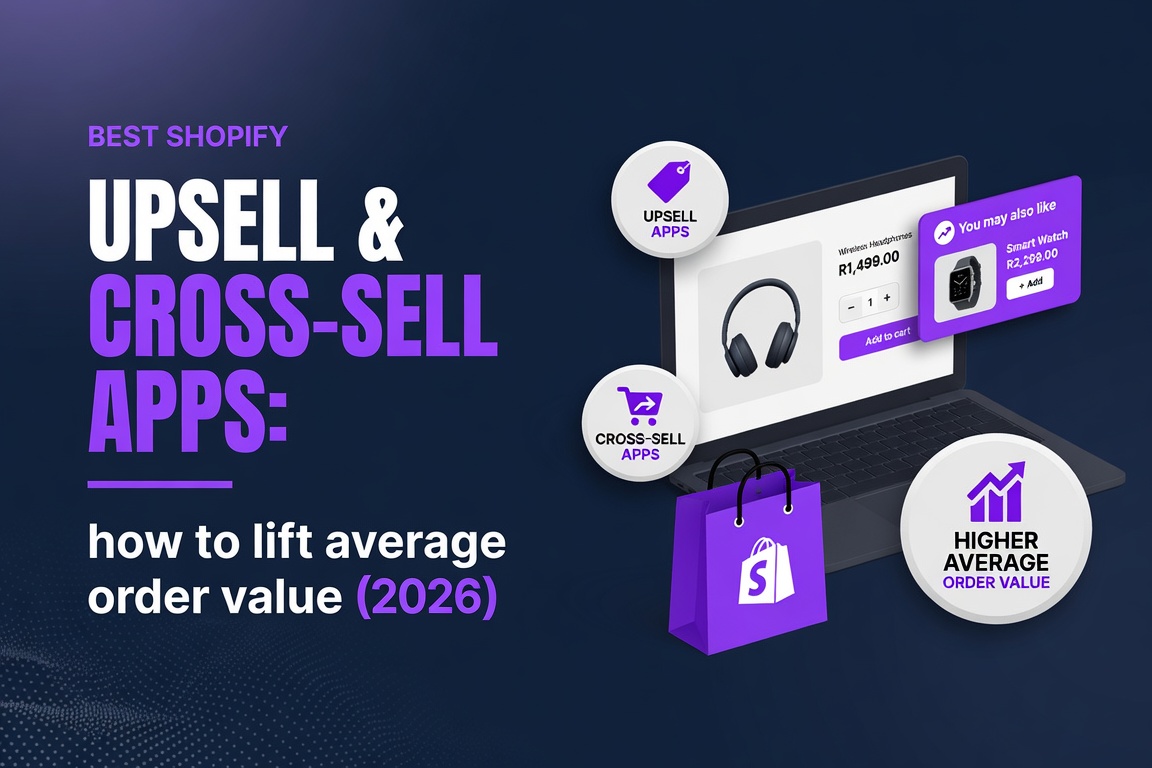

Best Shopify upsell & cross-sell apps: how to lift average order value (2026)
The cheapest extra revenue comes from the customer already buying. Upsell and cross-sell apps lift your average order value by offering the right add-on at the right moment — no extra ad spend required. Here’s how they work and which to choose.
There are three ways to grow store revenue: more customers, more frequent purchases, or a bigger spend per order. The first costs ad money and the second takes time, but the third — lifting average order value (AOV) — is the cheapest, fastest lever, because you’re selling more to someone who’s already decided to buy. A customer with their card out is your most receptive audience, and a well-timed “add this too” converts far more easily than a cold ad.
That’s what upsell and cross-sell apps do. This guide explains the difference, where the offers should appear, the best apps for SA stores, and how to do it without wrecking your conversion rate — because done badly, upsells annoy people. It pairs with our lean app stack guide (an AOV app is one of the worth-it additions for many stores).
Upsell vs cross-sell vs bundles
Three related tactics, often handled by the same apps:
- Upsell — offering a better/bigger version of what they’re buying. “Upgrade to the 1L for R40 more.”
- Cross-sell — offering a complementary product. “Customers who bought this also added…” — the case, the batteries, the matching item.
- Bundles — packaging products together at a slight discount so the customer buys more for a perceived deal. Great for lifting AOV while feeling like value.
All three aim at the same outcome: a bigger basket. The best one depends on your products — upsells suit tiered/variant products, cross-sells suit accessories and consumables, bundles suit complementary sets.
Three ways to a bigger basket
Which tactic fits which kind of product.
| Tactic | Example | Suits |
|---|---|---|
| Upsell | “Upgrade to the 1L for R40 more” | Tiered or variant products |
| Cross-sell | The case, the batteries, the matching item | Accessories and consumables |
| Bundle | Products packaged together at a slight discount | Complementary sets |
Where the offer appears matters
Timing and placement make or break the result. The main moments:
- Product page — “frequently bought together” and recommended add-ons while the customer is considering. Low-pressure, helpful.
- Cart — suggestions as they review their basket, often with a free-shipping-threshold nudge (“add R80 more for free delivery”) that does double duty.
- Checkout — one-click add-ons at the point of payment. High-converting because adding is frictionless, but available mainly on higher Shopify plans for native checkout upsells.
- Post-purchase — the underrated winner. An offer on the thank-you page after payment, added with one click. It can’t hurt your conversion rate because the original order is already secured — pure upside.
The post-purchase upsell is the safest place to start: zero risk to your core conversion, and any acceptance is incremental revenue.
Four places to make the offer
In the order the customer reaches them. Post-purchase is the safe place to start.
The best upsell apps for SA stores
A few well-regarded options, each with a slightly different emphasis. Most have free tiers or trials, and pricing is typically a monthly fee (sometimes plus a small commission on upsell revenue).
| App | Known for | Best for |
|---|---|---|
| ReConvert | Post-purchase & thank-you-page upsells | Risk-free AOV lift after checkout |
| Frequently Bought Together | Amazon-style product-page bundles | Cross-selling complementary items |
| Bold Upsell | True upsells (bigger/better version) | Tiered or variant products |
| Shopify native (Functions) | Built-in checkout upsells | Higher-plan stores wanting no extra app |
App features and pricing change — check current Shopify App Store listings. As USD-billed apps, factor the exchange rate into your rand budget. Some have a small commission on upsell-generated revenue, so read the pricing model, not just the monthly fee.
ReConvert is the common starting point because it specialises in post-purchase upsells — the risk-free placement. Frequently Bought Together is the go-to for Amazon-style cross-sell bundles on product pages. Bold Upsell is strong for genuine version upgrades. And if you’re on a higher Shopify plan, native checkout upsells via Shopify Functions may cover your needs without another app — keeping the stack lean.
How to upsell without hurting conversion
This is where stores get it wrong. Aggressive, irrelevant or constant upsells annoy customers and can cost you the original sale. The principles that keep upsells a net positive:
- Keep offers relevant. A genuinely complementary add-on helps; a random unrelated product feels like spam. Recommendation logic matters.
- Don’t block the purchase. Never put an upsell between the customer and completing their order in a way that adds friction or confusion. The core purchase always comes first.
- Favour post-purchase for the risk-free win. Start there, because it can’t reduce your conversion rate.
- Don’t overdo it. One or two well-chosen offers convert better than a barrage. More prompts means more annoyance and diminishing returns.
- Make accepting effortless. One click to add. Any friction kills the impulse.
- Use the free-shipping threshold. “Add R80 for free delivery” is an upsell customers thank you for — it lifts AOV and removes shipping-cost abandonment at once (see our shipping guide).
What AOV lift is realistic?
Done well, upsell and cross-sell apps commonly lift AOV by a meaningful single-digit-to-low-double-digit percentage. That compounds powerfully: a 10% AOV increase is effectively 10% more revenue from the same traffic and ad spend, dropping almost entirely to your bottom line because there’s no extra acquisition cost. On a store doing decent volume, an app costing a few hundred rand a month that lifts AOV even modestly pays for itself many times over. As always, measure it — check AOV and conversion together to be sure the upsells are adding, not deterring.
Frequently asked questions
The bottom line
Lifting average order value is the cheapest revenue growth available, because you’re selling more to customers who’ve already decided to buy. Upsell and cross-sell apps — ReConvert for risk-free post-purchase offers, Frequently Bought Together for cross-sell bundles, Bold Upsell for upgrades, or Shopify’s native checkout upsells on higher plans — make it automatic. The key is restraint and relevance: one or two well-targeted offers that help the customer, never block the sale, with post-purchase as the safe starting point. Get it right and it’s free money from traffic you already have.
If you’d like AOV-lifting offers set up properly — the right app, relevant recommendations, and placements that add revenue without hurting conversion — that’s part of the conversion work we do. See our other picks in recommended resources.

We have built 400+ online stores for South African businesses since 2014. Read more about eCommerce development in South Africa.