
WooCommerce shipping in South Africa: setup, couriers and rates
Shipping is where South African WooCommerce stores quietly lose margin. Flat rates that undercharge on heavy items, free shipping thresholds set by guesswork, and courier integrations nobody tested. Here is how to set it up so it stops costing you.
WooCommerce ships with a shipping system that is genuinely capable and genuinely confusing. Zones, methods, classes and rates interact in ways that are not obvious until you get one wrong and discover you have been subsidising Northern Cape deliveries for six months.
This guide is the WooCommerce configuration side. For the broader courier landscape and what drives cost, read our guide to shipping and delivery for South African online stores.
How WooCommerce shipping actually works
Four concepts, and the order matters.
- Shipping zones are geographic areas. A customer matches the first zone their address fits, and only that zone’s methods are offered.
- Shipping methods live inside zones. Flat rate, free shipping, local pickup, or a courier plugin’s live rates.
- Shipping classes group products that cost differently to ship. Bulky, fragile, heavy.
- Rates are what you charge, calculated per method and optionally per class.
The mistake almost everyone makes is creating one zone for South Africa and one flat rate. That works until someone in a remote area orders something heavy, and the courier charges you three times what you collected.
Zone first, then method, class and rate
The order WooCommerce applies the four shipping concepts.
A zone structure that works for South Africa
Most couriers price on a main-centre versus regional basis, plus weight. Your zones should mirror that.
| Zone | Covers | Typical approach |
|---|---|---|
| Main centres | JHB, PTA, CPT, DBN and immediate surrounds | Lowest rate. Most of your volume. |
| Regional | Other towns and smaller cities | Higher rate. Couriers charge more. |
| Outlying | Farm and remote addresses | Highest rate, or quote on request. |
| Local | Your own town | Local pickup or own delivery. |
| Rest of world | Everywhere else | Only if you actually ship internationally. |
Zones can be defined by postcode ranges, which is how you separate main centres from regional in practice. It takes an hour to set up properly and it is the difference between shipping being roughly break-even and shipping being a slow leak.
Flat rate versus live rates
Flat rate is simpler, faster at checkout, and easier for customers to understand. You absorb the variance. It works well when your products are similar in size and weight.
Live courier rates pull actual prices from the courier at checkout based on weight, dimensions and destination. You never undercharge. The trade-offs are real though: it requires accurate weights and dimensions on every product, it adds a checkout API call that can fail, and customers sometimes see rates that feel high because they are seeing the true cost.
Our default recommendation: flat rate per zone for stores with consistent product sizes, live rates once your catalogue varies widely in weight. If you go live rates, always configure a fallback rate for when the API does not respond. A checkout that shows no shipping option because a courier API timed out is a lost sale.
Courier integrations for WooCommerce
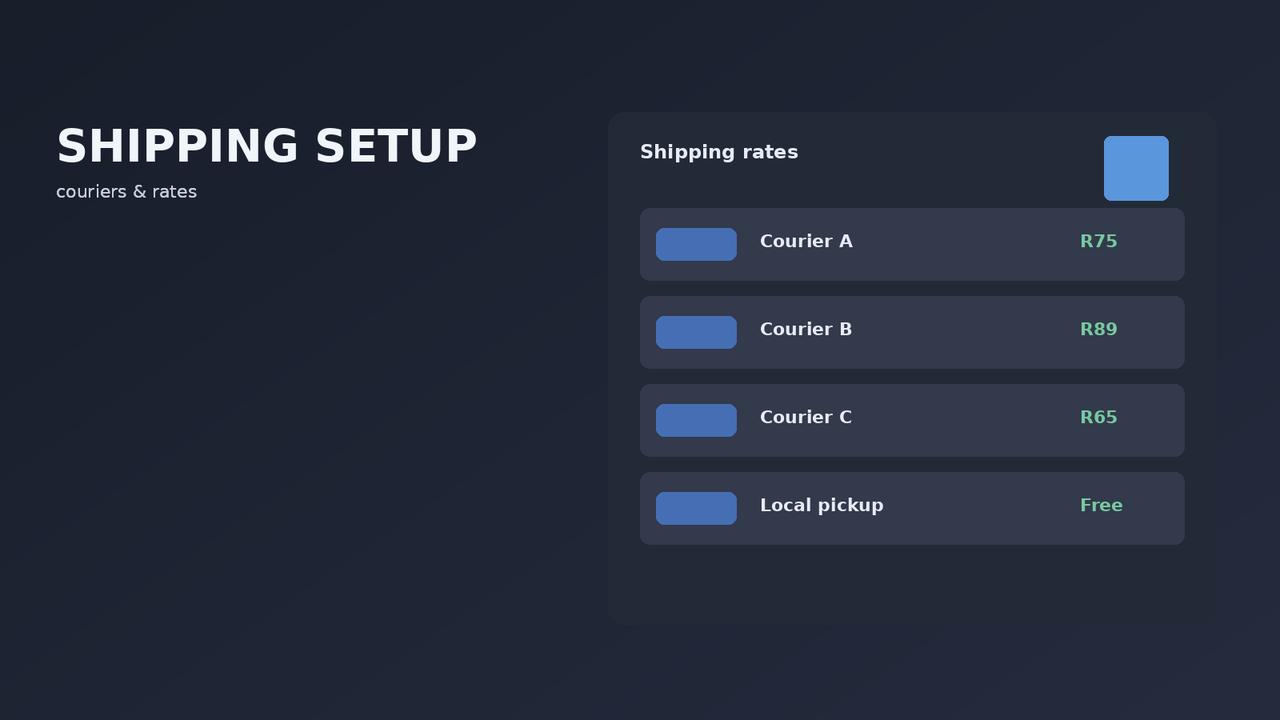
The main South African options integrate with WooCommerce either through a dedicated plugin or through an aggregator.
- Aggregators let you compare and book across multiple couriers from one account, and generally have the better WooCommerce plugins. Useful when you want choice without multiple courier accounts.
- Direct courier plugins tie you to one provider but sometimes give better negotiated rates once you have volume.
- Pickup point networks — lockers and counter collection — matter more in South Africa than in many markets, because a meaningful share of customers are not home during delivery hours and because it is usually cheaper than door-to-door.
Whichever you choose, test the full flow before launch: rate at checkout, order placed, waybill generated, tracking number written back to the order, customer notified. Integrations frequently break at the last two steps and nobody notices until a customer asks where their parcel is.
Test all five steps, especially the last two
A full courier integration test, from checkout to customer.
Steps 4 and 5 are where integrations most often fail unnoticed.
Setting a free shipping threshold that does not lose money
Free shipping lifts conversion and average order value. Set the threshold wrong and it destroys margin instead.
The calculation is straightforward. Take your average shipping cost, and your gross margin percentage. The threshold needs to be high enough that the margin on the order covers the shipping.
Worked example: average shipping cost R95, gross margin 40%. To cover R95 of shipping from a 40% margin you need an order of R237.50 (R95 ÷ 0.4), and that only breaks even. A R500 threshold clears it: R500 at 40% is R200 of margin, R105 left after shipping. Treat R237.50 as the floor, not the target. The threshold has to clear it plus whatever profit you want to keep on a free-shipping order.
Set it slightly above your current average order value, not below. The point of a threshold is to pull orders upward, not to give away shipping on orders people were placing anyway. Our profit margin breakdown walks through the wider maths.
Weights, dimensions and the thing everyone skips
If you plan to use live rates or want accurate cost reporting, every product needs a weight and dimensions. Not an estimate. The actual packed weight, including packaging.
Most stores skip this at launch and then cannot switch to live rates later without a full catalogue audit. Capture it as you add products. It takes seconds per product at the point of creation and hours later.
Also set up shipping classes for anything that breaks the pattern — oversized items, anything requiring special handling, anything where courier surcharges apply. A single shipping class for “bulky” will save you from the one product that costs four times what everything else does.
Communicating shipping properly
Unexpected shipping cost at checkout is the single most cited reason for cart abandonment, in South Africa as everywhere.
- Show shipping cost before checkout. A shipping calculator on the cart page removes the surprise.
- State delivery timeframes honestly. “2 to 4 working days to main centres, 3 to 7 regional” beats “fast delivery”.
- Say what happens if nobody is home. This is a genuine anxiety for South African shoppers.
- Send tracking automatically. The single biggest reduction in “where is my order” support emails.
Your shipping policy also has legal weight. The Consumer Protection Act and ECT Act set expectations around delivery timeframes and what happens when you cannot meet them — we cover that in our guide to returns, refunds and the CPA.
WooCommerce shipping FAQs
How do I set up shipping in WooCommerce for South Africa?
Create zones that mirror how your courier prices — main centres, regional, outlying — using postcode ranges. Add a method to each zone with a rate that reflects real cost. Add shipping classes for anything unusually heavy or bulky. Test with real addresses in each zone before launch.
Should I use flat rate or live courier rates?
Flat rate if your products are similar in weight and size. Live rates once your catalogue varies widely. Live rates require accurate weights and dimensions on every product, and always need a fallback rate configured for API failures.
What should I charge for shipping in South Africa?
Charge what it costs you, zoned. The instinct to undercharge to look competitive is where margin disappears. If you want to be competitive on shipping, do it through a free shipping threshold you have actually calculated, not by subsidising every order.
Why is my WooCommerce shipping showing no available methods?
Usually the customer’s address does not match any zone, or the matched zone has no method configured. Check that you have a catch-all zone, and that every zone has at least one method. If you use live rates, an API timeout with no fallback produces the same symptom.
Should I offer free shipping?
Above a properly calculated threshold, yes — it lifts average order value. Unconditionally, only if your margins genuinely absorb it. Calculate from your actual average shipping cost and gross margin rather than copying a competitor’s number.
Can I offer local pickup?
Yes, and you should if you have premises. It is free for you, free for the customer, and a meaningful percentage of local customers will take it. Restrict it to a local zone so people in another province are not offered collection.
How do I handle shipping to remote addresses?
Either a separate outlying zone with a higher rate, or quote on request for those postcodes. What you should not do is include them in your standard rate and average the cost across all customers — that overcharges your main-centre buyers, who are most of your volume.

We have built 400+ online stores for South African businesses since 2014. Read more about WooCommerce development in South Africa.