
Most SA store owners cannot tell you their real margin. Can you?
Ask a store owner what they make on a sale and you usually get the retail price minus what they paid the supplier. That number is comfortably wrong, and the gap between it and reality is where a lot of South African stores quietly go under.
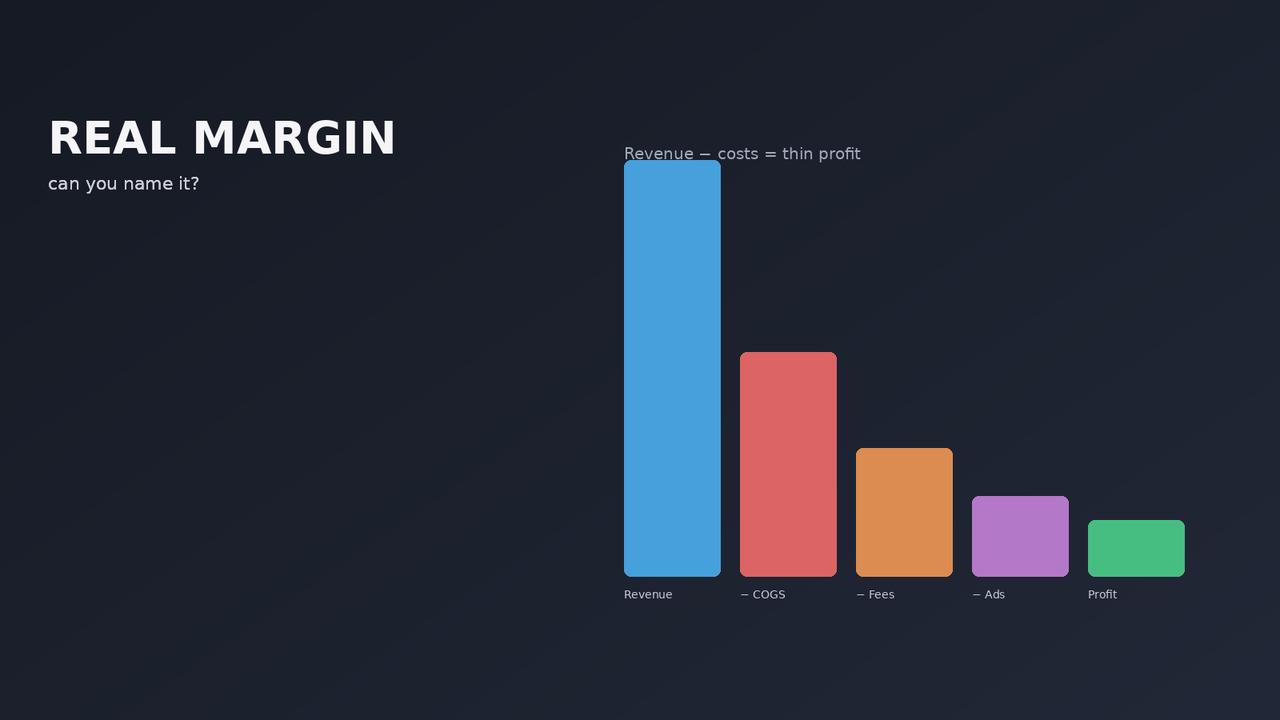
We built the Shopify Profit Margin Calculator after one too many conversations that went the same way. A store owner would tell us they were doing 45% margin. We would ask whether that included the gateway fee, the shipping subsidy, VAT and the packaging. It usually did not. The real figure was often closer to 20%.
The margin most people calculate
Sell price minus cost price, divided by sell price. Buy for R300, sell for R550, that is 45%.
It is a fine number for deciding whether a product is worth stocking. It is a terrible number for deciding whether your business works, because between that R250 and your bank account there are at least six deductions.
The deductions nobody counts
| Cost | Typical | Why it gets missed |
|---|---|---|
| Payment gateway fee | ~2.5–3.5% + per-transaction | Deducted before settlement, so it never appears as an expense you pay |
| VAT | Applicable rate on the sale | Feels like income because it lands in your account first |
| Shipping shortfall | Varies, often R30–R80 | The gap between what you charge and what the courier bills |
| Packaging | R8–R30 | Bought in bulk, so it feels like an overhead rather than per-order |
| Ad spend per order | Highly variable | Tracked as a marketing budget, not allocated per sale |
| Returns and write-offs | 2–10% of orders | Averaged into a bad month rather than costed per order |
| Platform and app fees | Fixed monthly | Genuinely fixed, but divides into a real per-order cost |
Run all of those against that R550 sale and the R250 you thought you made looks very different. We did exactly this exercise, line by line, in what you actually keep on a R500 sale in South Africa.
Three costs that come off the R250 on every order
Typical range per order, in rand, on the R550 sale. From the table above.
Gateway fee is 2.5–3.5% of R550, before the per-transaction rand fee. VAT, ad spend, returns and platform fees come on top.
The two that cause the most damage
VAT, if you are registered. The money arrives in your bank account, so it feels like yours. It is not. A store that has been spending its VAT and treats turnover as income will discover this at exactly the wrong moment. If you are near the registration threshold, our VAT guide for SA online stores covers when it becomes compulsory.
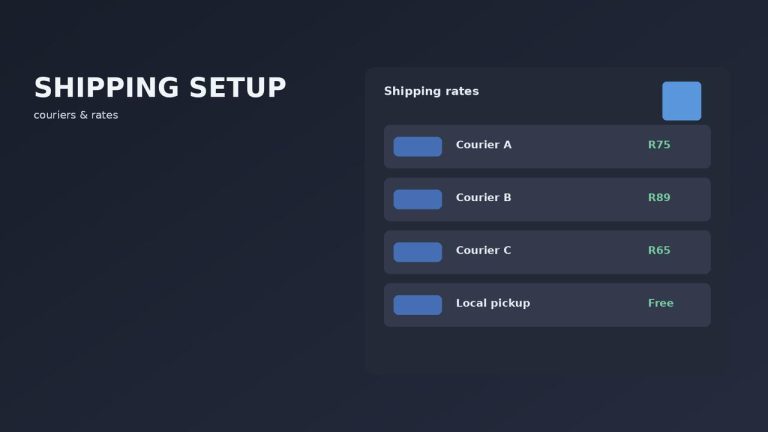
The shipping shortfall. If you charge a flat R80 and your average courier bill is R110, you are paying R30 for the privilege of every sale. Multiply by 300 orders a month. This is the single most common margin leak we find, and it is invisible because it never shows up as a line item — it just makes the courier account bigger than expected.
R30 out of your margin on every order
Flat R80 shipping charge vs an average R110 courier bill, per order.
At 300 orders a month the shortfall is R9,000 a month, R108,000 a year.
What the calculator does
You enter your sell price, your cost price, your gateway, your typical shipping cost and what you charge for it, and your ad spend. It returns what you actually keep, per order, in rands.
The useful part is not the number. It is watching the number move as you change one input. Raise the free shipping threshold by R100 and see what happens. Drop ad spend by a third. Switch the gateway. It takes about a minute to find the lever that matters most for your store, and it is rarely the one people assume.
Run your numbers through the calculator →
What to do once you know the real number
Four levers, in the order we usually find they pay off.
- Fix the shipping shortfall first. It is usually the biggest single leak and the easiest to close. Zone your rates properly and set a free shipping threshold you have calculated rather than guessed — the maths is in our shipping and delivery guide.
- Raise average order value. Every order carries fixed costs. Two items in one order is meaningfully more profitable than two separate orders, which is the entire argument for bundles and upsells.
- Audit your app and plugin spend. Fixed monthly costs divide into a per-order cost that gets worse the fewer orders you have.
- Reconsider gateway fees, but last. Real money above a certain volume, and a distraction below it. The comparator will tell you which side of that line you are on.
What we would not lead with is raising prices. It is the obvious move and sometimes the right one, but it is the only lever on the list that can cost you volume, and most stores have easier wins available first.
The uncomfortable part
Occasionally the calculator tells someone their best-selling product loses money. It happens more than you would expect, usually on heavy low-margin items where shipping eats the entire spread.
That is genuinely useful information. A product that generates revenue and destroys profit is worse than one that does neither, because it consumes stock capital, warehouse space and marketing budget while going backwards. Finding it is worth an uncomfortable afternoon.

We have built 400+ online stores for South African businesses since 2014. Read more about Shopify development in South Africa.