
HOSTAFRICA review 2026: is it the right host for a South African online store?
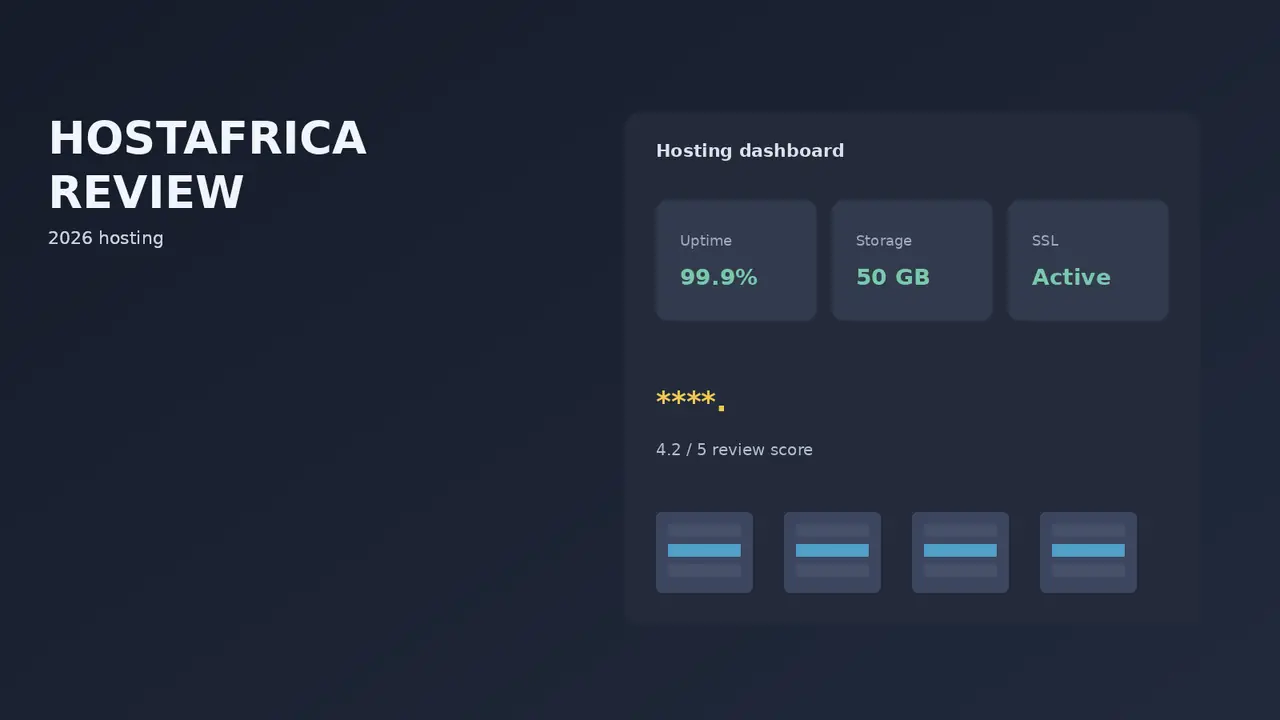
HOSTAFRICA is one of the few South African hosts that publishes its actual resource limits instead of hiding behind the word “unlimited”. That single fact tells you more about whether your store will run properly than any speed claim on their homepage. Here is what those numbers mean, and where this host wins and loses for a WooCommerce shop.
We build online stores for a living. That means we inherit other people’s hosting decisions regularly, and we have opinions about which ones cause us grief. This review looks at HOSTAFRICA specifically through the lens of running a store, not a brochure site, because those are very different workloads.
The short verdict
| Question | Answer |
|---|---|
| Good for a brochure or small business site? | Yes, comfortably. One of the better local options. |
| Good for a WooCommerce store? | Yes, but only from the WordPress “Power” or “Shop” tier up. Not on the R99 entry plan. |
| Biggest strength | Published resource limits, Tier 3 ISO 27001 Cape Town facility, and consistently strong support ratings. |
| Biggest weakness for stores | SSD rather than NVMe on shared plans, no Redis object cache advertised, and SSH only on request. |
| Entry price | R99/mo web hosting; R90/mo promotional WordPress hosting (renews R120). |
Who HOSTAFRICA actually is
HOSTAFRICA is a South African host with operations across several African markets, including Kenya, Nigeria, Ghana and Egypt. Locally they run out of a Tier 3, ISO 27001-certified facility in Cape Town. They are a ZARC-accredited registrar and an ISPA member, which matters more than it sounds: it means there is a formal complaints and take-down process behind them rather than a one-man reseller operation.
The publicly displayed review scores on their own site at the time of writing were a TrustScore of 4.9 across roughly 2,745 Trustpilot reviews, 4.8 on Google, and 4.73 on Hellopeter across about 245 reviews. Treat vendor-displayed ratings with the usual caution, but the volume is high enough and the Hellopeter presence local enough that the picture is credible. Support ratings are the recurring theme in the reviews, not speed.
The plans, and what they really cost
This is the part that trips people up: HOSTAFRICA sells two different shared products, and the cheaper one is not the one you want for a store.
Web Hosting (DirectAdmin)
The general-purpose shared range. Free .co.za domain for the first year, free Let’s Encrypt SSL, daily backups retained for around nine days, and DirectAdmin as the control panel.
| Plan | Price/mo | Storage | RAM | CPU | IOPS | Entry processes |
|---|---|---|---|---|---|---|
| Starter | R99 | 20 GB SSD | 1 GB | 100% | 512 | 20 |
| Basic | R139 | 40 GB SSD | 2 GB | 150% | 768 | 25 |
| Power | R245 | 100 GB SSD | 3 GB | 200% | 1024 | 30 |
| Business | R360 | 200 GB SSD | 4 GB | 300% | 2048 | 40 |
WordPress Hosting
A separate, WordPress-specific platform with LiteSpeed cache, staging, automatic updates and a WordPress-focused dashboard. Prices below were running at a 25% introductory discount; the renewal figure is what you will actually pay from year two.
| Plan | Promo/mo | Renews at | Storage | RAM | CPU | Sites |
|---|---|---|---|---|---|---|
| WP Starter | R90 | R120 | 20 GB SSD | 2 GB | 100% | 2 |
| WP Basic | R150 | R200 | 40 GB SSD | 4 GB | 200% | 4 |
| WP Power | R270 | R360 | 100 GB SSD | 4 GB | 300% | 6 |
| WP Shop | R450 | R600 | 200 GB SSD | 6 GB | 400% | 10 |
Two things to know before you click buy. First, the WordPress plans are billed as a prepaid year rather than in monthly instalments — the monthly figure is the annual total divided out. Budget for the full amount up front. Second, the renewal is roughly a third higher than the promotional rate. Neither of these is hidden, and we would rather a host print the renewal price on the plan card than bury it in the terms, which HOSTAFRICA does. But plan for the real number.
Check the current HOSTAFRICA pricing →
What the specs mean for a WooCommerce store
Here is where a store review has to diverge from a general hosting review. As we cover in our guide to WooCommerce hosting in South Africa, the pages that make you money — cart, checkout, account, AJAX add-to-cart — cannot be page-cached. They hit PHP and the database on every single request. So three specifications matter more than the headline storage number.
Storage: SSD, not NVMe
HOSTAFRICA lists SSD storage across the shared range, where several local competitors now advertise NVMe. On random database reads, which is exactly what WooCommerce generates, NVMe is meaningfully quicker. This is not disqualifying — a well-provisioned SSD plan will beat a starved NVMe one every time — but if you are comparing two plans at the same price and one is NVMe, that is a real point against HOSTAFRICA.
Object caching: not advertised on shared plans
We could not find Redis object caching listed on the shared web hosting or WordPress plans. The WordPress platform includes LiteSpeed cache, which is genuinely good, but LSCache is a page cache. It accelerates your product and category pages and does nothing for the checkout. An object cache is the feature that speeds up the uncacheable pages, and it is the single biggest WooCommerce performance win available. If you are buying here for a store, ask their team directly whether Redis can be enabled on your plan before you commit.
RAM and entry processes: the numbers that decide whether checkout survives
This is where publishing the limits works in HOSTAFRICA’s favour, because you can actually do the maths. The R99 Starter plan gives you 1 GB of RAM and 20 entry processes. Entry processes are roughly the number of simultaneous requests hitting PHP. Twenty sounds like plenty until you remember that one shopper loading a product page can consume several, and that a store also has an admin side, cron jobs and background tasks competing for the same pool.
For a real store we would not go below 4 GB of RAM and would want the CPU allowance at 300% or better. On the WordPress line that means WP Basic as an absolute floor and WP Power as the sensible starting point. On the web hosting line it means Business at R360. The R99 plan is a brochure-site plan, and buying it for a store is the mistake we see most often — then the owner blames WooCommerce for being slow.
SSH on request
SSH access is listed as available on request rather than enabled by default. For most store owners this is irrelevant. If you have a developer or an agency doing real work on the site, WP-CLI over SSH is how database search-and-replace, bulk imports and proper debugging happen. Get it enabled early rather than during an emergency.
Where HOSTAFRICA genuinely wins
- Transparency about resources. Publishing RAM, CPU, IOPS, entry processes and NPROC per tier is unusual and should be rewarded. It lets you size a plan honestly instead of guessing. Several competitors publish storage and the word “unlimited” and nothing else.
- Security stack included. CloudLinux with CageFS, ModSecurity, Imunify360 on the WordPress platform and cPGuard on the web hosting range. That is a serious stack to get at this price point, and it takes real pressure off your own WooCommerce security setup.
- Support hours and reputation. A South African team on live chat and tickets from 07:00 to 23:00 daily. The consistency of the support praise across thousands of independent reviews is the strongest single argument for this host.
- Staging on the WordPress plans. Included rather than an add-on. If you have ever broken a checkout with a plugin update, you understand why this matters.
- Free migration and a 30-day money-back guarantee. Which together mean trying them costs you very little.
- A named Tier 3, ISO 27001 facility. Relevant to the load-shedding question — proper facilities run generator and UPS redundancy, so the server side is generally covered.
Where we would push back
- SSD instead of NVMe on shared plans. Behind the local market on the specification that matters most for a database-heavy store.
- No advertised object cache. The biggest WooCommerce performance lever is not on the feature list.
- The two-product-line confusion. A buyer searching for hosting lands on the R99 web hosting page and reasonably assumes that is the offer. For a WordPress store the WordPress line is the right product, and nothing on the cheaper page makes that obvious.
- Only one FTP account and two mailboxes on the WordPress plans. Fine for a solo operator, tight the moment you have a designer, a developer and a couple of staff email addresses.
- Annual prepayment on the WordPress line. Presented as a monthly figure but charged as a year. Not deceptive, but it is a real cash-flow consideration for a new store.
How it compares to the other local options
Against HostKing, HOSTAFRICA loses on raw storage specification — HostKing advertises NVMe and LiteSpeed across the board at lower entry pricing — but wins decisively on transparency, because HostKing publishes no RAM or CPU figures at all. You can size a HOSTAFRICA plan. You have to ask HostKing.
Against xneelo, HOSTAFRICA is generally cheaper at entry level and more forthcoming about specifications, while xneelo owns and operates its own data centres, which is a genuine reliability argument. Against Domains.co.za, HOSTAFRICA gives you more storage per rand, while Domains.co.za ships a stack that is better tuned for WordPress out of the box.
There is no universally correct answer here, which is why our main hosting guide compares them side by side rather than crowning a winner.
Which plan should you actually buy?
- Brochure site or a store you have not launched yet: Web Hosting Starter at R99 is honestly fine. Move before you start taking real orders.
- New WooCommerce store, small catalogue: WP Basic. Four gigabytes of RAM is the floor for a store that has to survive two people checking out at once.
- Established store, a few hundred products, steady daily orders: WP Power. This is the plan most working SA stores belong on.
- Large catalogue, heavy images, or Black Friday headroom: WP Shop. Upgrade a week before the traffic, not during it.
- You need SSH, custom cron cadence or Elasticsearch: you have outgrown shared hosting. Look at their VPS range from around R130/mo, and budget for someone to manage it.
HOSTAFRICA review FAQs
Is HOSTAFRICA good for WooCommerce?
On the right plan, yes. On the R99 entry plan, no — 1 GB of RAM and 20 entry processes is not a store specification. Start at WP Basic and expect to sit on WP Power once you have real traffic.
Where are HOSTAFRICA’s servers?
Their South African hosting runs from a Tier 3, ISO 27001-certified facility in Cape Town. For a store selling to South African customers that means roughly 20–30ms latency instead of the 150–300ms you would get from Europe or the United States.
Does HOSTAFRICA use cPanel?
No, DirectAdmin. It is a perfectly capable panel and, importantly, a standard one, so migrating away later is straightforward. If your developer specifically needs cPanel, that is a reason to look elsewhere.
Is the migration really free?
Free migration is advertised on their plans, and independent reviews include accounts of bulk migrations handled at no charge. Confirm the scope for your specific site before you rely on it, particularly if you have many accounts or a large database.
What happens to the price after the first year?
The WordPress plans renew roughly a third above the promotional rate, and the free .co.za domain renews at the standard rate. The renewal figures are printed on the plan cards. Budget for the renewal price, not the sign-up price.
Is HOSTAFRICA better than an international host like Hostinger?
For a store whose customers are in South Africa, local hosting wins on latency and it is not close. A checkout is a dozen or more uncacheable requests, and the difference compounds across all of them. If most of your customers are overseas, the calculation changes.
Our verdict
HOSTAFRICA is a legitimate, well-run South African host that we would be comfortable putting a client store on, provided the client buys the right plan. The support reputation is earned and the transparency about resource limits is genuinely better than most of the local market.
The reservation is specification. If you are choosing purely on hardware for a database-heavy store, the lack of NVMe and an advertised object cache on shared plans puts them a step behind. If you are choosing on support, security stack and the ability to actually size your plan against published numbers, they are near the front.
Our practical advice: buy the WordPress product rather than the web hosting product, start at WP Basic or WP Power rather than the entry tier, ask about Redis before you commit, and use the 30-day guarantee as an actual test rather than a comfort blanket. Put a real order through the checkout on a quiet Tuesday and watch what happens.

We have built 400+ online stores for South African businesses since 2014. Read more about WooCommerce development in South Africa.