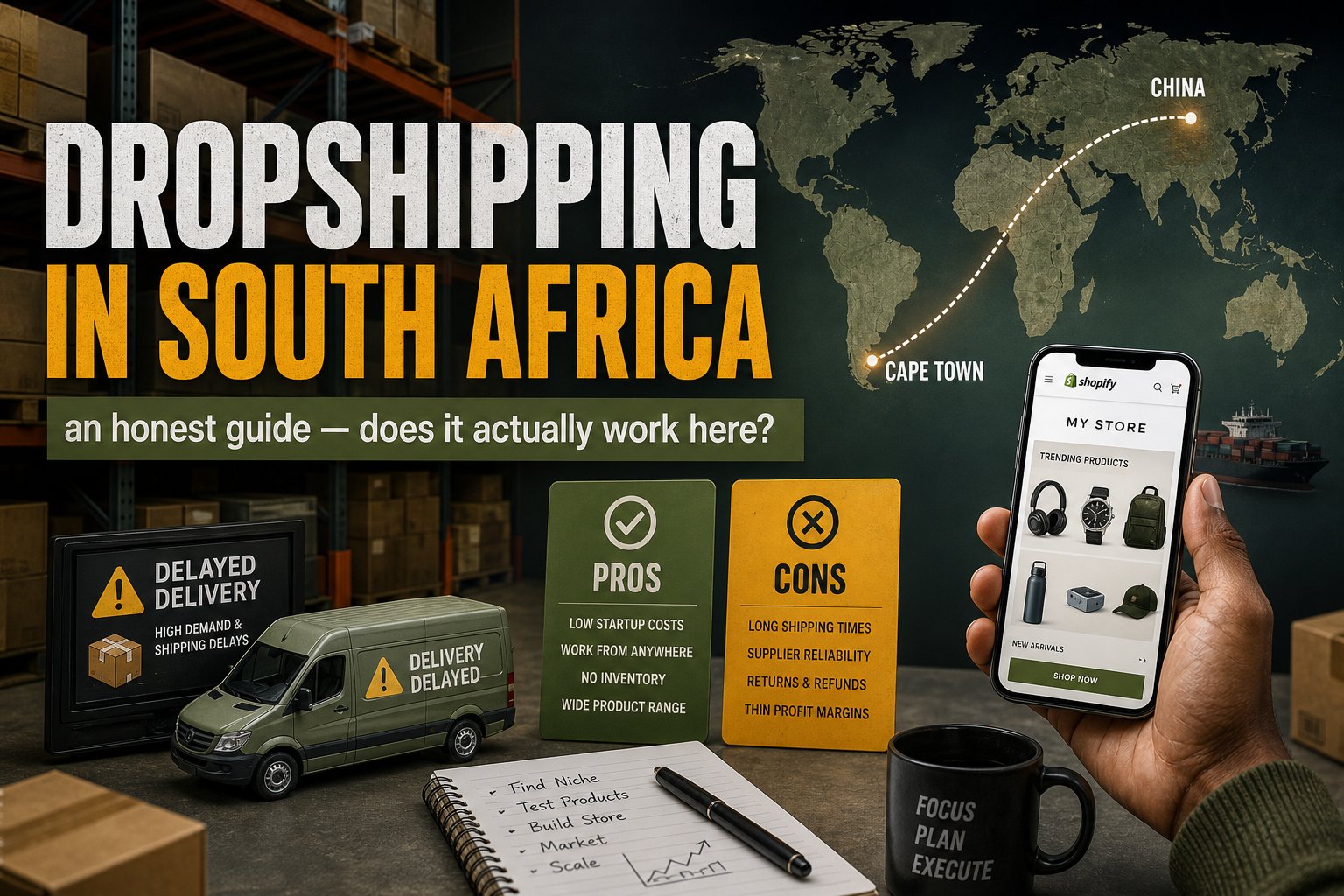

Dropshipping in South Africa: an honest guide (does it actually work here?)
Dropshipping is sold as the easy, no-capital way to start an online store. The model is real and legitimate — but the “get rich quick” version is a fantasy, and South Africa adds specific challenges the YouTube gurus never mention. Here’s the honest picture.
Dropshipping has a marketing problem: it’s been so oversold by “passive income” hustle culture that it’s hard to see the real model underneath. So let’s be clear and honest. Dropshipping is a legitimate, viable retail model where you sell products without holding stock — your supplier ships directly to your customer. It can absolutely work. But it’s a real business that requires real work, the margins are thinner than people expect, and doing it from South Africa carries specific challenges that the US-focused gurus skip entirely.
This guide is the straight version: how dropshipping actually works, its honest pros and cons, the SA-specific realities, and how to decide if it’s right for you. No hype, no “R100k in your first month.”
How dropshipping actually works
The model is simple: you set up a store and list products, but you don’t buy or hold any stock. When a customer orders, you forward the order to your supplier, who ships it directly to the customer. You never touch the product. Your profit is the gap between what the customer pays you and what you pay the supplier. The appeal is obvious — no upfront stock investment, no warehousing, low startup cost, and the freedom to test products without committing capital.
You sell it, the supplier ships it
One dropshipping order from start to finish. You never hold or touch the stock.
The honest pros
- Low startup capital. You don’t buy stock upfront, so the financial barrier to starting is genuinely low — mostly your store, apps and marketing.
- Low risk on unsold stock. You’re not stuck with inventory that doesn’t sell.
- Location-independent. You can run it from anywhere; no warehouse needed.
- Easy to test products. You can list and trial products without committing to bulk orders, then double down on what sells.
- Scalable. Order volume doesn’t require you to handle more physical goods yourself.
The honest cons (the bits gurus skip)
- Thin margins. Because you’re not buying in bulk and the model is easy to copy, margins are slim and competition is fierce. After ad costs, many dropshippers make far less per sale than they expected — and some lose money.
- You don’t control fulfilment. Your reputation depends on a supplier you don’t control. Slow shipping, stockouts, quality issues, wrong items — the customer blames you, but you can’t directly fix it.
- Customer service is harder. You’re the face of problems you can’t see into. “Where’s my order?” is awkward when you don’t hold or ship the stock.
- It’s competitive and ad-dependent. Many dropship stores live or die on paid ads, which means marketing skill and budget are decisive — it’s not passive.
- Quality is a gamble. If you’ve never seen the product, you’re trusting the supplier’s photos and description.
The South African realities
This is where SA dropshipping diverges sharply from the US tutorials — and where most aspiring SA dropshippers hit walls:
- Shipping times from overseas suppliers are long. The classic model uses overseas (often Chinese) suppliers, but shipping to SA can take weeks, and SA customs and import duties add cost, delay and complexity. SA shoppers expect days, not weeks — long delivery times kill conversion and trigger refunds.
- Customs and duties. Imported parcels can attract duties and VAT on arrival, creating surprise costs and held parcels — a fulfilment and customer-service nightmare.
- Payment friction. You need SA payment gateways for local customers (see the payments guide) while often paying overseas suppliers — exchange rates and forex eat further into thin margins.
- Local suppliers are the better play. The SA dropshippers who succeed often use local suppliers — faster delivery, no customs drama, ZAR pricing, fewer unhappy customers. The catch is fewer local dropship suppliers and often thinner margins, but the customer experience is vastly better.
- Consumer Protection Act. SA customers have real return and refund rights regardless of where your stock ships from — you carry that obligation.
Local suppliers trade some margin for speed
Local vs overseas dropship suppliers, selling to SA customers.
| Local supplier | Overseas supplier | |
|---|---|---|
| Delivery time | Days | Weeks |
| Customs | None | Duties and VAT on arrival; parcels can be held |
| Currency | ZAR pricing | Exchange rates and forex costs |
| Margin | Often thinner | Sometimes better |
| Choice | Fewer dropship suppliers | More products |
| Customer result | Fewer refunds and complaints | Long waits cut conversion and trigger refunds |
Summarised from the South African realities above and the supplier FAQ below.
How to do SA dropshipping properly (if you do it)
- Strongly favour local suppliers. The delivery-time and customs advantages usually outweigh the slightly better margins of overseas sourcing. Customer experience wins long-term.
- Vet suppliers hard. Order samples yourself. Check their shipping times, reliability and quality before you stake your reputation on them.
- Be honest about delivery times. If shipping takes a while, say so clearly — surprise delays cause refunds and bad reviews. Managed expectations convert better than hidden ones.
- Build a real brand, not a generic store. The race-to-the-bottom generic dropship store is the one that fails. A focused niche, genuine brand and good content compete far better.
- Master your marketing. Since dropshipping is ad-dependent and competitive, your ads and SEO skill is often the deciding factor. Model your margins carefully — thin margins plus ad costs is where dropshippers lose money.
A year of ads costs three times the store
Starting figures, rand. Low cost to start is not the same as cheap to run.
Ad spend from R5,000/month and a built store from around R20,000 (see the FAQ below). Both are minimums. A DIY store costs less to build; platform and app fees come on top.
Is dropshipping right for you?
Honest guidance: dropshipping suits someone who wants to start lean, is willing to learn marketing properly, will vet suppliers diligently, and treats it as a real business requiring effort — not someone chasing passive income from a YouTube promise. For testing product ideas with low capital risk it’s genuinely useful. But if your goal is a durable, profitable store, many SA entrepreneurs do better holding stock of a focused range (better margins, control over fulfilment and quality) or using local suppliers for a hybrid approach. There’s no shame in dropshipping — just go in with clear eyes.
Dropshipping vs holding stock
The three routes covered in this guide.
Weeks to deliver, plus customs
Slim margins
Supplier controls fulfilment
Suits: testing products with low capital
Days to deliver
Margins often thinner still
Supplier controls fulfilment
Suits: a lean start with faster delivery
You control delivery
Better margins
You control fulfilment and quality
Suits: a durable store with a focused range
Summarised from the pros, cons and SA realities in this guide.
Frequently asked questions
The bottom line
Dropshipping is a real, workable model — not the passive-income fantasy it’s often sold as. Its genuine advantages (low capital, low stock risk, easy testing) are balanced by genuine drawbacks (thin margins, no fulfilment control, ad-dependence), and South Africa adds real friction around overseas shipping times, customs and forex. The SA dropshippers who succeed favour local suppliers, build real brands, vet rigorously, and treat it as the business it is. Go in clear-eyed and it’s a legitimate path; go in chasing easy money and it’ll cost you.
If you’re weighing dropshipping versus holding stock, or want a store built to do either properly — local supplier integration, honest delivery expectations, marketing that fits thin margins — that’s the kind of thing we help SA entrepreneurs think through and build. Read how to start an online store for the wider picture.

We have built 400+ online stores for South African businesses since 2014. Read more about eCommerce development in South Africa.