Takealot vs Amazon.co.za in 2026: which is cheaper to sell on?
Amazon is running an aggressive launch promotion in South Africa until 31 March 2027: R1 a month and a flat 5% referral fee. Takealot still has far more shoppers. We compared every fee, ran three products through both marketplaces now and after the promotion ends, and built a free calculator so you can run your own.
The short answer
Right now, Amazon is much cheaper to sell on. In our three examples, Amazon’s fees take 4% to 8% of the selling price during the promotion, against 21% to 34% on Takealot. Even at Amazon’s standard rates after March 2027, its lower FBA fees keep it slightly cheaper on most products.
But Takealot sells more. 35.3% of SA online shoppers used Takealot in 2025, against 12.7% for Amazon. For most sellers the answer is both: use Amazon’s promotion to build reviews and margin, and Takealot for volume.
Takealot vs Amazon fee calculator
Your product on both marketplaces, side by side, now and after Amazon’s promotion ends.
Fees side by side
| Fee | Takealot | Amazon.co.za now (to 31 Mar 2027) | Amazon.co.za standard |
|---|---|---|---|
| Monthly subscription | R400 ex VAT | R1 (Professional) | R400 (Professional) or R10 per item (Individual) |
| Commission | Success fee about 5%–18% by category | Flat 5%, all categories | Referral fee 6%–18% by category, min R10 |
| Commission charged on | VAT-inclusive price | Price excl. VAT (per Amazon’s fee page) | Price excl. VAT (per Amazon’s fee page) |
| Fulfilment (warehouse) | Per unit by size and weight, about R32–R360 | FBA pick-and-pack waived (apparel excluded) | FBA R27 (under 250 g) to R87 (20–30 kg) |
| Storage | Free for about 35 days of stock, then charged | Waived | R36 per cubic metre per month |
| Inbound shipping | Your cost | 90% off via Amazon’s partner carrier (to 31 Dec 2026) | Your cost |
| Ship-it-yourself option | Leadtime (deliver each order to a Takealot DC) | Easy Ship from R20, or self-ship | Easy Ship from R20, or self-ship |
| Who can sell | Individuals and businesses, after vetting | Individuals and businesses | Individuals and businesses |
Watch the VAT basis. Takealot’s success fee is a percentage of the price including VAT; Amazon’s fee page says its referral fee is based on the price excluding VAT. On a R399 product, 12% on Takealot is R47.88, while 12% on Amazon would be R41.63. Takealot also raised its fulfilment fees by 7% from 1 April 2026.
Fulfilment fees by weight
| Packed weight (standard size) | Takealot (indicative, ex VAT) | Amazon FBA (ex VAT) | Amazon Easy Ship, items R500+ (ex VAT) |
|---|---|---|---|
| Up to 250 g | R32 | R27 | R43 |
| 250–500 g | R32 | R28 | R44 |
| 500 g–1 kg | R32 | R29 | R45 |
| 1–2 kg | R42 | R31 | R46 |
| 2–5 kg | R62 | R34 | R50 |
| 5–10 kg | R85 | R41 | R59 |
| 10–20 kg | R85–R120 | R46 | R73 |
| 20–30 kg | R120 | R87 | R99 |
Amazon Easy Ship is a flat R20 when every product in the parcel costs under R500 incl. VAT. Takealot’s bands are seller-reported and may not include the April 2026 increase; check the Fee Estimator in your Seller Portal.
Standard Amazon referral fees by category
| Category | Amazon standard | Takealot typical |
|---|---|---|
| Wireless (phones and accessories) | 8% | 5%–8% |
| Computers | 9% | 5%–8% |
| Consumer electronics | 13% | 5%–8% |
| Home and kitchen | 13% | 10%–15% |
| Beauty | 13% | 10%–15% |
| Baby | 13% | 8%–15% |
| Toys | 12% | 10%–15% |
| Sports | 15% | 10%–15% |
| Pet | 10% | 10%–15% |
| Apparel | 15% | 10%–18% |
| Books | 14% | 5%–14% |
| DIY and tools | 11% | 10%–12% |
| Jewellery | 18% up to R950, 10% above | Varies |
Three products, both marketplaces
A VAT-registered seller, stock in each marketplace’s warehouse (Takealot DC, Amazon FBA), 60 units a month, a 3% return rate, R8 per unit inbound and no ads.
| Takealot | Amazon now | Amazon from April 2027 | |
|---|---|---|---|
| Phone case: R149, cost R40, under 250 g | |||
| Marketplace fees | R50.06 (33.6%) | R6.49 (4.4%) | R44.84 (30.1%) |
| Profit per unit | R31.51 | R75.07 | R36.72 |
| Kitchen appliance: R399, cost R140, 2–5 kg | |||
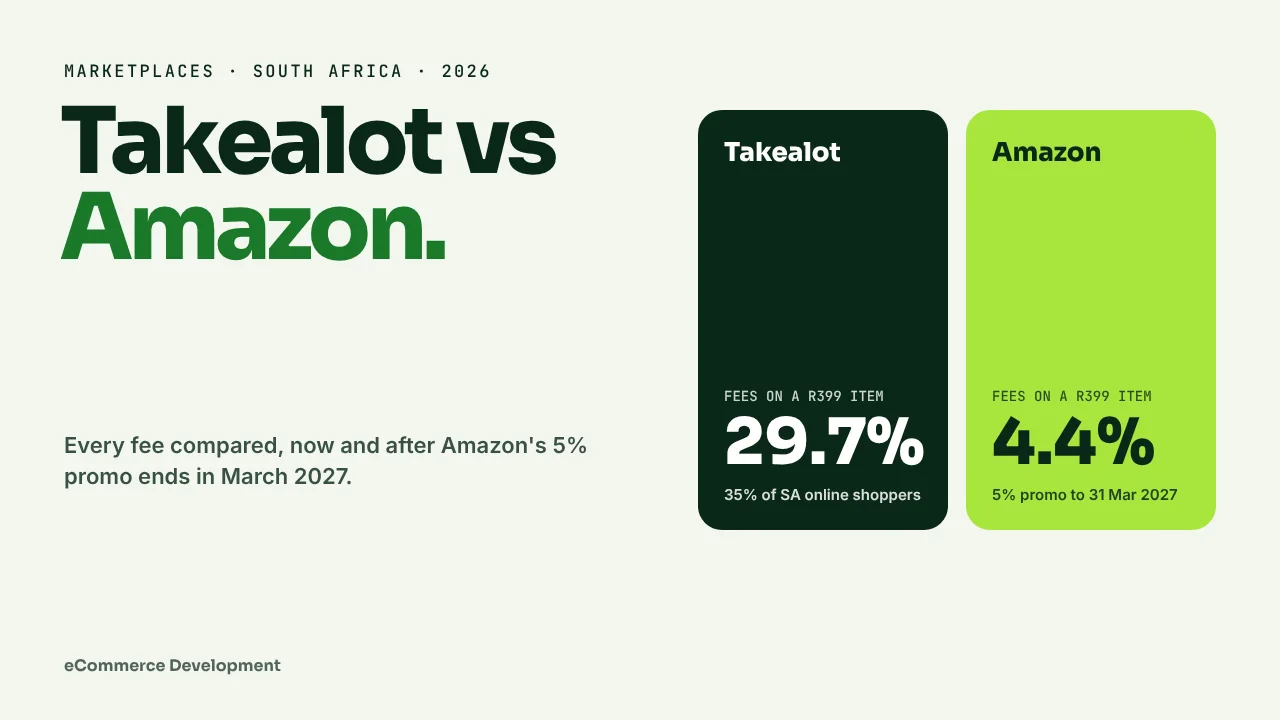
| Marketplace fees | R118.41 (29.7%) | R17.36 (4.4%) | R86.79 (21.8%) |
| Profit per unit | R80.55 | R181.59 | R112.17 |
| Sneakers: R799, cost R300, 1–2 kg (apparel still pays FBA) | |||
| Marketplace fees | R169.78 (21.2%) | R66.69 (8.3%) | R142.81 (17.9%) |
| Profit per unit | R217.01 | R320.10 | R243.97 |
Fees on a R399 kitchen appliance
Marketplace fees as a share of the selling price. Lower is better.
Calculated with our Takealot vs Amazon calculator. Takealot fees use typical success-fee and indicative fulfilment rates.
The gap is biggest on cheap, light products, where Takealot’s fixed fulfilment fee and the success fee on the VAT-inclusive price bite hardest. On a R149 phone case, Amazon’s promotion more than doubles your profit per unit.
Fees aren’t everything: who sells more?
| Takealot | Amazon.co.za | |
|---|---|---|
| Launched in SA | 2011 | 7 May 2024 |
| Share of online shoppers using it (2025) | 35.3% | 12.7% |
| Scale | 6.2m+ active customers, 60m+ orders, about R17.7bn revenue (FY to Mar 2026) | Estimated R8bn–R10bn turnover (World Wide Worx estimate) |
| Marketplace sellers | About 15,000 | Not published |
| Membership | TakealotMORE: R39/month (free delivery over R500) or R99 Premium | Prime: R59/month or R399/year, launched June 2026 |
| Pickup points | Own pickup points and lockers | 4,000+ pickup points |
| Marketplace model | Closed, vetted sellers | Open to individuals and businesses |
A product that sells 100 units a month on Takealot might sell 30 on Amazon today. Run the calculator, then multiply profit per unit by realistic volume on each. More on the market in our SA eCommerce statistics 2026.
Which should you choose?
Takealot first if…
- You need volume quickly
- Your products are R300+ and compact
- You sell electronics, where Takealot’s success fees are low
- You want the biggest SA audience for Black Friday
Amazon first if…
- You sell cheap or light products where Takealot’s fees eat the margin
- You want to build reviews and sales history at low cost before April 2027
- You’re an individual or a new brand not yet accepted by Takealot
- You want Prime buyers and Amazon’s growing pickup network
Most established sellers should be on both, with stock synced to their own store so nothing oversells. Start with how to sell on Takealot and price your products with the Takealot fee calculator.
What you need to register
| Takealot | Amazon.co.za | |
|---|---|---|
| Individuals | Yes, after vetting | Yes |
| Documents | ID or CIPC documents, bank account, proof of address, tax details | ID or passport, proof of address (90 days), credit card, phone, bank account that can receive ZAR |
| Approval | Reviewed within about 10 business days | Identity verification, usually 3 business days or less |
| VAT registration | Not required to apply | Not required to apply |
Common mistakes
- Pricing on the promotion forever. Amazon’s 5% ends on 31 March 2027. Make sure products still make money at standard rates.
- Comparing commission percentages only. The VAT basis, fulfilment fees and subscriptions change the answer.
- Ignoring volume. Lower fees on a marketplace with a third of the shoppers can still mean less profit.
- Running separate stock pools without sync. Overselling on one marketplace hurts your performance scores on both.
- Forgetting apparel. Amazon’s FBA fulfilment waiver excludes apparel.
Selling on Takealot, Amazon and your own store? We build Shopify and WooCommerce stores connected to both marketplaces, with one stock source and channel pricing. See our Shopify development services or get a quote within 24 hours.
Frequently asked questions
Is it cheaper to sell on Amazon or Takealot in South Africa?
Until 31 March 2027, Amazon is far cheaper: R1 a month, a flat 5% referral fee and free FBA pick-and-pack on most categories. At standard rates, Amazon’s lower FBA fees still make it slightly cheaper on most products in our examples, but Takealot has about three times the shopper reach.
How much does Amazon charge sellers in South Africa?
Normally R400 a month (Professional) or R10 per item (Individual), referral fees of 6% to 18% by category with a R10 minimum, and FBA fulfilment from R27 per unit. Storage is R36 per cubic metre per month. During the promotion the plan costs R1 a month and referral fees are 5%.
How much does Takealot charge sellers?
R400 a month ex VAT, a success fee of about 5% to 18% of the VAT-inclusive price, and a fulfilment fee per unit by size and weight. Storage is free for stock that sells within about 35 days.
When does Amazon’s 5% promotion end?
On 31 March 2027, according to Amazon’s South African fee page. Amazon can change or withdraw the promotion with notice.
Can I sell on both Takealot and Amazon?
Yes. Many sellers do. Keep stock in sync between both marketplaces and your own store to avoid overselling.
Sources
- Amazon.co.za Seller Central: fees (promotion to 31 March 2027)
- Amazon: selling fees South Africa 2026 (PDF)
- Amazon.co.za: Fulfilment by Amazon
- Amazon.co.za: how to register as a seller
- Takealot: fulfilment fee adjustment from 1 April 2026
- Netcash: how to sell on Takealot (subscription, success fee basis)
- Takealot Repricer: indicative fulfilment fee bands (2026)
- World Wide Worx: Online Retail in South Africa 2026
- BusinessTech: Amazon launches in South Africa
- Business Day: Amazon launches Prime in SA (June 2026)
- Notebookcheck: Amazon Prime South Africa pricing

We have built 400+ online stores for South African businesses since 2014. Read more about eCommerce development in South Africa.